
Fix Noise: 9 Steps for Assessors on Test Validity and Reliability

Validity asks whether a score means what you intend it to mean. Reliability asks whether that score would show up again if you measured the same person tomorrow. The two are related but not interchangeable: reliability is necessary but not sufficient for validity, because a test can produce wonderfully consistent scores that measure the wrong thing entirely. What follows breaks down the types of evidence, the statistics used to estimate each one, and the practical steps for building an assessment that holds up under both.
TL;DR:
- High reliability is essential first, as inconsistent scores cannot support a valid assessment, especially when measuring traits that should remain stable over time.
- Validity depends on whether the test scores accurately predict the intended outcome, with content, internal structure, relations to variables, response processes, and consequences serving as key evidence sources.
- Collecting strong validity evidence requires defining a clear purpose, building a content blueprint, piloting with representative samples, and analyzing construct and criterion relationships.
- Most assessment issues stem from weak measurement noise, which can be remedied by targeted item design and standardized administration, not just content review.
- Using role-specific item generation and built-in anti-cheat tools streamlines validation, providing ongoing evidence without excessive manual work, especially for role-based assessments.
Table of Contents
- Understanding Test Validity: What It Actually Means
- Understanding Test Reliability: Consistency Over Accuracy
- Test-Retest, Internal Consistency, and Interrater Reliability Explained
- Reliable but Wrong, or Valid but Noisy: The Confusion Cleared Up
- A Step-by-Step Plan for Gathering Validity and Reliability Evidence
- A Practical Checklist for Stronger Assessments
- How Assessment Platforms Document Validity in Practice
- What the Research Actually Tells You to Prioritize
- Build Validated Assessments Without the Manual Evidence Trail
- Sources
- FAQ
Understanding Test Validity: What It Actually Means
Validity is not a property a test carries around like a certification sticker. It is an argument, built from evidence, about whether score interpretations support a specific intended use. A coding assessment might be highly valid for predicting on-the-job debugging performance and completely invalid for predicting leadership potential, even though it’s the exact same test. The score didn’t change. The claim you’re making about the score did.
This is where a lot of confusion starts. People ask “is this test valid?” as if validity were binary, but the Standards for Educational and Psychological Testing frame it as a unified validity argument, built from five sources of evidence rather than a checklist of separate “types.” Those five sources are:
- Content evidence — do the test items actually represent the domain or skill in question?
- Internal structure evidence — do items grouped together statistically match the constructs they’re supposed to measure?
- Relations to other variables — does the score correlate with outside measures the way theory predicts (this covers what older textbooks called convergent, discriminant, and criterion validity)?
- Response processes evidence — are test takers actually engaging the skill you intend to measure, or gaming the format?
- Consequences evidence — does using the test produce fair, intended outcomes, or unintended harm to specific groups?
Purpose determines which evidence you need most. A pre-employment coding test leans hard on content and criterion evidence. A personality inventory used for team placement leans on internal structure and relations evidence. Validity ultimately rests on whether the test predicts the outcome it claims to predict, not on whether the items look polished.
Understanding Test Reliability: Consistency Over Accuracy
Reliability measures whether a test produces the same result under the same conditions, repeatedly. It has nothing to do with whether the result is correct. A kitchen scale that reads 14 ounces every single time you put a one-pound weight on it is perfectly reliable and consistently wrong by two ounces.
Reliability is the consistency and reproducibility of a measurement, indicating how dependable the results are over repeated trials, while validity is the separate question of accuracy and meaning. Every measurement contains some amount of error, random noise from fatigue, distraction, ambiguous wording, or an inconsistent grader that pushes an observed score away from a person’s “true” score. Reliability is really an estimate of how much of that noise exists.
- Low reliability means scores bounce around unpredictably between attempts, sessions, or raters.
- High reliability means scores stay stable when nothing meaningful about the person has changed.
- Reliability sets a ceiling on validity: a badly noisy measure cannot correlate strongly with anything, including the outcome it’s supposed to predict.
That last point deserves emphasis, because it’s the mechanical link between the two concepts. Low reliability in either measure caps the maximum observable correlation between them, an effect called attenuation. Three common forms of reliability, test-retest, internal consistency, and interrater agreement, each capture a different source of that noise.
Test-Retest, Internal Consistency, and Interrater Reliability Explained
Test-retest reliability measures stability across time. You administer the same test to the same people twice, usually two to four weeks apart, and correlate the two sets of scores. It fits stable traits, like general cognitive ability or personality dimensions, poorly suited constructs that are meant to change quickly, like mood or short-term stress.
Internal consistency measures whether items on a single test agree with each other, typically via Cronbach’s alpha. It’s the fastest reliability check to run because it needs only one administration, which is why it gets overused. Alpha is sensitive to the number of items on a test, so a long test can produce an inflated alpha even when individual items are mediocre. Omega coefficients handle this better for tests with unequal item quality, though alpha remains the industry default.
Interrater reliability matters whenever a human scores something subjective, a writing sample, a structured interview, a video-based task. Cohen’s kappa or an intraclass correlation coefficient (ICC) quantifies agreement between raters, correcting for the agreement you’d expect by chance alone.
Pro Tip: A test-retest correlation at a reasonably high level (often near +.80 or higher) is commonly treated as a practical benchmark for stable traits. Anything meaningfully below that on a trait that shouldn’t shift week to week signals a design problem worth investigating before you build any validity case on top of it.
Context decides which form matters most. A skills test scored automatically needs strong internal consistency but no interrater check at all. A structured interview needs interrater agreement above almost everything else.
Reliable but Wrong, or Valid but Noisy: The Confusion Cleared Up
The cleanest way to see the difference between test validity vs reliability is through two failure modes that look nothing alike but both wreck an assessment.
- Reliable but invalid: a biased thermometer that reads two degrees high every single time. It’s perfectly consistent, which makes it reliable, but every reading is wrong, which makes it invalid.
- Valid but unreliable: a skills test with only three items covering a broad competency. On average across many test takers it might correlate reasonably with job performance, but any one person’s score bounces around too much between attempts to trust individually.
These examples answer the two questions people search for most. Which comes first? Reliability, functionally, because you cannot build a defensible validity argument on top of inconsistent scores. Can a test be reliable without being valid? Yes, easily, and it happens constantly with tests that are internally consistent but simply measure the wrong construct for the intended use.
If your reliability is strong but validity evidence is thin, the fix is usually content: pull in subject experts and check whether items actually represent the job or trait. If reliability itself is weak, no amount of validity evidence will save the test. You have to fix the measurement noise first, typically by adding well-targeted items or tightening scoring rules, before the validity question is even answerable.
A Step-by-Step Plan for Gathering Validity and Reliability Evidence
Building a defensible validity argument is a sequence, not a single study. Here’s the order that produces evidence you can actually stand behind.
- Define the intended use in one sentence. “This assessment predicts first-90-day performance for a customer support role” is specific enough to guide every decision after it.
- Build a content blueprint. List the skills or knowledge domains the intended use requires, weighted by importance, before writing a single item.
- Run an expert content review. Have two or three subject-matter experts independently rate whether each item maps to the blueprint and flag anything off-target.
- Pilot the test on a representative sample. Even 40 to 80 responses reveal item-level problems, confusing wording, ceiling effects, items nobody gets wrong.
- Run internal structure analysis. Use exploratory or confirmatory factor analysis to check whether items cluster the way your blueprint predicts, and compute Cronbach’s alpha or omega for each subscale.
- Check convergent and discriminant relationships. Correlate scores against an established measure of the same construct and against an unrelated one to confirm the test measures what it claims to.
- Collect criterion data when feasible. Track actual outcomes, job performance ratings, promotion rates, error rates, and correlate them against the original scores.
- Report sample size, context, and confidence intervals. A reliability coefficient from 30 people in one office means something different from one based on 2,000 people across five countries.
- Document the whole argument. Write down what evidence was gathered, why, and how it supports the specific intended use defined in step one.
Pro Tip: Skip step one and everything downstream gets harder to defend later. Reviewers, auditors, and even your own team will keep asking “valid for what?” if the intended use was never written down in the first place.
Teams building job-specific screening tests often shortcut straight to piloting and skip the blueprint step, which is exactly backward. The blueprint is what makes every later step interpretable.
A Practical Checklist for Stronger Assessments
Most validity and reliability problems trace back to a handful of fixable design choices. Before you ship or revise an assessment, check these:
- Every item should map back to a specific line in your content blueprint; cut anything that doesn’t earn its place.
- More well-targeted items generally beat fewer broad ones, since additional items reduce measurement noise and raise internal consistency.
- Standardize administration conditions, time limits, instructions, environment, so variation in scores reflects the person, not the setting.
- Train raters on a shared rubric and check interrater agreement before trusting any single grader’s judgment.
- Pilot before full rollout, and treat the first version as a draft that will need revision.
- Gather criterion or convergent data whenever you can, even informally, and log it alongside the rest of your evidence.
Pro Tip: Employers building audit-ready skills tests often find that the biggest reliability gain comes from standardizing scoring, not from adding questions. A vague rubric will undo the benefit of a well-built item bank every time.
Mapping items back to an actual job description rather than a generic skill label also tightens content evidence considerably, since generic labels invite generic, low-relevance items.
How Assessment Platforms Document Validity in Practice
Collecting this evidence by hand, spreadsheets of item statistics, separate rater notes, a folder of pilot data, is exactly why most teams stop at a content review and call it done. A platform built around structured, role-specific testing can compress that cycle instead of eliminating the rigor.
Generating items directly from a job description or skill list gives you a content blueprint from the first draft, rather than reverse-engineering one after items already exist. Randomized item delivery and anti-cheat monitoring, including screen and webcam checks, strengthen response-process and consequences evidence by reducing the chance that a score reflects cheating rather than skill. Exportable item statistics, session replays, and performance summaries turn what used to be a scattered validation folder into something closer to a running record.
The platform’s approach treats every completed assessment as a data point in an ongoing validity argument, not just a hiring decision, which is what separates a defensible testing program from a gut-feel one.
What the Research Actually Tells You to Prioritize
The biggest gap between conventional advice and what the evidence supports is sequencing. Most guidance treats validity and reliability as parallel checklists to run through once. They aren’t parallel. Reliability is the floor; validity is what you build on top of it, and no amount of expert content review rescues a test whose scores bounce around from one sitting to the next.
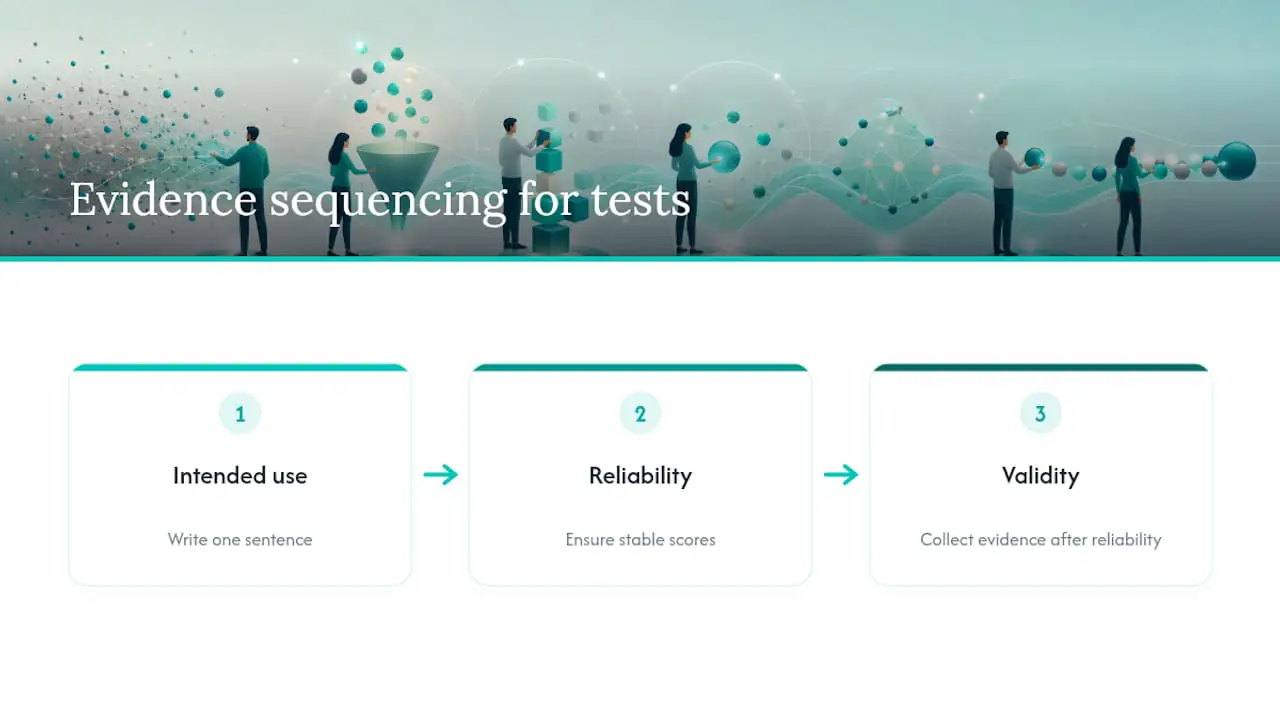
The second gap is more uncomfortable: teams love content evidence because it’s cheap and fast, three experts, one afternoon, done. Criterion evidence, actually checking whether scores predict the outcome you claim they predict, gets skipped almost everywhere outside academic research, because it requires patience and outcome data most hiring teams never bother collecting.
If you take one thing from this, take this: write down your intended use in a single sentence before you write a single item. Everything else, the blueprint, the statistics, the rater training, only works if that sentence is precise. Vague intended use produces vague evidence, no matter how sophisticated the factor analysis looks.
— Jimmie
Build Validated Assessments Without the Manual Evidence Trail
Documenting a validity argument by hand, tracking item stats in one spreadsheet, rater notes in another, pilot data somewhere else, is exactly the kind of work that quietly gets skipped under deadline pressure. A tool generates role-specific items straight from a job description, giving you a content blueprint before you’ve written a single question, while built-in anti-cheat monitoring and session replays add the response-process evidence most teams never collect at all.

There’s no subscription to commit to. You pay per completed candidate, so the cost scales with the hiring you’re actually doing, not a flat license fee. If you’re evaluating skills for a specific role and want the reliability and validity evidence built into the process rather than assembled after the fact, check out the platform and see how a job description turns into a testable, defensible assessment in minutes.
Sources
Classic textbooks still teach content, construct, and criterion validity as if they’re three separate boxes to check. Modern psychometrics treats them as facets of one argument, and some experts argue explicitly against isolating them because a test can look fine on one facet and fail badly on another. Here’s how the evidence actually breaks down by when and how you collect it:
- Reliability vs Validity in Research
- An introduction to validity in educational and psychological testing
- Validity for Assessments
- Reliability and validity of measurement (LibreTexts)
Distinguishing pre-data expert judgment from post-data statistical checks matters because teams often stop at step one. A content review from three subject experts feels thorough, but it says nothing about whether the test predicts anything real.
FAQ
Which Comes First, Validity or Reliability?
Reliability functionally comes first. You cannot build a convincing validity argument on scores that aren’t consistent, though reliability alone never proves a test is valid.
Can a Test Have Reliability Without Validity?
Yes. A test can produce highly consistent scores that still measure the wrong construct entirely, the classic example being a scale that reads the same wrong weight every time.
What Is the Main Difference Between Reliability and Validity?
Reliability asks whether a measurement is consistent; validity asks whether that measurement actually captures what it claims to measure for a specific intended use.
What Are Some Examples of Validity and Reliability?
A biased thermometer that always reads two degrees high is reliable but invalid; a three-item test that predicts job performance on average but swings widely for individuals is valid but unreliable.
How Do You Measure Test Reliability?
The three most common methods are test-retest correlations, internal consistency measures like Cronbach’s alpha, and interrater agreement statistics like kappa or ICC, chosen based on whether the test is repeated, scored by items, or scored by human raters.