
How Job Descriptions Drive Assessments That Actually Predict Performance

A job description written as observable, competency-linked tasks is the single most important input for designing valid, defensible assessments. Skip that step, and even a well-built test measures the wrong thing. Every serious methodology, from federal job analysis (JTA) guidance to SME validation panels, starts here: the job description isn’t marketing copy, it’s the blueprint for the entire assessment. That’s how job description drives assessments in practice, and it’s why platforms like Talent Approved build their tools around parsing job description fields directly into assessment templates.
Get this right, and three things follow immediately:
- Assessment formats match what the role actually demands, not what a template happened to include.
- Scoring rubrics have a defensible anchor point instead of a hiring manager’s gut feeling.
- Hire and no-hire decisions hold up under scrutiny because you can trace every question back to a job task.
Key Takeaways
Competency-linked job descriptions determine which assessment methods, rubrics, and cut scores will actually predict on-the-job performance.
| Point | Details |
|---|---|
| Job analysis comes first | Run a JTA with high performers before designing any assessment stage. |
| Match method to competency | Use work samples for hands-on tasks, structured interviews for judgment calls. |
| Anchor rubrics to behavior | Define strong, mixed, and weak performance before scoring a single response. |
| Document for defensibility | Track essential functions and version history to support accommodation and legal review. |
| Talent Approved operationalizes the chain | Magic Create turns job description fields into ready-to-score templates while keeping SME sign-off in place. |
Table of Contents
- What Job Descriptions Must Contain to Drive Assessments
- From Job Analysis to Competency Mapping
- Designing Assessments That Follow the Job Description
- Scoring, Cut Scores, and Validity
- Monitoring, Fairness, and Legal Considerations
- A Practical Checklist for Turning JD Lines Into Assessment Items
- How an Assessment Platform Operationalizes This Chain
- What HR Teams Actually Get Wrong First
- Turn Job Descriptions Into Ready-to-Use Assessments
- Sources
- FAQ
What Job Descriptions Must Contain to Drive Assessments
Most job descriptions are written to attract applicants, not to inform testing. That’s the disconnect. A job description built for assessment purposes needs to separate essential duties, the ones that determine success or failure, from incidental tasks that show up occasionally but don’t define the role.
Four elements make a job description usable as an assessment input:
- Essential functions only. List what the person must do to succeed, not everything they might touch.
- Day-One competencies. Name the skills a new hire needs to demonstrate immediately, with a measurable success indicator attached to each.
- Contextual constraints. Note the tools, software, physical environment, or time pressure that shape how the task actually gets done.
- Plain, specific language. Strip out vague or prestige-coded phrasing like “rockstar” or “self-starter” that Harvard Business Review has flagged as damaging to both applicant fit and downstream evaluation accuracy.
Pro Tip: If you can’t picture a candidate demonstrating a line in a job description during a 20-minute assessment, that line is either too vague or not essential. Rewrite it or cut it.
From Job Analysis to Competency Mapping
Turning job description prose into something testable requires a real Job Task Analysis, not a guess. OPM’s competency-based assessment guidance treats job analysis as the mandatory first step before anyone writes a single test question.
The process looks like this in practice:
- Interview two or three high performers currently in the role and ask them to walk through a typical week.
- Shadow or survey them on which tasks consume the most time and which mistakes cost the most when they happen.
- Translate each recurring task into a competency with a behavioral indicator (not “communication skills,” but “explains a technical delay to a non-technical client without jargon”).
- Rank tasks by criticality, frequency, and consequence of failure, then decide which ones earn a dedicated assessment stage.
- Document every task-to-competency link in a single spec sheet that assessment designers reference directly, so nobody has to re-derive the logic later.
Skipping this step is how companies end up testing Excel formulas for a role that mostly requires client diplomacy.
Designing Assessments That Follow the Job Description
Once competencies are mapped, the method choice should follow, not precede, the job description. A work sample fits hands-on, tool-specific tasks. A structured interview fits interpersonal judgment and decision-making under ambiguity. A situational judgment test (SJT) fits roles where the right answer depends on constraints, not just skill.
HHS guidance on hiring assessment strategies recommends sequencing these into a multi-hurdle structure so candidate burden rises only as the stakes do. A typical flow:
- Screening quiz or short applied task — filters volume, low cost per candidate.
- Work sample or simulation — tests the core technical competency identified in the job task analysis.
- Structured interview — probes judgment, communication, and edge cases the simulation couldn’t capture.
- Final panel or reference check — confirms fit for the highest-stakes hires only.
How much detail the job description carries determines whether stage two needs a 45-minute simulation or a 10-minute applied task. A vague job description produces vague hurdles. A precise one lets you calibrate exactly how much friction each stage should add, which keeps the process fair without wasting anyone’s afternoon.
Scoring, Cut Scores, and Validity
Turning job description evidence into a hiring decision requires a rubric anchored to actual behavior, not vibes. OPM’s guidance notes that precise behavioral anchors, strong, mixed, weak, tied directly to Day-One competencies make scoring far less subjective and give you something to point to when a decision gets challenged.
Cut scores work best when they’re criterion-referenced: set the passing bar using performance data from current employees in the role, not an arbitrary percentage.
- Define what “strong,” “mixed,” and “weak” performance looks like for each competency before anyone scores a single response.
- Set cut scores against a baseline, either post-hire performance data or a criterion panel of high performers.
- Track inter-rater reliability regularly; if two raters score the same response three points apart, your rubric needs tighter anchors.
- Keep a validity file documenting how each assessment maps back to the job description, in case the decision is ever questioned.
An outcome-first design approach, working backward from a 90-day performance target, tends to produce assessments with stronger predictive validity than tests built from a generic skills checklist.
Monitoring, Fairness, and Legal Considerations
A job description that clearly states essential functions does more than guide test design. It’s also your primary defense when an assessment decision faces legal scrutiny. The EEOC’s enforcement guidance is explicit that pre-employment tests must be job-related and validated, and that documentation of essential functions directly supports accommodation decisions.
Four practices keep the process defensible:
- Run adverse impact analyses on every assessment stage, not just the final interview, and adjust weighting if one group is screened out disproportionately.
- Document essential functions clearly enough that an accommodation request has something concrete to measure against.
- Version-control every job description and rubric update, so you can show exactly what was in effect when a given candidate was evaluated.
- Review assessment outcomes quarterly, not just at launch, since roles and tools change faster than most companies update their job descriptions.
A Practical Checklist for Turning JD Lines Into Assessment Items
Converting a job description into working assessment criteria doesn’t require a committee. It requires three questions asked in order:
- What’s the task? Pull the exact line from the job description (e.g., “reconciles vendor invoices against purchase orders weekly”).
- What’s the observable evidence? Decide what a candidate would actually produce or say to prove they can do it (a corrected reconciliation sheet, a walkthrough of their error-checking process).
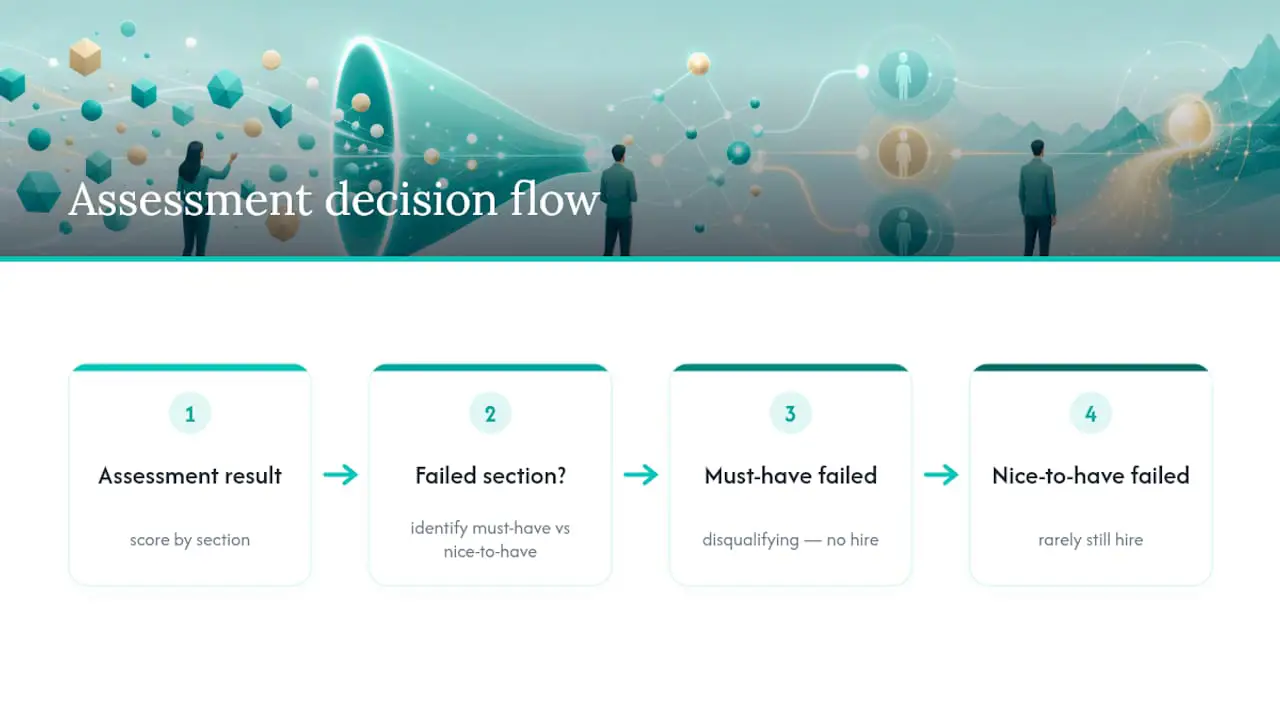
- What method and level? Choose work sample, structured interview, or SJT, and mark it “must-have” or “nice-to-have” before scoring begins.
Pro Tip: Write the pass/fail gate before you see a single candidate’s response. Deciding “we’ll know it when we see it” mid-review is how bias creeps back in.
Document the acceptable evidence threshold in the screening test design itself, not in a separate memo nobody reads later.
How an Assessment Platform Operationalizes This Chain
The intake to scorecard to screen-criteria workflow works best when a platform generates the draft and a human still signs off. Unsupervised AI intake can invent credentials that were never in the actual job description, which is why a structured intake pattern matters as much as the technology itself.
Talent Approved’s Magic Create feature builds a tailored assessment template directly from job description fields, while anti-cheat monitoring and AI-generated summaries cut review time without removing the SME’s final call. Versioning and documented sign-off keep the whole chain auditable.
What HR Teams Actually Get Wrong First
Most rollouts fail from over-specification, not under-specification. Teams try to assess every line in a job description instead of the three or four tasks that actually predict success. Pilot one role, measure the 90-day outcome, and let subject matter experts, not a template, approve what counts as a must-have.
Turn Job Descriptions Into Ready-to-Use Assessments
Talent Approved cuts the distance between writing a job description and running a validated assessment down to minutes instead of weeks. Paste in your job description or a list of skills, and Magic Create generates a role-specific test with scoring built in, so you’re not starting rubric design from a blank page every time you open a requisition.
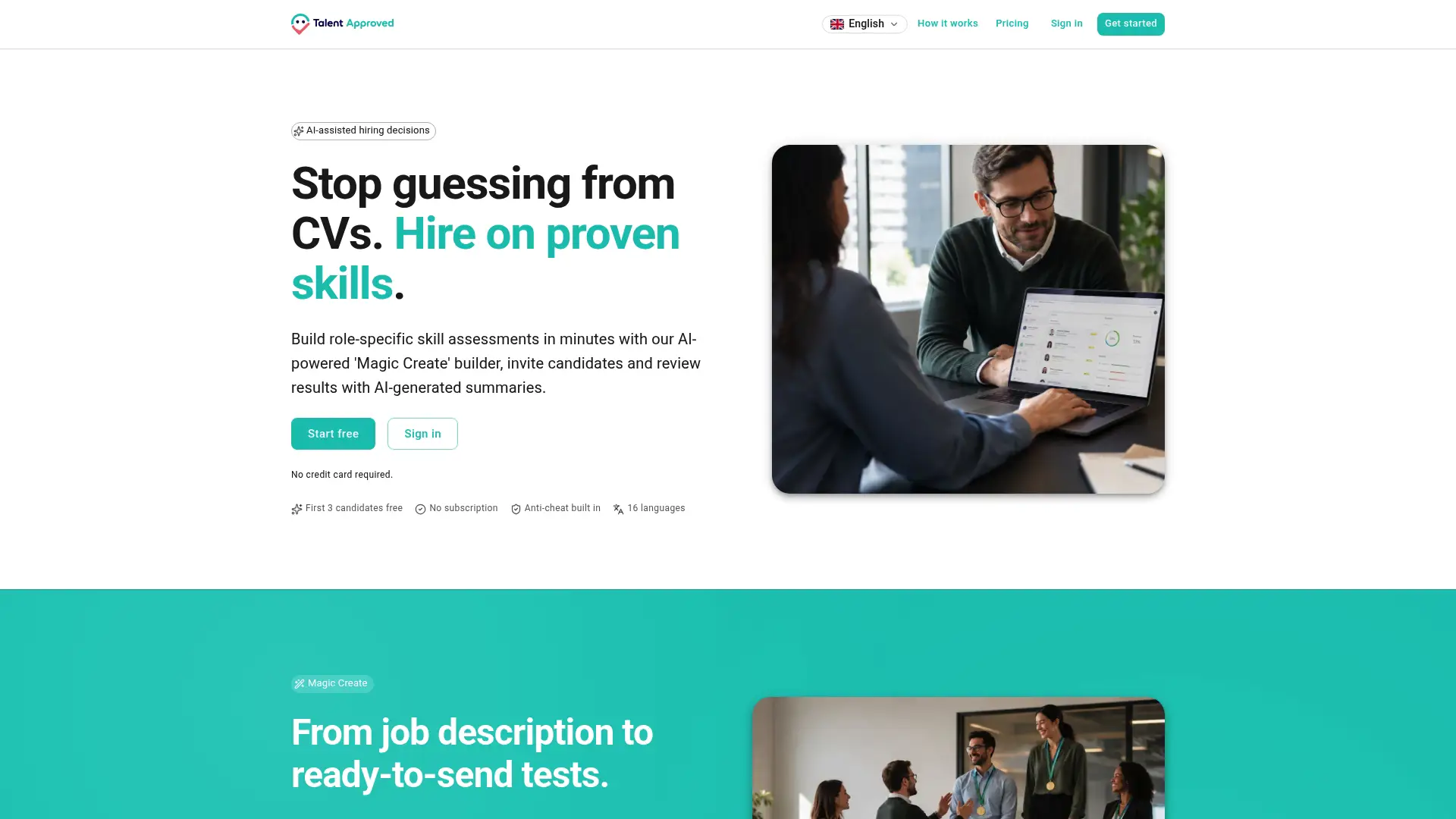
Anti-cheat monitoring, session replays, and AI-generated candidate summaries handle the review grind, while the pay-as-you-go model means you’re only paying $5 per candidate who actually completes the test, not a flat subscription for a tool sitting idle between hiring pushes. That structure fits HR teams running one role a quarter as easily as it fits a recruiter screening two hundred applicants for a single opening.
If your next requisition is sitting in a draft folder, that job description is already most of what Magic Create needs. Visit the Talent Approved homepage to generate a template from it and see the scorecard it builds before you commit to anything.
Sources
- OPM — Designing a competency-based assessment strategy
- HHS — Hiring assessment strategies
- EEOC — Enforcement guidance on disability-related inquiries and medical examinations
- Harvard Business Review — How to write a job description that gets people to apply
FAQ
Can you fail an assessment and still get the job?
Rarely, and only when the failed section was marked “nice-to-have” rather than a must-have gate tied to an essential function; most well-designed assessments treat core competency failures as disqualifying.
What is the purpose of job descriptions in hiring?
Beyond attracting applicants, a job description defines the essential functions and performance criteria that assessments, interviews, and accommodation decisions all reference.
Why do companies use assessments when they are hiring?
Assessments let employers verify a candidate can actually perform the tasks in the job description rather than relying on résumé claims, which improves predictive validity and reduces mismatched hires.
What does an assessment specialist do?
An assessment specialist runs the job task analysis, maps competencies to methods, builds scoring rubrics, and validates that test results correlate with actual job performance, work that platforms like Talent Approved partially automate through Magic Create while keeping a human in the review loop.
How often should job descriptions be updated to keep assessments valid?
Review them at least annually, or sooner if tools, tasks, or reporting structures change, since an outdated job description quietly breaks the link between what’s tested and what the role now requires.