
Validation First Sales Skills Assessment: 6 Competencies HR Must Test

A sales skills assessment objectively measures the selling competencies that predict on-the-job performance and maps candidates to roles and training plans. It works for hiring managers screening applicants, HR teams standardizing evaluations across regions, and sales leaders diagnosing why a team’s close rate has stalled. Talent Approved builds these assessments as validated, role-specific tools rather than generic personality quizzes.
TL;DR:
- Validated sales assessments are role-specific and measure core competencies such as prospecting, questioning, and closing to predict actual sales performance accurately.
- Different assessment formats, including situational judgment tests and role-plays, serve distinct purposes and should be chosen based on the skills highlighted for each role.
- Standardized benchmarking against proven performers and consistent administration practices are crucial for obtaining reliable, actionable results.
- Subscores should drive targeted interview questions, coaching plans, and re-evaluation cycles to improve hiring and development outcomes.
- Talent Approved streamlines creating role-specific tests with anti-cheat tools and AI summaries, reducing operational friction and speeding up decision-making.
Table of Contents
- What a Sales Skills Assessment Measures and Why Validation Matters
- Core Sales Competencies Worth Testing
- Choosing the Right Assessment Format
- Sample Sales Assessment Questions and What They Reveal
- How to Administer and Score a Sales Skills Test
- Turning Assessment Results Into Hiring and Coaching Decisions
- How Talent Approved Solves the Operational Gaps
- An Editorial Take: What Hiring Teams Get Wrong About Sales Testing
- Try Talent Approved for Your Next Sales Hire
- Sources
- FAQ
What a Sales Skills Assessment Measures and Why Validation Matters
A sales skills assessment is a structured test that evaluates how well a candidate or employee performs core selling tasks, not just how they describe their experience on a resume. The distinction matters because self-reported skill and demonstrated skill correlate poorly, especially in sales roles where confidence and competence don’t always travel together.
Three test families cover different ground. Aptitude tests measure raw problem-solving and numerical reasoning, useful for predicting trainability. Competency tests measure specific selling behaviors like discovery questioning or objection handling. Behavioral assessments measure personality traits like resilience and coachability, which correlate with long-term retention more than short-term output.
Validation is what separates a defensible hiring decision from a guess. Business research on bad-hire costs shows that a poor sales hire drains far more than a base salary. It costs ramp time, lost pipeline, manager attention, and often a replacement search six months later.
A validated instrument reduces that risk with:
- Standardized scoring compared against real performer benchmarks, not arbitrary cutoffs
- Predictive evidence that scores correlate with actual sales outcomes
- Subscores that separate distinct skills instead of one vague composite number
Core Sales Competencies Worth Testing
Not every selling skill deserves equal weight. Some competencies separate top performers from the middle of the pack; others barely move the needle. Here’s the priority order most sales leaders should test for, and why each one matters:
- Prospecting and pipeline discipline — predicts whether a rep will generate their own opportunities or wait on inbound leads
- Questioning and diagnosis — the ability to uncover a buyer’s real problem before pitching a solution
- Presentation and persuasion — translating a diagnosis into a compelling, buyer-specific case
- Objection handling and negotiation — staying composed and strategic when a deal gets hard
- Gaining commitment — the actual close, often the weakest skill even among experienced reps
- Resilience and coachability — determines whether training investment will stick
An account executive role leans hardest on questioning, presentation, and closing. A business development representative role leans on prospecting and resilience. Testing the same competency mix for both wastes assessment time and produces misleading comparisons.
Pro Tip: Weight your scoring model by role before you administer a single test. A generic composite score treats a hunter and a farmer as interchangeable, and they are not.

Choosing the Right Assessment Format
Different formats answer different questions, and picking the wrong one wastes both the candidate’s time and yours.
- Situational judgment tests (SJTs) present realistic scenarios and ask candidates to choose the best response. They scale easily across large applicant pools and, according to HubSpot’s guidance on sales assessments, work best paired with other formats rather than alone.
- Role-plays and simulations put candidates through a live or recorded selling scenario. They produce the highest-fidelity signal but demand more evaluator time.
- Work samples and micro-simulations ask candidates to draft a cold email, build a call plan, or handle a mock objection in writing. They give direct evidence of skill without the scheduling overhead of a live role-play.
- Aptitude and personality measures predict potential and cultural fit rather than a specific selling skill, useful for early screening but insufficient on their own.
Sample Sales Assessment Questions and What They Reveal
Concrete questions beat abstract rubrics. Here’s what a well-built sales skills assessment actually looks like in practice:
- SJT example: “A prospect says your price is 20% above budget but loves the product. What do you do next?” This reveals negotiation instinct and whether a candidate defaults to discounting or to value reinforcement.
- Behavioral prompt: “Describe a deal you lost and what you’d do differently.” This maps directly to a resilience and self-awareness subscore.
- Aptitude-style question: A quick math prompt calculating quota attainment or pipeline coverage ratio tests prioritization under pressure.
- Role-play structure: Give the candidate a product brief and a buyer persona, then score them against a rubric covering discovery questions asked, objections addressed, and whether they attempted to close.
Sales aptitude questions built around resilience and diagnostic ability are strong predictors precisely because they mirror real deal friction, not textbook scenarios, according to Asher Strategies’ breakdown of sales aptitude testing.
How to Administer and Score a Sales Skills Test
Consistency in administration matters as much as the questions themselves. A test given under different conditions to different candidates produces noise, not signal.
- Set role-specific benchmarks before you test anyone, using industry benchmark surveys rather than internal guesses
- Give every candidate the same time window, generally enough for a full competency battery without causing fatigue
- Use remote proctoring with screen and webcam monitoring to prevent a candidate from having someone else complete the test
- Build reports that show subscores by competency, not just one overall number, alongside a plain-language fit recommendation
By the numbers: Benchmarking candidates against groups of proven high performers, rather than against a generic population average, is what makes a scenario-based sales test meaningfully more accurate than an unstandardized interview.
Turning Assessment Results Into Hiring and Coaching Decisions
A score sitting in a spreadsheet does nothing. The value shows up when subscores drive specific decisions.
- Map subscores to interview questions. If a candidate scores low on objection handling, ask them to walk through a real objection they’ve faced. Compare their live answer to their test response.
- Set role-specific thresholds, not one universal cutoff. A closer role might require a higher commitment-gaining score than a prospecting role does.
- Build 30/60/90 training plans around common subscore gaps. If half your team scores low on discovery questioning, that becomes month-one coaching, not a generic onboarding deck.
- Run a baseline-to-reassessment cycle. Test before training, deliver targeted coaching, then retest 60 to 90 days later. Sales enablement practitioners consistently find this loop produces the clearest evidence of training ROI, since you’re comparing the same person against their own baseline.
Pro Tip: Don’t wait until annual review season to reassess. A 90-day cycle catches skill decay or improvement while it’s still actionable, and it gives new hires an early, low-stakes checkpoint.
Use the results to guide broader interview design too. Our candidate motivation assessment techniques resource pairs well with competency scores when you’re deciding who to advance to a final round.
How Talent Approved Solves the Operational Gaps
Most of the friction in running sales skills assessments isn’t about knowing what to test. It’s about building the test, stopping cheating, and reading the results fast enough to act on them.

Talent Approved’s ‘Magic Create’ feature builds a tailored, role-specific assessment in minutes from a job description or a list of target skills, which removes the biggest bottleneck most HR teams face: starting from a blank page. Built-in anti-cheat tools, including screen and webcam monitoring with session replay, address the proctoring gap most DIY tests never solve. AI-generated summaries then turn raw subscores into a plain-language fit recommendation, so a hiring manager doesn’t need a statistics background to read a candidate report.
Talent Approved’s platform applies these same principles across:
- Role-specific question libraries built for sales competencies
- Anti-cheat monitoring during remote testing
- Candidate ranking and AI summaries for faster review
An Editorial Take: What Hiring Teams Get Wrong About Sales Testing
The biggest mistake in sales assessment isn’t picking the wrong test. It’s treating one score as the whole verdict. A candidate who bombs a timed aptitude section but shines in a role-play might still be your best closer. Do this: align every question to the actual role, pilot the assessment on a small group before rolling it out company-wide, and always pair scores with a live interview.
Don’t do this: don’t let a single number override your judgment, don’t skip proctoring because it feels like overkill for a “friendly” hire, and don’t lean on a generic personality test as your only screen. Personality predicts fit. It doesn’t predict whether someone can run a discovery call.
— Jimmie
Try Talent Approved for Your Next Sales Hire
The operational headaches this guide covers, building a test from scratch, catching cheaters, reading dense reports, are exactly what Talent Approved was built to remove. Magic Create turns a job description into a finished, role-specific assessment in minutes instead of days. Built-in anti-cheat monitoring and AI-generated summaries mean you spend your time reviewing decisions, not chasing red flags manually.
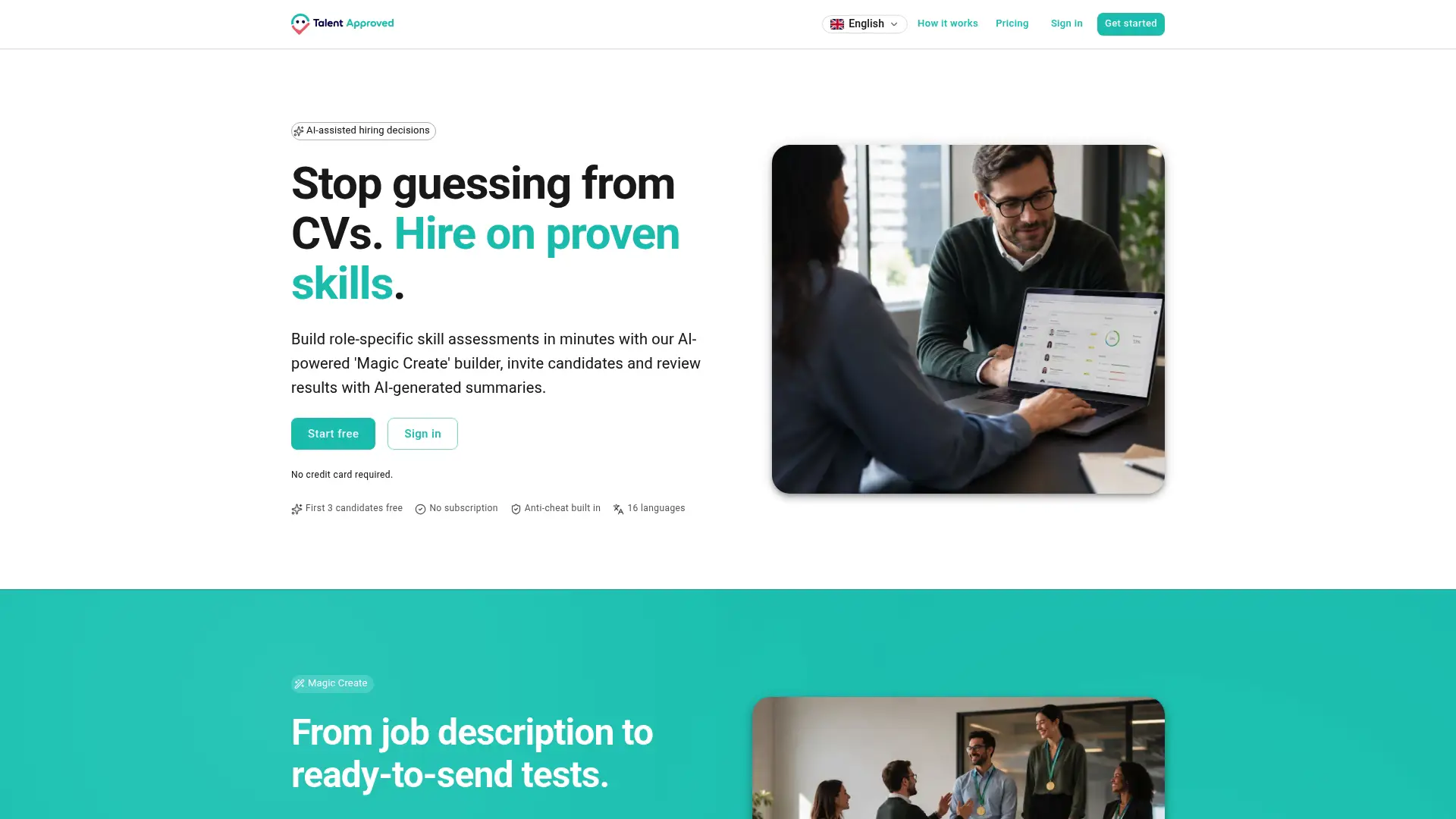
There’s no subscription to commit to. You pay $5 per candidate who completes an assessment, so a small hiring push and a high-volume sales team both scale their costs to actual usage. If you’re deciding which skills to test first, our guide on choosing the right skills to assess is a solid next stop. When you’re ready, build your first assessment and see a sample candidate report for yourself.
Sources
- How Much Does a Bad Hire Cost?
- 5 best sales skill assessments for hiring top talent
- Top 10 sales aptitude test questions and why they matter
- Benchmark surveys — IX Communities
FAQ
What are the 6 basic selling skills?
Most frameworks converge on prospecting, questioning and discovery, presentation, objection handling, negotiation, and closing, with resilience often added as a seventh trait that sustains the other six.
What are the top 3 skills for sales?
Questioning and diagnosis, objection handling, and gaining commitment consistently separate high performers, since these skills directly control whether a diagnosed problem turns into a closed deal.
How do I pass a sales assessment test?
Answer situational questions based on how you’d actually behave under pressure rather than what sounds ideal, since well-built tests like those Talent Approved generates cross-check consistency across multiple question types.
What are the 7 steps of selling skills?
A common version includes prospecting, preparation, approach, presentation, handling objections, closing, and follow-up, though some frameworks combine or split these stages differently.
How long should a sales skills assessment take?
A full competency battery typically runs about 30 minutes, long enough to cover multiple subscores without causing candidate fatigue or drop-off.