
Retail Store Manager Interview Questions That Predict Hires

Run a structured kit, not a freeform chat: pair a mapped question bank with a one-week operations work sample and a numeric rubric, and you will separate strong retail store manager candidates from weak ones in a single round.
- Behavioral and situational questions mapped to 8 core competencies
- A one-week operations work sample (staffing, promotions, stock plan)
- A 1-to-5 scored rubric with a pass/hire threshold
Pro Tip: Budget around an hour for the interview and a few hours for the take-home assignment. Schedule the assessment before you finalize your shortlist, not after.
Key Takeaways
A structured retail store manager interview kit combining a mapped question bank, a one-week work sample, and a weighted rubric predicts on-the-job performance far better than an unstructured conversation.
| Point | Details |
|---|---|
| Test 8 to 9 competencies | Missing more than 3 to 4 core skills raises the risk of turnover and margin loss. |
| Pair questions with a work sample | A one-week operations plan reveals execution ability that interviews alone miss. |
| Use a weighted 1-to-5 rubric | Set thresholds like 75+ for hire, 60 to 74 for conditional offer, below 60 for pass. |
| Standardize interviewer roles | Assign a lead, skills assessor, and culture-fit interviewer to reduce scoring drift. |
| Deploy the kit with Talent Approved | Magic Create builds the question bank and scores the work sample with anti-cheat protection included. |
Table of Contents
- Why Structured Interviews Lower Retail Hiring Risk
- What Competencies Should You Test in a Retail Manager Interview?
- Mapped Interview Questions by Competency
- Work-Sample Exercises and a Scoring Rubric That Works
- How to Structure the Interview Panel and Timeline
- Staying Legally Sound During Retail Manager Interviews
- Turning Rubric Scores Into a Hire Decision
- The Real Trade-Off Between Speed and Predictive Hiring
- Build and Deploy This Kit Faster With Talent Approved
- Sources
- FAQ
Why Structured Interviews Lower Retail Hiring Risk
Unstructured interviews let gut feeling override evidence, and gut feeling is a poor predictor of who can run a profit-and-loss store unit. A retail store manager should demonstrate at least 8 to 9 core competencies before you make an offer; missing more than 3 or 4 of them reliably shows up later as staff turnover, shrinking margins, or a service slide.
Structured kits fix this by scoring every candidate against the same criteria, which makes comparisons real instead of impressionistic.
- Faster shortlisting because scores, not memory, drive the ranking
- More consistent evaluations across multiple interviewers or store locations
- Lower bias risk since every candidate answers the same prompts
Combining a scorecard with a work-sample test also catches candidates who interview well but cannot execute, a gap unstructured conversations rarely surface.
What Competencies Should You Test in a Retail Manager Interview?
Retail management hiring guides point to a consistent set of skills worth testing directly, not just discussing. Indeed’s hiring guidance recommends assessing leadership, organizational ability, customer service, financial acumen, problem-solving, communication, delegation, and training capability, a list that maps closely to what actually predicts store performance.
- Leadership — does the candidate describe motivating a team through a hard stretch, or just supervising one?
- Customer experience — how do they turn a complaint into a recovery, not just an apology?
- Inventory management — do they treat stock as a financial asset or an afterthought?
- Financial/P&L literacy — can they read a P&L statement and tie decisions to margin?
- Sales and merchandising — do they connect floor layout and promotions to conversion?
- Operational planning — can they build a staffing and stock plan that survives a busy week?
- Coaching and development — how do they grow a struggling associate, not just replace one?
- Decision-making under pressure — do they prioritize correctly when three things break at once?
- Tech and omnichannel aptitude — are they comfortable with POS data and buy-online-pickup-in-store logistics?
Top performers get evaluated like owners of a standalone business unit, which is why financial literacy and inventory-as-asset thinking deserve equal weight to customer-facing skills.
Pro Tip: For a small-format or single-door store, weight leadership and customer experience heaviest. For a big-box or multi-department store, weight financial acumen and operational planning heaviest, since the P&L stakes are much higher.
Mapped Interview Questions by Competency
Ask two behavioral questions, one situational prompt, and one technical question per competency. Behavioral questions force candidates into the STAR format (Situation, Task, Action, Result); a strong answer names a specific outcome, not a general philosophy.
- Leadership: “Tell me about a time you turned around an underperforming shift.” / “Describe a decision your team disagreed with. How did you handle it?” Situational: “Two associates clash publicly on the floor during a rush. What do you do?”
- Customer experience: “Walk me through a service recovery you’re proud of.” / “Tell me about a time you trained a team on service standards.” Situational: “A customer demands a refund outside policy. Walk me through your response.”
- Inventory: “Describe how you’ve reduced shrink or improved stock accuracy.” Technical: “How would you set reorder points for a fast-moving SKU?”
- Financial acumen: “Tell me about a time you hit a margin target under pressure.” Technical: “Walk me through how you’d read a monthly P&L to spot a problem.”
- Delegation and coaching: “Describe developing an associate into a keyholder or supervisor.”
Weak answers stay vague (“I’m a people person”). Strong answers name numbers, timeframes, and results. Probe further with: “What would you do differently?” or “What did the data show afterward?” These follow-ups separate a rehearsed story from real judgment. See how role-specific tests get built from a job description if you want the question bank auto-generated rather than hand-written.
Work-Sample Exercises and a Scoring Rubric That Works
Interviews alone under-predict performance. A work-sample test paired with structured questions gives a far stronger signal, especially for a role this operational.
- Role-play: Hand the candidate a staffing-shortage scenario (two call-outs on a Saturday) and have them talk through their response in real time. Score their prioritization, communication, and customer-impact awareness.
- One-week operations plan: Give a home assignment with a sample sales history and headcount. Ask for a staffing schedule, one promotional idea, and a stock reorder plan. Evaluate against a checklist tied to coverage, cost, and sales lift.
- POS or inventory analysis: Provide a week of sales data and ask the candidate to flag a problem and recommend a fix. This tests financial fluency directly rather than by self-report.
A sample scorecard rates each competency from 1 to 5, with weights reflecting your store’s priorities.
Pro Tip: A weighted score of 75 or higher signals a strong hire, 60 to 74 suggests a conditional offer with a training plan, and anything below 60 is a pass, a threshold structure built into standard scorecard design.

How to Structure the Interview Panel and Timeline
Run the process in four stages: resume screen, skills assessment, panel interview, then reference checks. Keep the full cycle under two weeks to avoid losing strong candidates to competing offers.
- Screen (30 minutes) — confirm baseline experience and availability.
- Skills assessment (2 to 3 hours, often take-home) — the operations plan and any technical exercise.
- Panel interview (90 to 120 minutes) — split among a lead interviewer, a skills assessor, and a culture-fit interviewer.
- Reference and background checks — final verification before an offer.
- Assign one interviewer to own competency scoring, not general impressions.
- Standardize note-taking with the same rubric sheet for every panelist.
- If running remote assessments, use anti-cheat monitoring to protect the integrity of a take-home task.
- Brief every interviewer beforehand; training hiring managers to use assessments consistently is what actually makes scores comparable across panels.
Staying Legally Sound During Retail Manager Interviews
Structured doesn’t mean risk-free unless you also screen your questions. Avoid asking about age, marital or family status, disability, or medical history, even indirectly (“Do you have kids who’d affect your schedule?”). Rephrase toward the job requirement instead: “This role requires weekend availability. Can you commit to that schedule?”
- Use the same question set and rubric for every candidate in a given round.
- Document scores and notes immediately, not from memory later.
- Offer reasonable accommodations for assessments (extra time, alternate format) when requested.
- Keep interviewer training current on what not to ask.
Pro Tip: A documented, consistent process is your best defense if a hiring decision is ever challenged. Consistency, not intent, is what regulators and courts actually look at.
Turning Rubric Scores Into a Hire Decision
Scores only matter if you act on them consistently. Set clear thresholds before you interview anyone, not after you’ve fallen for a candidate.
- Weighted score of 75+ : move to offer.
- Score of 60 to 74: conditional hire with a 30 or 60-day development plan, or a paid trial shift.
- Score below 60: pass, regardless of interview charisma.
- Always pair the rubric score with reference checks; a strong test score with poor references is a real flag, not something to explain away.
- For borderline candidates, a trial shift often reveals more than a second interview round.
- A candidate scoring 4/5 on leadership but 2/5 on financial literacy might still work for a smaller-format store where P&L stakes are lower.
Combining tests with references is standard guidance across retail assessment research: no single input should carry the whole decision.
The Real Trade-Off Between Speed and Predictive Hiring
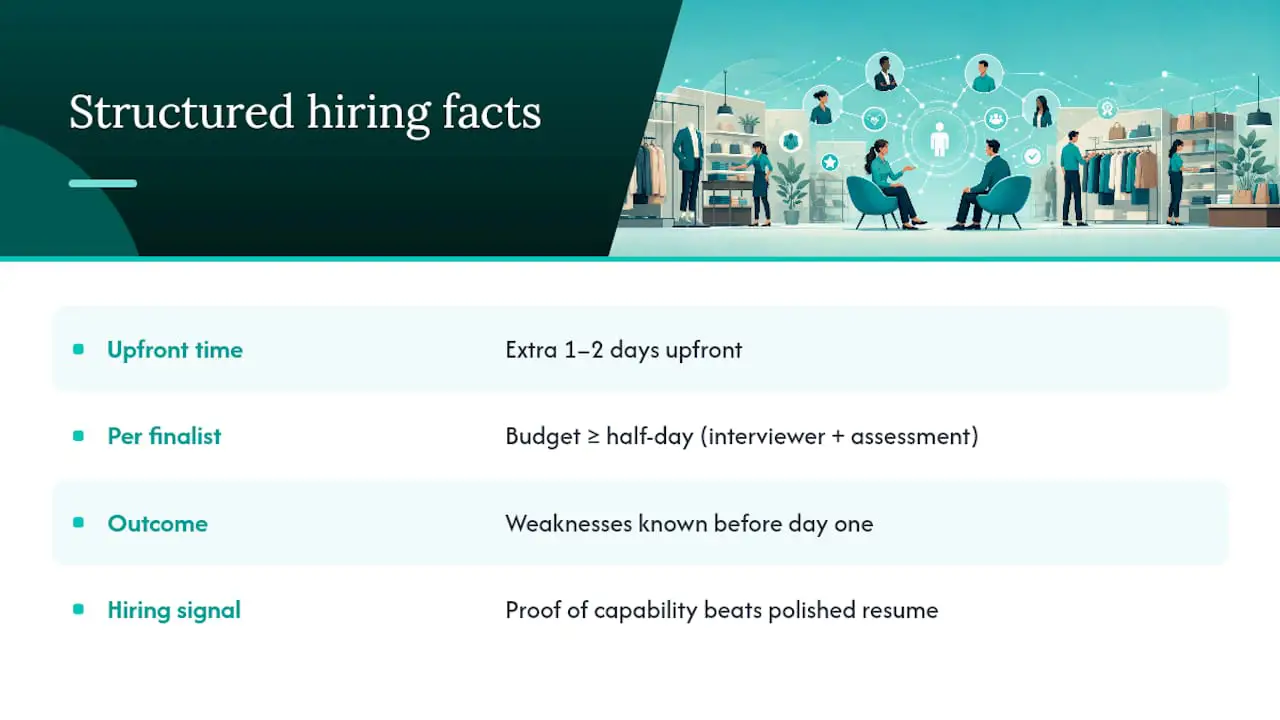
Fast hiring feels efficient until you’re replacing the same store manager role twice in a year. Structured kits cost you an extra day or two upfront, but the return is a hire whose weaknesses you already know before day one. Budget at least a half-day of combined interviewer and assessment time per finalist. Talent Approved’s affiliation with structured, skills-first hiring shapes this view: proof of capability beats a polished resume every time.
Build and Deploy This Kit Faster With Talent Approved
Talent Approved turns everything above into a live assessment in minutes instead of days. Its Magic Create feature builds a mapped question bank directly from a retail store manager job description, and the platform delivers the one-week operations work sample as a scored, anti-cheat-protected assessment with screen and session monitoring built in.
Instead of manually building a rubric spreadsheet, you get AI-generated candidate summaries and rankings the moment an assessment is completed, so your panel walks into the final interview already knowing where each finalist scored on financial acumen, leadership, and operational planning. There’s no subscription; you pay $5 per completed candidate assessment, so the cost scales with how many finalists you’re actually screening.
Start by creating your first retail store manager assessment on Talent Approved using the competency list from this article, then layer in a work-sample task before your next round of interviews.
Sources
- 7 skills every retail manager needs to succeed — Retail Doctor
- Skills for store managers — Indeed Career Guide
FAQ
How many interview rounds should a retail store manager hire go through?
Most hiring teams use three stages: a screen, a skills assessment or work sample, and a final panel interview, completed within about two weeks.
What is the biggest mistake hiring teams make in retail manager interviews?
Relying entirely on unstructured conversation without a scored work sample, which misses whether a candidate can actually execute an operations plan.
Should I use a vendor test or a custom assessment?
A custom assessment mapped to your store’s specific competencies, like one built with Talent Approved’s Magic Create, tends to produce more relevant scoring than a generic off-the-shelf test.
What score should disqualify a retail manager candidate?
A weighted rubric score below 60 out of 100 is typically treated as a pass, while 60 to 74 supports a conditional hire with a development plan.
Can I run these assessments remotely?
Yes, remote work-sample assessments work well when paired with anti-cheat safeguards like screen and webcam monitoring to protect scoring integrity.