
Decide Fast: Portfolio vs Skills Test in 5 Compliance Checks

Use a portfolio when past deliverables map directly to job-critical tasks and you can verify who did the work. Use a skills test when you need comparable, current evidence collected under the same conditions for every candidate. Use both when the role calls for context and comparability. Either way, the U.S. Office of Personnel Management and the EEOC expect the method to be job-related and validated. The sections below walk through the design steps and one fast implementation option.
TL;DR:
- Skills tests are preferable for technical roles where standardized evaluation of current performance under controlled conditions predicts job success better than past work samples.
- Portfolios are most effective for creative or writing roles where demonstrated deliverables directly reflect the job, but only if ownership can be verified.
- Combining a short, validated skills test with targeted portfolio review and structured interview offers the most reliable and scalable assessment process.
- Ensuring assessments are job-related, based on a proper job analysis, and monitored for adverse impact is critical for legal compliance.
- Using assessment platforms with anti-cheat tools and pay-per-candidate pricing can streamline designing and administering role-specific evaluations.
Table of Contents
- Portfolio vs Skills Test: What’s the Actual Difference?
- Should I Use a Portfolio, a Skills Test, or Both?
- How Do You Design and Validate a Fair Assessment?
- What’s the Right Order for Screening Candidates?
- How Do You Verify Portfolio Ownership and Stop Test Cheating?
- What Hiring Teams Get Wrong About This Trade-Off
- Build Role-Mapped Assessments Without the Manual Setup
- Sources
- FAQ
Portfolio vs Skills Test: What’s the Actual Difference?
A portfolio shows what a candidate has already built, in whatever context they built it. A skills test shows what a candidate can do right now, under conditions you control. That distinction sounds small until you’re comparing two candidates for a data analyst role: one has a GitHub full of side projects, the other has three years of internal dashboards nobody outside their company will ever see. Neither portfolio tells you how either person handles your specific data problems.
Skills tests solve that by putting every candidate through the same task. Work-sample assessments that mirror actual job duties carry strong content validity precisely because they measure the behavior you care about, not a proxy for it, according to OPM’s guidance on work samples and simulations. Portfolios can still carry meaningful evidence, especially for creative and writing roles where the deliverable itself is the job product. The catch is access bias: candidates with flexible schedules, prior high-profile clients, or personal brands build stronger portfolios regardless of raw skill.
| Factor | Portfolio | Skills test |
|---|---|---|
| Evidence type | Past work, variable context | Observed performance, controlled conditions |
| Best for | Creative, writing, design roles with tangible output | Technical, analytical, or process-driven roles |
| Scalability / time per candidate | Slow; each review is manual | Fast; scores and batches at volume |
| Validation concerns | Hard to verify authorship or context | Easier to standardize and validate |
| Implementation complexity | Low tooling, high reviewer judgment | Higher setup cost, lower ongoing judgment |
A few things follow from that table:
- Portfolios reward candidates who’ve had the opportunity to build visible work, which can quietly exclude strong performers from less flexible backgrounds.
- Skills tests reward candidates who test well under pressure, which isn’t always identical to job performance.
- Portfolios take longer per candidate to review properly; skills tests take longer to build properly but score almost instantly after that.
- Neither method replaces the other for verifying communication, judgment, or team fit, which is where a structured interview still earns its place.
Should I Use a Portfolio, a Skills Test, or Both?
Three questions settle most of these decisions. First, are the required skills expected on day one, or will you train them after hire? Work-sample tests make sense only when the competency is already expected at entry, per OPM; if you’re hiring for trainable skills, a test measures the wrong thing. Second, can you verify who actually did the portfolio work? If you can’t confirm ownership, a polished sample tells you less than you think. Third, how many candidates are you screening? A design lead search with 12 applicants can absorb manual portfolio review. A customer support hire with 400 applicants cannot.
Put those together and the pattern gets simple. Creative and portfolio-heavy roles, such as illustrators or copywriters, lean on portfolios because the work product is the job. Technical roles like engineers or data analysts lean on skills tests because concrete task performance under standard conditions predicts the job better than a resume of past projects. High-volume roles lean on tests by default, simply because manual portfolio review doesn’t scale past a few dozen candidates without a hiring team burning a week on reading.
Pro Tip: If you’re unsure which way to lean, run a small pilot: score five candidates both ways and see which method actually separates strong performers from weak ones for that specific role.
Before locking in a method, run this checklist:
- Confirm the skill is expected at entry, not trained post-hire.
- Confirm you can verify authorship if using a portfolio.
- Estimate applicant volume and reviewer hours available.
- Decide whether the role needs comparability across candidates or contextual depth from real deliverables.
- Document the job-relatedness rationale for whichever method you pick.
How Do You Design and Validate a Fair Assessment?
Start with a job analysis, not a template. Every credible assessment, portfolio or test, begins by mapping the actual tasks of the role to what you’re going to measure. SIOP’s guidance on AI-based assessments treats this step as the foundation for everything that follows, and skipping it is the single most common reason assessments get challenged later.

For portfolios, build an observable scoring rubric that separates craft quality from business impact. A polished landing page and a landing page that lifted conversion by a measurable amount are different signals, and a rubric that scores them together loses information. Score them on separate axes instead.
For skills tests, realism matters more than difficulty. A test that mimics the actual work, spreadsheet cleanup, a coding fix, a client email response, predicts performance better than an abstract puzzle. Decide upfront whether you’re scoring pass/fail or ranking candidates on a scale, since that decision changes how you set your cutoff.
- Pilot every new test on a small group before rolling it out at scale.
- Track subgroup outcomes to catch adverse impact early, as EEOC’s UGESP guidance requires of any selection procedure.
- Keep versioning records: what changed, when, and why.
- Store scoring logic and instructions so a later audit can reconstruct exactly how a score was reached.
Fairness isn’t a one-time checkbox. SIOP’s own analysis of predictive validity points out that job-specific, structured assessments consistently outperform generic ones, but only when someone keeps monitoring outcomes after launch, not just at design time. Tools like the scoring rubric templates built for this exact purpose can shortcut a lot of the setup work.
What’s the Right Order for Screening Candidates?
Sequence matters as much as the methods themselves. A workable order looks like this:
- Define the job-critical skills before writing a single question, using guidance on selecting the right skills to test.
- Run a brief, standardized skills test first, since it produces comparable evidence across every candidate at low cost per person.
- Move to a targeted portfolio review only for candidates who clear the test, and only when the role genuinely benefits from contextual work samples.
- Close with a structured interview to confirm ownership and probe reasoning, which OPM’s research on structured interviews links to higher validity and better rater agreement.
Most skills tests take candidates 20 to 45 minutes depending on role complexity, and score automatically once submitted. Portfolio review runs slower, often 10 to 15 minutes of focused reviewer time per candidate if you’re using a rubric instead of freeform judgment. Batch your portfolio reviews into single sessions rather than spreading them across a week; reviewer calibration drifts otherwise. Keep your shortlist to a number your team can interview properly, usually five to eight finalists, so the structured interview stage doesn’t become the new bottleneck.
How Do You Verify Portfolio Ownership and Stop Test Cheating?
Ask every portfolio candidate the same three questions: what exactly did you do, what alternatives did you consider, and what evidence shows impact. A common interpretation of the Uniform Guidelines from the EEOC supports using fixed, observable anchors rather than guessing at contribution from the artifact alone.
- Check commit history, timestamps, or client permission letters where the work allows it.
- Run a light reference check when the portfolio piece was a team effort.
- Require proctoring, screen monitoring, or session replay for remote skills tests to catch outside help.
- Keep device and browser logs for any flagged session in case of a later dispute.
Pro Tip: Session replay isn’t just an anti-cheat feature. Watching how a candidate approached a problem, not just their final answer, often tells you more than the score itself.
What Hiring Teams Get Wrong About This Trade-Off
The real mistake isn’t choosing the wrong method. It’s treating the choice as permanent. A structured skills test paired with a targeted portfolio check and a follow-up interview beats either method alone, and small teams should build in that order, cheapest and fastest first. Document what you measure, watch subgroup outcomes, and revisit the test itself every few hiring cycles. Assessment design is never finished; it’s maintained.
— Jimmie
Build Role-Mapped Assessments Without the Manual Setup
Designing a validated, job-mapped skills test from scratch takes real hours, job analysis, rubric drafting, pilot runs. Certain platforms offer features that compress the design of tailored, role-specific assessments into minutes by feeding in a job description or a list of target skills, generating an assessment ready to send to candidates.
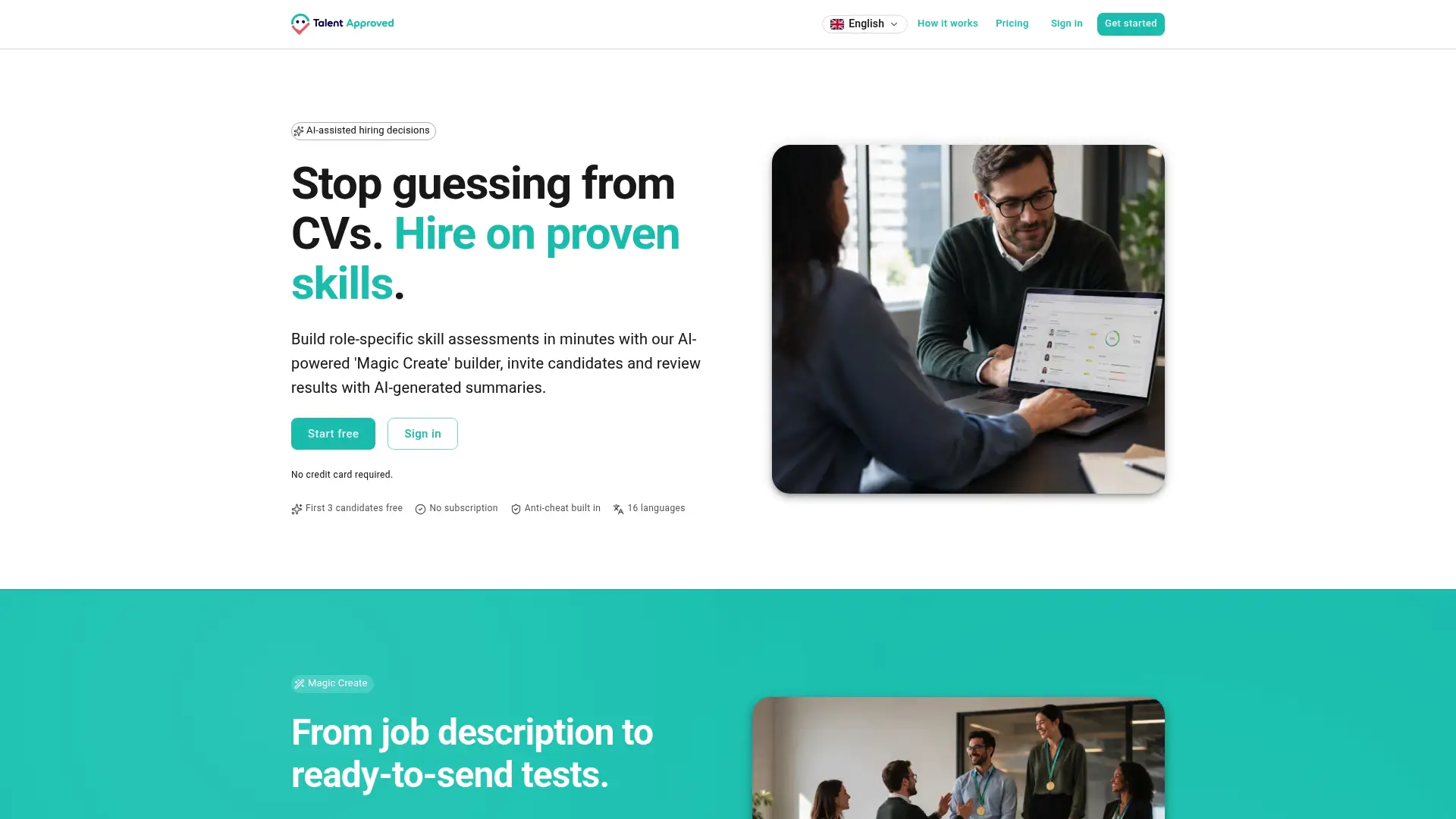
Some assessment platforms include anti-cheat protections, such as screen and webcam monitoring and session replay, to automate verification steps rather than relying on manual log checks. AI-generated summaries can condense candidate performance to help teams focus review time on finalists rather than raw data. Some services offer pay-as-you-go pricing where fees are charged per candidate who completes an assessment rather than requiring a subscription, allowing costs to scale with actual hiring volume. Check current skill assessment pricing and build your first job-mapped test today.
Sources
- Work samples and simulations | U.S. Office of Personnel Management
- Employment tests and selection procedures | U.S. Equal Employment Opportunity Commission
- Structured interviews | U.S. Office of Personnel Management
- Considerations and recommendations for the validation and use of AI-based assessments for employee selection | SIOP
FAQ
Is a Skills Test Better Than a Portfolio?
Neither is universally better. A skills test wins when you need comparable evidence across many candidates under identical conditions; a portfolio wins when past deliverables genuinely reflect job-critical output and ownership is verifiable.
Can I Legally Require a Skills Test for Hiring?
Yes, as long as the test is job-related and validated, which the EEOC’s employment testing guidance requires of any selection procedure. Document the job analysis behind the test and monitor outcomes across subgroups.
How Much Does a Skills Assessment Cost With Talent Approved?
Talent Approved charges $5 per candidate who completes an assessment, with no subscription required. You only pay for candidates who actually finish the test.
Should I Use a Portfolio for Every Creative Role?
Not automatically. A portfolio works best when you can verify individual contribution and the deliverables genuinely mirror the job. For high-volume creative hiring, a brief work-sample test paired with a short portfolio check often screens faster without losing signal.
What’s the Biggest Compliance Risk With Skills Tests?
Using an unvalidated or unmapped test is the biggest risk. SIOP’s guidance on AI-based assessments recommends starting every test with a job analysis and tracking subgroup results over time to catch adverse impact early.