
Recruiters: Build an Operations Skills Test From 3–5 Key Skills

An operations skills test measures whether a candidate can actually perform the core technical and process-management tasks the job demands, not just whether they can talk about them in an interview. It’s the right tool when you’re screening candidates for operations coordinator, supervisor, or operations manager roles and need proof over polish. The fastest path forward: pick a role-mapped prebuilt test or build a short, tailored assessment around the three to five skills that matter most for that specific job.
TL;DR:
- Tailored operations assessments should focus on the three to five critical skills that predict success, such as process improvement, supply chain, and people management.
- Different test formats serve specific purposes: simulations and case tasks provide deep insight but require more grading time, while multiple-choice and adaptive tests are quicker but less performance-focused.
- The recommended test length is 15 to 25 minutes for screening candidates, with final assessments extending up to an hour for deeper evaluation of senior roles.
- Using a short initial screening with quick formats like MCQs or SJTs followed by detailed simulations for top candidates optimizes both speed and depth.
- Many candidates underperform due to test mechanics, not skill, often caused by time pressure or misunderstanding scenarios, emphasizing the importance of clear instructions and preparation.
Table of Contents
- What Operations Skills Tests Measure
- Which Test Format Fits Your Operations Role?
- How to Choose or Build an Operations Skills Assessment
- How Long Should an Operations Skills Test Take?
- How Talent Approved Supports Operations Hiring
- Why Do Candidates Struggle With Operations Tests?
- Recruiter Perspective: Three Common Pitfalls And What To Prioritize
- Build an Operations Skills Test in Minutes
- Selected Public Assessment Guides And Sample Materials
- Sources
- FAQ
What Operations Skills Tests Measure
The best operations assessments don’t try to cover everything. They isolate the handful of competencies that predict whether someone will actually succeed in the role, then test each one with a purpose-built question or task.
Most operations-focused tests, including the structured booklet used by Southern California Gas Company, converge on the same core categories:
- Process optimization and continuous improvement: candidates review a workflow with a bottleneck and propose a fix, or rank three process changes by expected impact.
- Supply chain and logistics: numeric problems involving lead times, reorder points, or inventory turnover.
- Quality control: scenario judgment questions where a candidate spots a defect pattern or decides whether to halt a production line.
- Budgeting and forecasting: math-based tasks like calculating variance against a budget or projecting next-quarter demand from historical data.
- People management: situational judgment items covering delegation, conflict resolution, and performance feedback.
- Data literacy: reading a dashboard or spreadsheet correctly and drawing the right conclusion from it.
A high score on process optimization usually means the candidate can spot waste and prioritize fixes by cost and effort, not just list generic improvement ideas. A middling score often signals someone who understands theory (Lean, Six Sigma, that kind of vocabulary) but struggles to apply it to a messy, real-world scenario. A low score is a flag that the candidate may need heavy onboarding before they can run a process independently.
Weighting shifts by seniority. For an entry-level coordinator, lean harder on data literacy and quality control basics. For a senior operations manager candidate, people management and budgeting should carry more weight than raw numeric speed, since the job is less about doing the math and more about deciding what the math means.
Which Test Format Fits Your Operations Role?
Different formats measure different things, and picking the wrong one wastes both your time and the candidate’s.
- Multiple-choice questions (MCQs) score fast and scale to hundreds of candidates, but they measure recall and basic judgment better than real execution. Good for a first screening pass.
- Situational judgment tests (SJTs) present a realistic dilemma, like a shipment delay or a staffing conflict, and ask the candidate to choose the best response from several plausible options. These correlate well with how someone behaves under pressure.
- Simulations and work samples ask candidates to actually do the job in miniature: build a schedule, reconcile a budget, or redesign a workflow diagram. Higher fidelity, but they take longer to grade unless the platform auto-scores them.
- Case tasks hand the candidate a short business problem and ask for a written recommendation. Strong for senior roles where judgment and communication matter as much as technical skill.
- Adaptive tests adjust question difficulty based on prior answers, which shortens testing time without sacrificing much precision.
The trade-off is consistent across formats: MCQs and adaptive tests scale beautifully but tell you less about real performance. Simulations and case tasks tell you a lot more but cost more grading time, unless scoring is automated.
Pro Tip: Run a short MCQ or SJT screen first to cut your candidate pool, then reserve a simulation or work sample for your final three to five finalists. You get speed at the top of the funnel and depth where it actually counts.
How to Choose or Build an Operations Skills Assessment
Most hiring teams either grab a generic test off the shelf or write one from scratch with no structure. Both approaches leave gaps. A better method follows four steps.
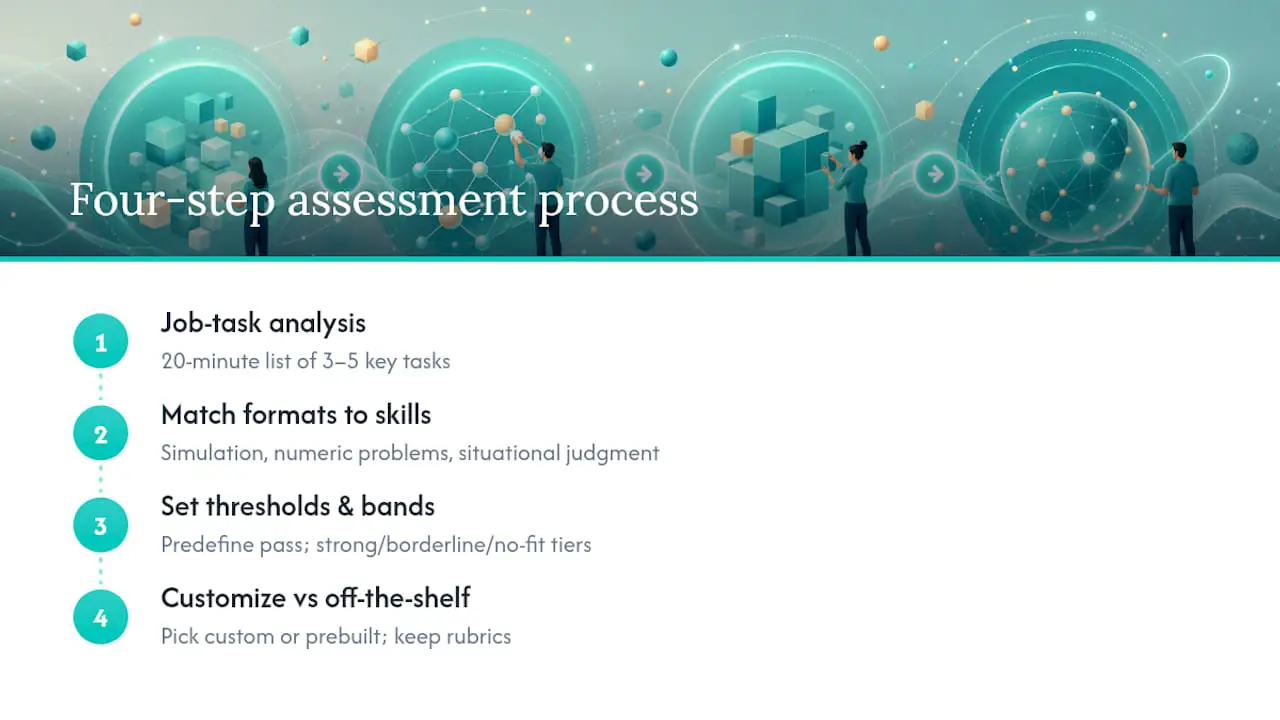
Step 1: Run a quick job-task analysis. Sit down with the hiring manager for 20 minutes and list the three to five tasks that separate a strong performer from a mediocre one in this specific role. Skip the full job description. Focus on what the person does on a Tuesday afternoon when things go wrong.
Step 2: Match formats to skills. Process improvement calls for a simulation or work sample. Forecasting calls for numeric problems. People management calls for situational judgment. Don’t force every skill into a multiple-choice format just because it’s easier to build.
Step 3: Set pass thresholds and banding. Decide in advance what a passing score looks like, and build tiers (strong, borderline, no fit) rather than a single cutoff. Borderline scores are where interviews earn their keep. If a candidate scores low on budgeting but high everywhere else, that’s a specific, targeted interview question, not an automatic reject.
Step 4: Decide customization versus off-the-shelf. A prebuilt test saves time for common roles like operations coordinator. A senior operations manager search usually justifies a custom build tied to your company’s actual workflows. Either way, maintain a reusable question bank and consistent scoring rubrics so every hiring manager applies the same bar.
Resources like how to choose the right skills to test applicants and practical skills evaluation for HR walk through this mapping process in more depth if you’re building your first structured assessment.
How Long Should an Operations Skills Test Take?
Screening tests should run 15 to 25 minutes. In-depth assessments for finalist candidates can run closer to an hour, in line with the roughly one-hour format recommended in employer assessment booklets for coordination, problem-solving, and numerical sections.
Combine auto-scoring for objective items (math, multiple choice) with rubric-based scoring for open-ended tasks, and let AI for Social Media Managers-generated summaries flag patterns across a candidate pool rather than replace human review entirely.
Test integrity matters just as much as test design:
- Use screen recording and webcam proctoring for remote assessments where stakes are high.
- Session replay lets you spot unusual pauses or copy-paste behavior after the fact instead of watching live.
- Tell candidates in advance what’s being monitored. Transparency protects you legally and keeps the process feeling fair.
- Give clear setup instructions: quiet room, reliable internet, a calculator if the test allows one, and a defined time window.
Employer booklets that spell out equipment needs and environment setup in advance tend to produce more consistent results, because candidates aren’t scrambling to find a quiet spot mid-test.
How Talent Approved Supports Operations Hiring
Talent Approved’s Magic Create feature turns a job description into a role-specific assessment in minutes, which shortens the job-task-analysis step described above instead of replacing it. Ready-made operations tests, built-in anti-cheat monitoring, and AI-generated candidate summaries handle the administration and scoring checklist without extra tooling. Rubrics stay consistent across hiring managers, and reports arrive ready for review the moment a candidate finishes.
Why Do Candidates Struggle With Operations Tests?
Most candidates who underperform on operations assessments don’t lack the underlying skill. They stumble on test mechanics.
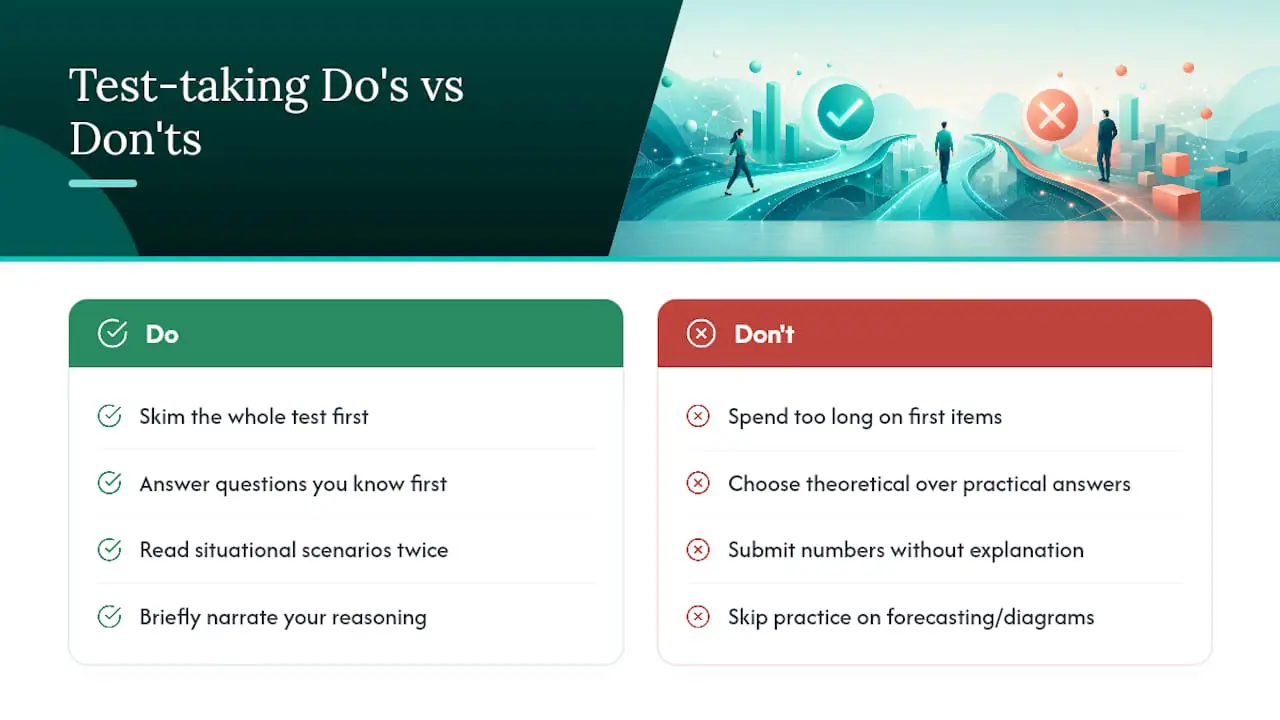
Time pressure is the biggest culprit. Numeric and forecasting sections often get rushed because candidates spend too long on the first few questions and run out of time on the rest. The fix is simple: skim the whole test first, answer the questions you’re confident about, then circle back to the harder ones.
Situational judgment questions trip people up differently. Candidates often pick the answer that sounds most “correct” in theory instead of the one that reflects how a good operations professional actually behaves under real constraints. Reading the scenario twice before answering helps more than reading the answer choices twice.
Simulations and work samples reward candidates who narrate their reasoning, even briefly, rather than just submitting a final number or plan. A recruiter reviewing two similar answers will usually favor the one that shows the thinking behind it.
For test takers, the practical prep advice is unglamorous but effective: brush up on basic forecasting and variance math, practice reading a workflow diagram for bottlenecks, and get comfortable making a decision with incomplete information, because that’s exactly what the job requires. Employers who explain what’s being tested and why, similar to how a realistic job preview works in a formal assessment booklet, tend to get calmer, more representative performances from candidates.
Recruiter Perspective: Three Common Pitfalls And What To Prioritize
The most common mistake I see is weighting every competency equally instead of matching weight to what the role actually demands. The second is leaning on MCQs alone for a role that requires judgment, not recall. The third is treating a test score as a verdict instead of a conversation starter. When volume is high, lean on quick screens. When you’re hiring a senior operations manager, spend your time on the interview probes a mid-range score should trigger, not on finding a “perfect” cutoff.
— Jimmie
Build an Operations Skills Test in Minutes
Talent Approved turns the four-step framework above (job analysis, format matching, thresholds, customization) into something you can execute the same afternoon, not over a two-week project. Magic Create builds a tailored operations assessment straight from a job description or a short skills list, so you skip the blank-page problem entirely.
Ready-made operations tests, anti-cheat monitoring with screen and webcam checks, and AI-generated summaries mean you get a fair, defensible screening process without building rubrics from scratch. The service uses a pay-as-you-go pricing model with fees based on completed candidate assessments and no subscription required. Head to Talent Approved to build your first operations assessment and see a candidate report before your next round of interviews.
Selected Public Assessment Guides And Sample Materials
For a firsthand look at real administration formats, review the Operations and Support Assessment booklet for sample questions and timing guidance, and the sample candidate PDF for a look at how reporting is structured.
Sources
- Operations and Support Assessment (Southern California Gas Company)
- Operations Manager Skills Test | ProProfs
FAQ
What Are the 5 P’s of Operations Management?
The 5 P’s commonly cited in operations management are people, processes, plants (facilities), parts (materials and inventory), and planning and control systems. Operations skills tests typically probe several of these at once, particularly people management, process design, and planning through forecasting and scheduling questions.
Can You Still Get Hired if You Fail an Assessment Test?
Yes. Most employers treat a low score on one competency as a discussion point for the interview rather than an automatic disqualifier, especially when the candidate scores well elsewhere. A borderline result often leads to a targeted follow-up question instead of a rejection.
What Are Operations Skills?
Operations skills are the practical abilities needed to keep a business’s day-to-day work running smoothly, including process improvement, supply chain and inventory management, quality control, budgeting and forecasting, and people management. An operations skills test measures these directly through numeric problems, scenario judgment items, and simulations rather than relying on self-reported experience.
Is It Hard to Pass an Aptitude Test?
Difficulty depends heavily on preparation and time management rather than raw skill alone. Candidates who skim the full test first, pace themselves through numeric sections, and read situational judgment scenarios carefully tend to score noticeably better than those who rush question by question.