
Hiring Teams: Marketing Skills Assessment Backed by AMA and Forrester

A short scenario-based test, graded on a 1-5 evidence-backed proficiency scale, is the fastest reliable way to screen marketing candidates and baseline your team’s skills. It works for recruiters, hiring managers, and talent teams alike. The immediate move: build a 10 to 20 minute assessment now and require every rating of 3 or higher to include one concrete example or deliverable; consider leveraging expert marketing and people advisory services to connect your assessment outcomes to organizational hiring and marketing needs.
TL;DR:
- A 10 to 20 minute scenario-based test, with evidence-backed scoring of at least level 3, is essential for reliable marketing candidate screening.
- The assessment should cover core categories like strategy, analytics, content, SEO, paid media, and communication, tailored to seniority levels.
- Use role-appropriate formats such as quizzes for high-volume screening, scenario tasks for applied judgment, and work samples for senior roles, with strict proctoring.
- Score candidates consistently using a 5-level proficiency scale that requires concrete examples for ratings of 3 or higher to ensure evaluation accuracy.
- Regularly update tests quarterly, leveraging ready-made frameworks like AMA and Forrester to stay aligned with evolving marketing competencies.
Table of Contents
- What Should a Marketing Skills Assessment Actually Test?
- Which Assessment Format Fits Your Hiring Stage?
- What Sample Questions Should You Use?
- How Do You Score a Marketing Skills Assessment?
- How Do You Build Assessments Into Your Hiring Process?
- What Do AMA and Forrester Say About Marketing Competency?
- Where to Find Ready-Made Competency Frameworks
- A Practitioner’s Take on Reading the Results
- Run a Real Assessment Instead of Guessing From a Resume
- Sources
- FAQ
What Should a Marketing Skills Assessment Actually Test?
Testing the wrong skills is worse than not testing at all, because it gives you false confidence. A useful marketing skills assessment covers roughly nine core categories, each showing a different face depending on seniority.
- Marketing strategy: entry level explains a target audience; mid level builds a positioning brief; senior level defends trade-offs against business goals.
- Analytics: entry level reads a dashboard; mid level diagnoses a metric drop; senior level ties data to revenue decisions.
- Content strategy: entry level drafts on brief; mid level plans a content calendar around funnel stages; senior level sets editorial voice and governance.
- SEO: entry level knows on-page basics; mid level runs a content gap analysis; senior level owns technical and organic strategy together.
- Paid media: entry level sets up a campaign; mid level optimizes spend across channels; senior level forecasts budget against pipeline targets.
- Email and automation: entry level segments a list; mid level builds a nurture flow; senior level architects lifecycle programs.
- Product or UX mindset: entry level gathers user feedback; senior level shapes go-to-market around usability data.
- AI literacy: entry level uses AI tools for drafts; senior level judges when AI output is wrong and why.
- Communication and problem solving: this one cuts across every level and often predicts performance better than any single channel skill.
Which Assessment Format Fits Your Hiring Stage?
The right format depends on volume and how much judgment the role actually requires. Running one format for every stage of hiring wastes both your time and the candidate’s.
- Short quizzes work best for high-volume screening. A quiz in the 10 to 20 minute range, scored against a scenario-informed benchmark, lets you rank 200 applicants before lunch.
- Scenario-based tasks test applied judgment. Give a candidate a messy campaign brief and ask them to prioritize three fixes. This format catches people who know the vocabulary but freeze when a decision actually matters.
- Work samples or take-home briefs suit senior hires where role fit matters more than raw speed. Cap these at 90 minutes; longer tasks filter for free time, not talent.
- Multi-rater or 360 reviews fit internal development rather than hiring. A manager, a peer, and a self-assessment together catch blind spots no single rater sees.
Whatever format you pick, set a visible time limit, disable copy-paste on scenario answers, and use session recording or webcam monitoring for anything above entry-level stakes. Unsupervised, untimed tests invite outside help and tell you nothing about the candidate.
What Sample Questions Should You Use?
Copy-ready prompts save you from staring at a blank test builder. A few examples across formats:
- Multiple choice: “A landing page’s conversion rate drops 40% after a redesign. What’s the first metric you check?” The correct answer (page load speed or a broken form field, not “traffic source”) reveals whether a candidate diagnoses before they optimize.
- Multiple choice: “Which KPI matters most for a top-of-funnel content campaign?” Reach or impressions beats a click-through-rate answer here, and wrong answers often signal funnel confusion.
- Scenario: “You have $10,000 and three channels to test. Walk through your allocation and how you’d measure success in 30 days.” Score on structure, not on which channel they pick.
- Take-home brief: give a real (anonymized) product one-pager and ask for a go-to-market outline with channel mix and success metrics. Evaluate against a short checklist: clarity of audience, logical channel choice, and a measurable success definition.
Adjust question difficulty by seniority. Entry-level candidates get definitional questions; senior candidates get trade-off questions with no clean right answer.
How Do You Score a Marketing Skills Assessment?
A 5-level proficiency scale, running from no familiarity to proficient, keeps scoring consistent across reviewers instead of leaving it to a gut feeling. The scale only works if you enforce one rule: any rating of 3 or above needs a written example, not just a number. A rater who checks “4” for analytics without pointing to a specific answer or deliverable is guessing, not assessing.
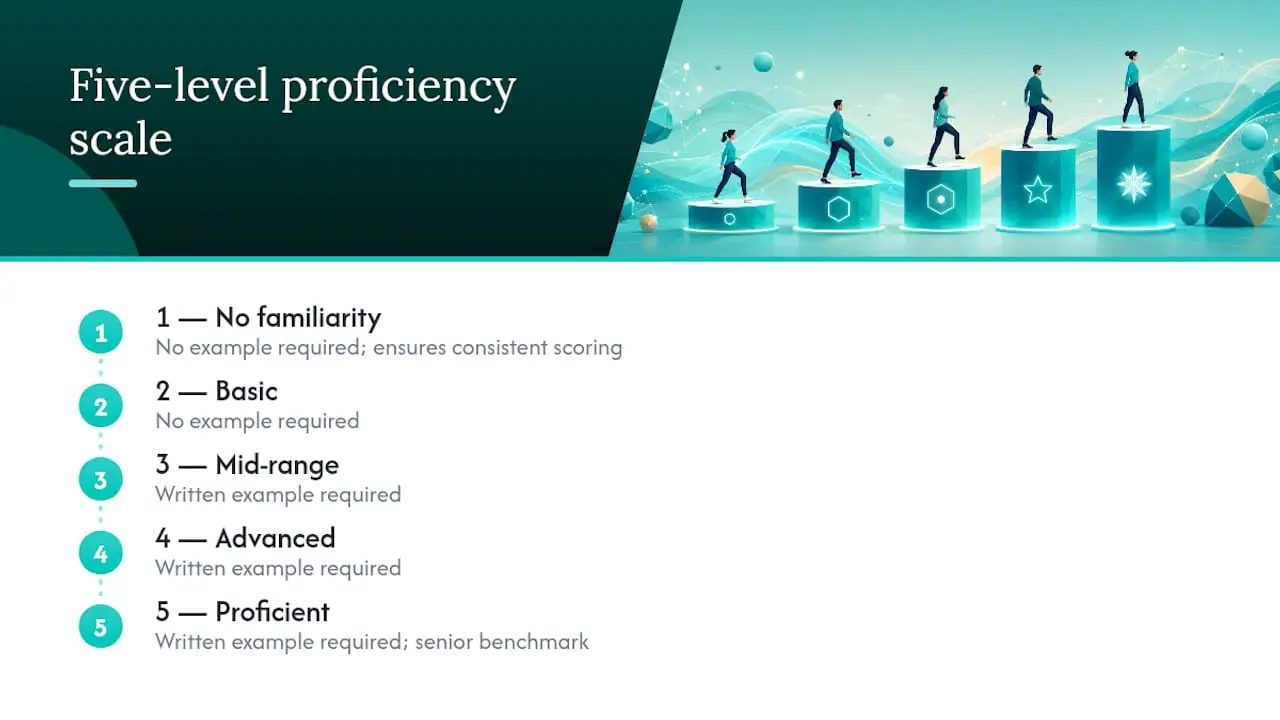
Weight essential capabilities like communication and problem solving as heavily as channel-specific skills, since a brilliant SEO answer paired with muddled reasoning rarely survives a real job. As a rough hiring benchmark, junior roles should clear an average proficiency level in the mid-range, mid-level roles should demonstrate solid competence, and senior roles should show high proficiency, with no individual essential-skill score falling below a moderate level.
Pro Tip: Rebuild your question bank at least once a quarter. Generative AI is reshaping which marketing competencies actually matter, and a test written two years ago may be scoring the wrong skills entirely.
How Do You Build Assessments Into Your Hiring Process?
Bolting a test onto the end of a hiring process rarely works. It needs a place in the funnel and clear rules for what happens at each stage.
- Screening stage: a 10 to 20 minute quiz filters volume. Anyone scoring below a 2.5 average moves no further.
- Scenario stage: candidates who pass screening get one scenario task, reviewed by a hiring manager against the rubric, not by gut feel.
- Interview stage: use the scenario answer as an interview prompt. Ask the candidate to walk through their reasoning.
- Work sample stage: for senior or specialized roles, a take-home brief closes the loop before an offer.
Document who builds each test, who grades it, and require the evidence notes mentioned above. Training hiring managers on how to use assessments consistently prevents the same test from producing wildly different scores across two reviewers. Blind review of written answers, balanced multi-rater scoring for internal moves, and mandatory evidence entries all cut down on bias that creeps into informal hiring. Feed the final scores into both the hiring decision and, for internal candidates, a development plan.
What Do AMA and Forrester Say About Marketing Competency?
The AMA Marketing Team Skills Matrix and the Forrester B2B Marketing Competency Framework both push the same idea from different angles: skills assessment only works when it is structured, evidence-backed, and tied to business goals rather than gut instinct.
A 5-level proficiency scale paired with required evidence for every rating of 3 or higher stops grade inflation before it starts, and it turns a subjective interview impression into something you can actually defend in a hiring decision.
A tool that builds role-specific tests from a job description in minutes mirrors the competency-mapping approach Forrester recommends. Anti-cheat monitoring and AI-generated summaries can handle the evidence-capture and scoring-consistency problem the AMA matrix is designed to solve. Run a validity audit on your question bank every quarter, the same cadence AMA and HBR both point to for staying current.
Where to Find Ready-Made Competency Frameworks
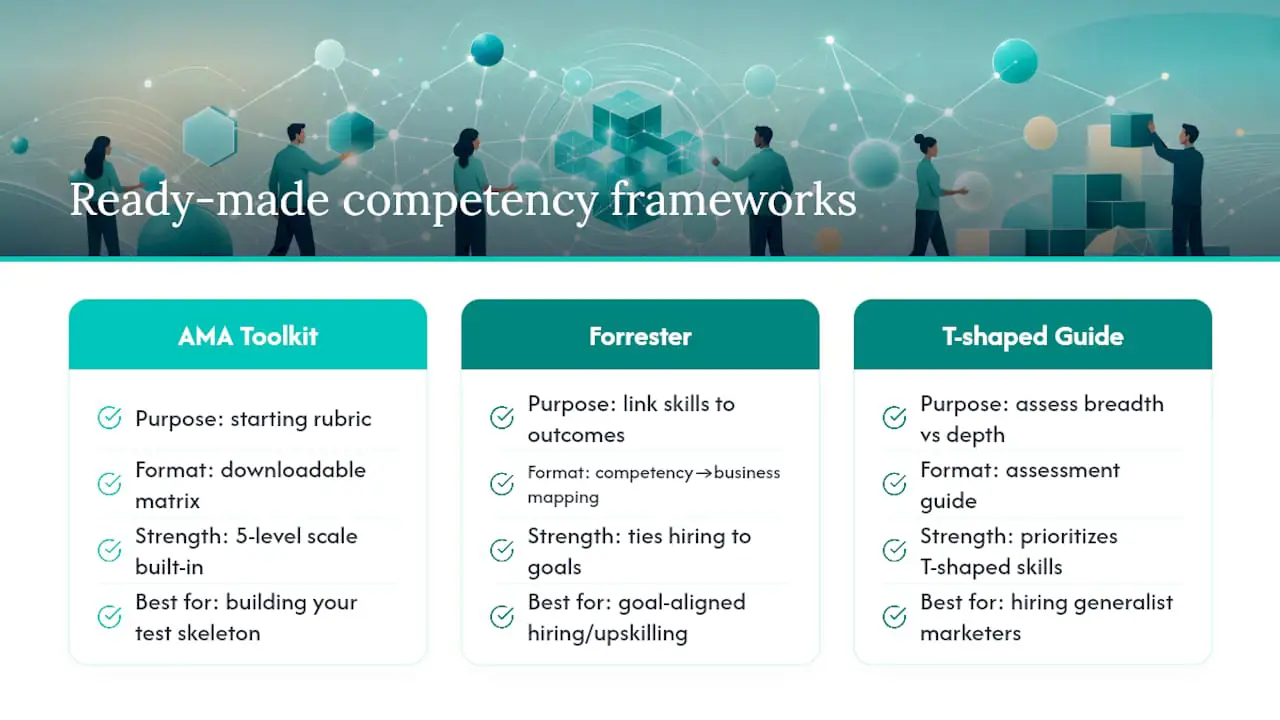
You do not need to build a competency model from scratch. The AMA Marketing Team Skills Matrix Toolkit gives you a structured, downloadable rubric with the 5-level scale already built in, useful as a starting skeleton for your own test.
The Forrester B2B Marketing Competency Framework takes a different angle, mapping competencies directly to business outcomes so hiring and upskilling decisions tie back to actual goals rather than a generic skills checklist. If you’re deciding which skills matter most for a specific opening, a guide on choosing the right skills to test applicants walks through that prioritization directly.
For teams weighing breadth against depth, especially when hiring a generalist marketer who needs to flex across channels, a look at how T-shaped skills get assessed fills in a gap neither framework covers well on its own. None of these tools replace judgment. They give your reviewers a shared vocabulary and a shared scale, which is usually the actual gap in most hiring processes, not a lack of test questions.
A Practitioner’s Take on Reading the Results
Most hiring mistakes come from skipping structure, not from bad questions. When reviewing a work sample, check whether the candidate explains their reasoning, not just their answer. Use assessment scores to sharpen interview questions, never as a replacement for the conversation itself.
— Jimmie
Run a Real Assessment Instead of Guessing From a Resume
Talent Approved turns everything covered above into something you can launch before your next candidate applies. Magic Create takes a job description or a skill list and builds a role-specific test in minutes, already structured around the same evidence-based scoring this guide recommends. Anti-cheat monitoring, including screen and webcam checks, keeps scenario answers honest, and AI-generated summaries turn a stack of scored tests into a bankable shortlist without hours of manual review.
The pricing model is pay per completed candidate, without subscription or long-term commitment, so testing a new role or a full hiring wave costs accordingly. If you’re rebuilding a marketing test from scratch or comparing candidates who all look identical on paper, run Magic Create on your next open role at Talent Approved and see the scored results the same day.
Sources
- AMA Marketing Team Skills Matrix Toolkit
- The Forrester B2B Marketing Competency Framework
- Digital Marketing Institute — Skills Test
FAQ
What Are the Top 5 Marketing Skills to Test?
Strategy, analytics, content, SEO or paid media, and communication consistently matter most, with communication and problem solving cutting across every channel skill.
What Is a Marketing Skills Assessment?
It’s a structured test, usually a scenario-based quiz or short work sample, scored on a proficiency scale to measure a candidate’s or employee’s actual marketing competence rather than resume claims.
What Are Some Examples of Marketing Skills?
Examples include campaign analytics, SEO, email automation, content strategy, paid media budgeting, and AI literacy, each assessed differently depending on the seniority level being tested.
What Are the Best Tools for Marketing Skills Assessment?
Tools range from short benchmarking quizzes like the Digital Marketing Institute’s skills test to full assessment platforms like Talent Approved, which builds role-specific tests with Magic Create and scores them with anti-cheat monitoring built in.
How Often Should You Update a Marketing Skills Test?
Update your question bank at least quarterly. Marketing tools and AI capabilities shift fast enough that a test written a year ago can score outdated skills as if they still matter most.