
6 Validation Checks HR Must Demand from Automated Assessment Feedback

Automated assessment feedback is AI-generated scores, summaries, and reviewer notes produced by a skill-assessment platform to support hiring decisions. It speeds up screening and keeps scoring consistent across large candidate pools, but it only earns your trust when the output rests on validated criteria, gets reviewed by a person, and comes with a clear explanation for both recruiters and candidates.
TL;DR:
- Automated assessment feedback must be validated to ensure scores measure relevant skills and correlate with actual job performance.
- Clear explanations tailored for both managers and candidates are essential, detailing what was assessed, how confident the model is, and where its limits lie.
- Human review remains critical, especially near cutoff scores, with formal procedures and thresholds in place before deployment.
- Vendors should provide recent bias testing results, audit logs, and detailed validation reports to verify the tool’s fairness and accuracy.
- Piloting with detailed documentation and ongoing monitoring helps ensure the assessment system reliably supports hiring without bias or legal risks.
Table of Contents
- Why Automated Assessment Feedback Matters for Hiring Teams
- What Trustworthy Automated Assessment Feedback Must Include
- How to Evaluate a Platform’s Automated Feedback Before You Buy
- Rolling Out Automated Assessment Feedback Without Losing Control
- Templates for Candidate and Reviewer Summaries
- Treating Automated Feedback as Support, Not the Final Word
- How Talent Approved Fits Into a Responsible Rollout
- Sources
- FAQ
Why Automated Assessment Feedback Matters for Hiring Teams
Screening 200 applicants by hand for one role takes days. An automated grading system built into a skill-assessment platform can score and summarize that same pool in hours, which is why most high-volume hiring teams have already adopted some form of it to benefit from the boosting recruitment quality that AI assessment offers. The upside goes beyond speed.
Candidates who wait weeks for a response tend to disengage or accept another offer. Instant feedback tools shorten that gap and give applicants a sense that the process respects their time, which SIOP’s applicant-reactions research ties directly to how fairly candidates rate the entire hiring experience.
The risk sits on the other side of the same coin:
- A score with no explanation behind it tells a hiring manager nothing about whether it reflects a real, job-relevant skill.
- An unvalidated test can reward traits that have nothing to do with performance on the job.
- A model trained without bias checks can quietly disadvantage a protected group, and the employer stays legally responsible even when a third-party vendor built the tool.
Speed without validation is just fast guessing.
What Trustworthy Automated Assessment Feedback Must Include
Before you trust a single score from any assessment feedback software, check it against six criteria drawn from professional and regulatory guidance.
- Validity evidence. The platform should show that its scores measure job-relevant knowledge, skills, abilities, and other characteristics (KSAOs) and correlate with actual job performance. A polished AI-generated summary is not proof of validity on its own.
- Tailored explainability. Hiring managers need action-oriented detail: what was measured, how confident the model is, and where its limits are. Candidates need something plainer: what was assessed and how to raise a concern, a distinction NIST’s framework draws explicitly.
- Human review with defined thresholds. Someone qualified signs off before a rejection goes out, especially near cutoff scores.
- Privacy and disclosure. Candidates should know what data gets collected, how long it’s kept, and who can access it.
- Bias testing and ongoing monitoring. Scores get checked for adverse impact at launch and rechecked on a schedule, not just once.
- Audit trail and version tracking. Every score should trace back to the model version and source responses that produced it.
Pro Tip: Ask any vendor for their most recent adverse-impact test results before you sign, not after your first hiring cycle. If they can’t produce one, that’s your answer.
How to Evaluate a Platform’s Automated Feedback Before You Buy
A structured pilot beats a sales demo every time. Before committing budget, request the following from any assessment feedback software vendor:
- A job-analysis mapping document showing which questions tie to which KSAOs.
- Validation and bias-test reports, not marketing claims about accuracy.
- Sample candidate-facing and reviewer-facing summaries you can actually read.
- Documentation of data retention periods and who at the vendor can access candidate responses.
During the pilot itself, audit a random sample of scored candidates by hand and compare your judgment to the machine’s. Track time-to-feedback, since that number tells you whether the tool is actually saving your team hours or just moving the bottleneck. Read the candidate-facing explanations as if you were the applicant. If they read like a black box, candidates will feel that too.
On the contract side, confirm the vendor can produce audit logs, define who owns the data after the relationship ends, and spell out escalation steps when a candidate disputes a result. Vendor involvement never transfers legal responsibility for outcomes to the vendor. That stays with you.
Pro Tip: Set a human sign-off threshold before the pilot starts, such as automatic manual review for anyone scoring within five points of your cutoff. Deciding this after seeing results invites bias into the decision.
Rolling Out Automated Assessment Feedback Without Losing Control
A responsible rollout follows a sequence, not a single launch date.
- Map the role. Document the KSAOs the job actually requires and pick one or two pilot roles with enough hiring volume to generate meaningful data.
- Set success metrics up front. Decide what “working” looks like: time-to-feedback, reviewer agreement rate, candidate satisfaction, or all three.
- Run the pilot and test for adverse impact. Compare pass rates across demographic groups before you scale to more roles. This is where structured adverse-impact testing earns its keep.
- Build disclosure and correction paths. Candidates need a way to request accommodations or challenge a result before it becomes final.
- Train reviewers and set a revalidation calendar. Reviewers need clear escalation rules, and the whole system needs a recheck scheduled, not left to chance.
Skipping steps to launch faster is exactly how teams end up debugging bias complaints instead of hiring.
Templates for Candidate and Reviewer Summaries
The format of the summary matters almost as much as the score itself. A candidate-facing summary should name the areas assessed, give concrete evidence (“scored in the top quartile on data interpretation questions”), and explain how to request a review. A reviewer-facing summary needs the opposite emphasis: raw scores linked back to specific KSAOs, plus a suggested next action, not just a single composite number.
A few rules keep both documents honest:
- Preserve the raw responses and scoring logic behind every summary so a human can reconstruct the reasoning later.
- Link every claim in the summary to the specific question or task that produced it.
- Never present one score as the final word. Pair it with context a hiring manager can weigh against other evidence, an approach how role-specific tests get built covers in more depth.
Talent Approved’s Magic Create feature builds role-specific assessments directly from a job description, then generates these paired summaries automatically, giving reviewers a starting template rather than a blank page.
Treating Automated Feedback as Support, Not the Final Word
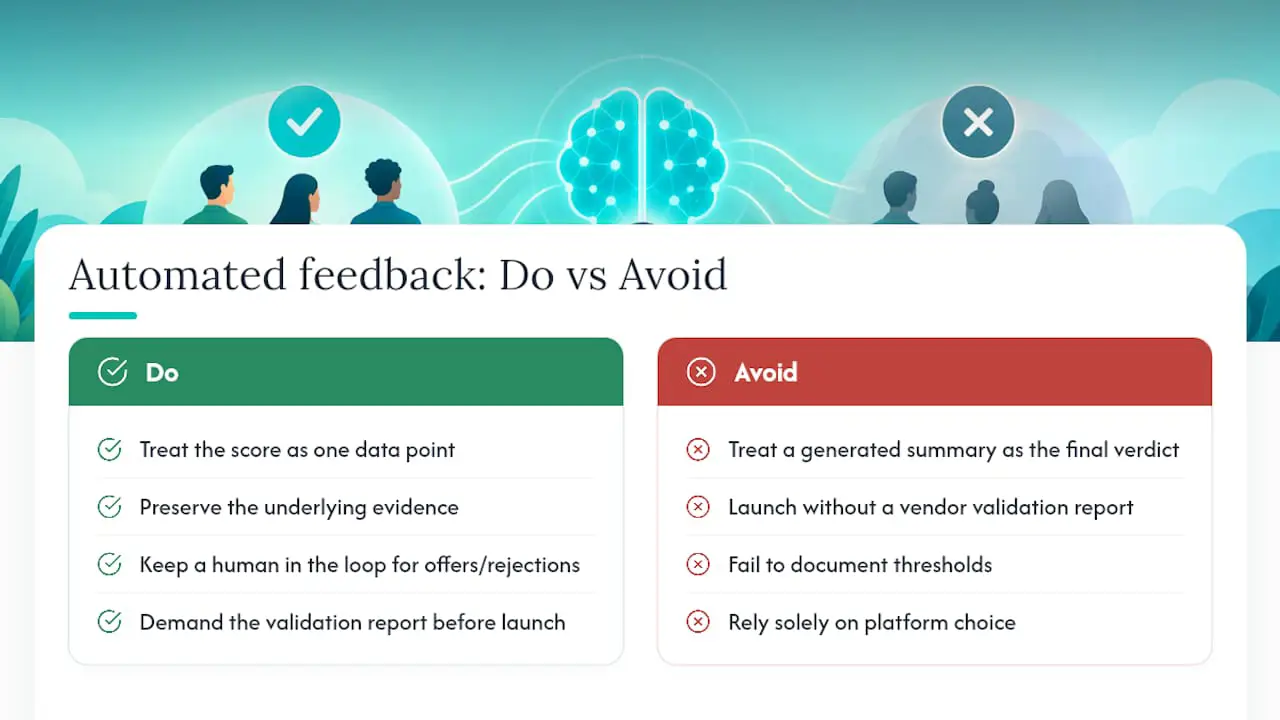
The biggest mistake I see hiring teams make isn’t choosing the wrong platform. It’s forgetting that a generated summary is an input, not a verdict. Treat the score as one data point, preserve the underlying evidence so you can defend the decision later, and keep a human in the loop for anything that touches an offer or a rejection.
Pilots tend to surprise people in the same way: the score distribution looks fine until someone asks for the validation report, and the vendor doesn’t have one ready. Demand it before launch, not after a complaint. Document why you chose the thresholds you did. That paper trail is what protects your hiring decisions months later, when someone inevitably asks why.
— Jimmie
How Talent Approved Fits Into a Responsible Rollout
Talent Approved is built for HR teams who want scoring speed without giving up the oversight this guide walks through. Magic Create turns a job description into a role-specific test in minutes, anti-cheat monitoring and session replays keep evidence intact for later review, and AI-generated summaries pair scores with the context a reviewer actually needs.
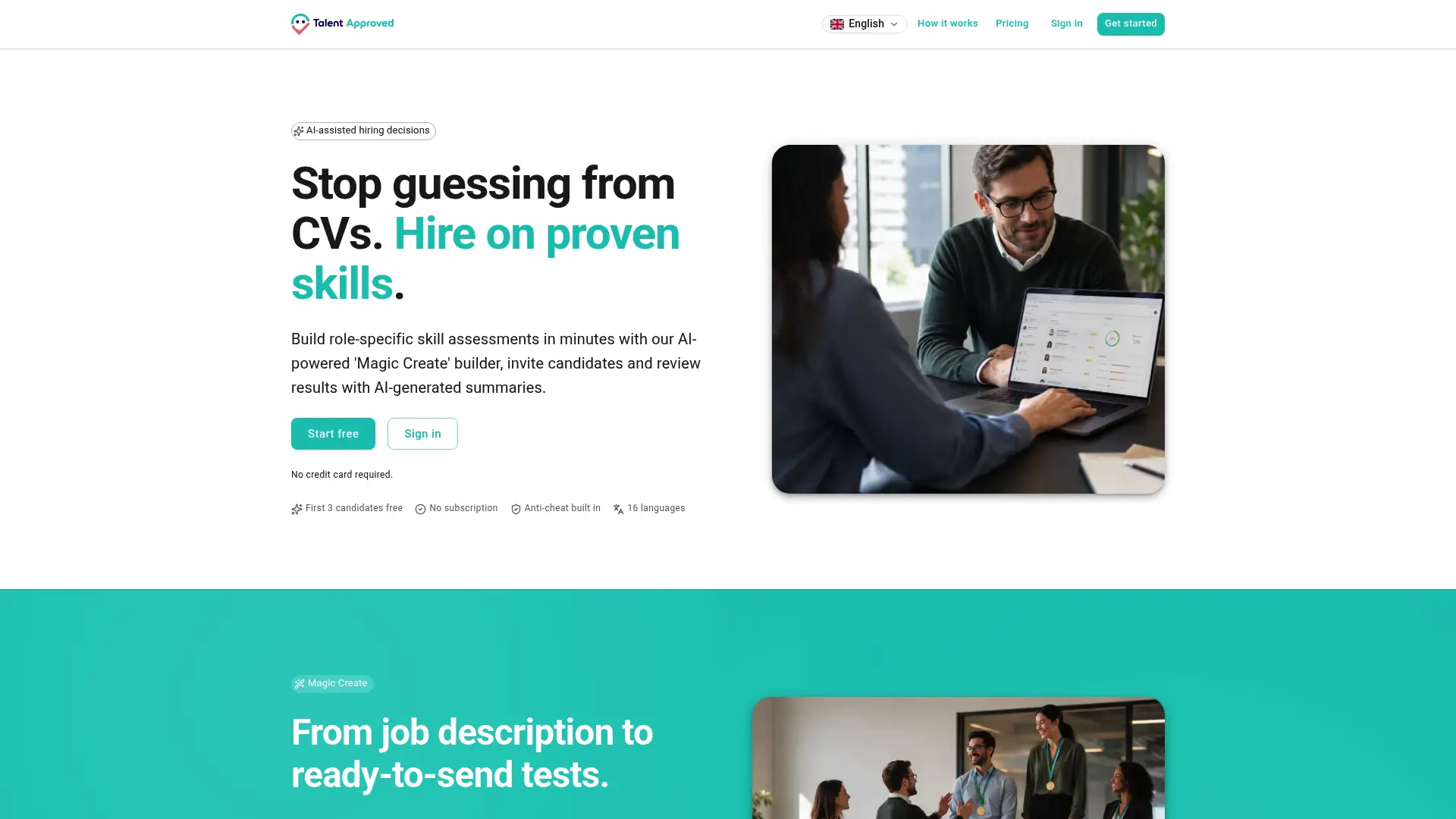
Instead of a subscription, Talent Approved charges $5 per completed candidate assessment, so a small pilot on one or two roles costs almost nothing to test against your own validation checklist. Before rolling it out further, ask for sample summaries and bias-test data the same way this guide recommends asking any vendor. Then visit the pricing page to start a pilot on your next open role.
Sources
- Considerations and Recommendations for the Validation and Use of AI-Based Assessments for Employee Selection (SIOP)
- AI Risk Management Framework (NIST)
- What is the EEOC’s role in AI? (EEOC)
FAQ
What Is Automated Assessment Feedback in Hiring?
It’s the AI-generated scores, summaries, and reviewer notes a skill-assessment platform produces after a candidate completes a test. It supports recruiter decisions but works best alongside human review and documented validity evidence.
Is Automated Assessment Feedback Legally Risky?
It can be, if scores aren’t validated or bias-tested. EEOC guidance confirms employers remain liable for adverse impact even when a vendor builds the tool.
How Much Does Talent Approved Cost?
Talent Approved uses a pay-as-you-go model priced at $5 per completed candidate assessment, with no subscription required.
How Do I Know If a Vendor’s Feedback Is Trustworthy?
Ask for validity evidence tying scores to job-relevant skills, a recent bias-test report, and sample audit logs. If a vendor can’t produce these, the SIOP validation framework says you shouldn’t trust the scores yet.
Should Candidates Be Able to Appeal an Automated Score?
Yes. Giving candidates a way to challenge results and receive timely, informative feedback improves fairness perceptions and is a core recommendation in SIOP’s applicant-reactions research.