
Attention to Detail Jobs: Assessments That Actually Predict It

The strongest predictor of attention-to-detail performance isn’t a personality quiz or a timed pattern-spotting drill. It’s a validated cognitive ability test paired with a role-specific work sample that includes planted errors, backed up by structured behavioral interview questions. Work samples carry a meta-analytic validity of roughly r = .54 for predicting job performance, and the Attention to Detail Test (ADT) offers performance-based evidence that this kind of testing predicts supervisor ratings of detail-oriented tasks. Speed-only tests and self-report questionnaires do not hold up nearly as well.
Here’s the stack we recommend for evaluating attention to detail jobs:
- A validated general mental ability (GMA) test to measure reasoning capacity
- A role-specific work sample with deliberately embedded errors, timed to measure accuracy rather than speed
- Structured behavioral interview probes tied to real incidents, not generic self-assessment questions
Talent Approved’s Magic Create tool builds these role-specific assessments straight from a job description in minutes, and its anti-cheat monitoring plus AI-generated summaries make the review process fast without sacrificing rigor.
Key Takeaways
A validated stack of cognitive ability testing, role-specific work samples with planted errors, and structured behavioral interviews predicts attention-to-detail performance far more reliably than speed tests or self-report questionnaires.
| Point | Details |
|---|---|
| Skip speed-only tests | Processing-speed puzzles measure scanning speed, not real-world error detection on the job. |
| Work samples lead validity | Work samples show meta-analytic validity around r = .54, edging out general cognitive ability tests |
| Score both hit and false alarm rates | A candidate who flags too many non-errors isn’t more careful, just less discriminating. |
| Pilot before you set cutoffs | Test incumbents first to set realistic detection-rate bands instead of guessing at thresholds. |
| Build assessments fast with Talent Approved | Magic Create generates role-specific tests from a job description, with anti-cheat and AI summaries built in. |
Table of Contents
- Why Validated Assessments Matter for Attention to Detail Jobs
- Building an Assessment Stack That Actually Works
- How to Design Role-Specific Work Samples With Planted Errors
- Scoring Systems That Separate Careful Candidates From Lucky Ones
- Rolling Assessments Out Without Losing Fairness or Consistency
- What Recruiters Get Wrong About Attention-to-Detail Hiring
- Try a Role-Specific Pilot With Talent Approved
- Sources
- FAQ
Why Validated Assessments Matter for Attention to Detail Jobs
Recruiters often default to whatever attention-to-detail test shows up first in a Google search, and that’s a costly habit. The research on selection methods is unambiguous: general mental ability predicts job performance at roughly r = .51, and work samples outperform it slightly at r = .54, according to Schmidt and Hunter’s meta-analytic work on selection method validity. Those numbers exist because both methods require candidates to actually reason through a task, not just glance at two images and spot which one looks different.
Understanding matters because most real-world errors aren’t visual, they’re contextual. A billing discrepancy, a mismatched contract clause, or a transposed shipping code requires domain comprehension, not just sharp eyes. That’s precisely where speed-based tests and self-report tools fall apart:
- Speed tests measure how fast someone scans, which practitioners note is a different skill from detecting a substantive error under realistic time pressure
- Self-report questionnaires (“Are you detail-oriented?”) invite social-desirability bias and correlate poorly with actual job behavior
- Generic pattern-matching puzzles rarely resemble the actual content candidates will handle on the job
Building an Assessment Stack That Actually Works
No single test captures attention to detail on its own. Each component in a strong stack measures something the others miss, and skipping one leaves a gap in your prediction.
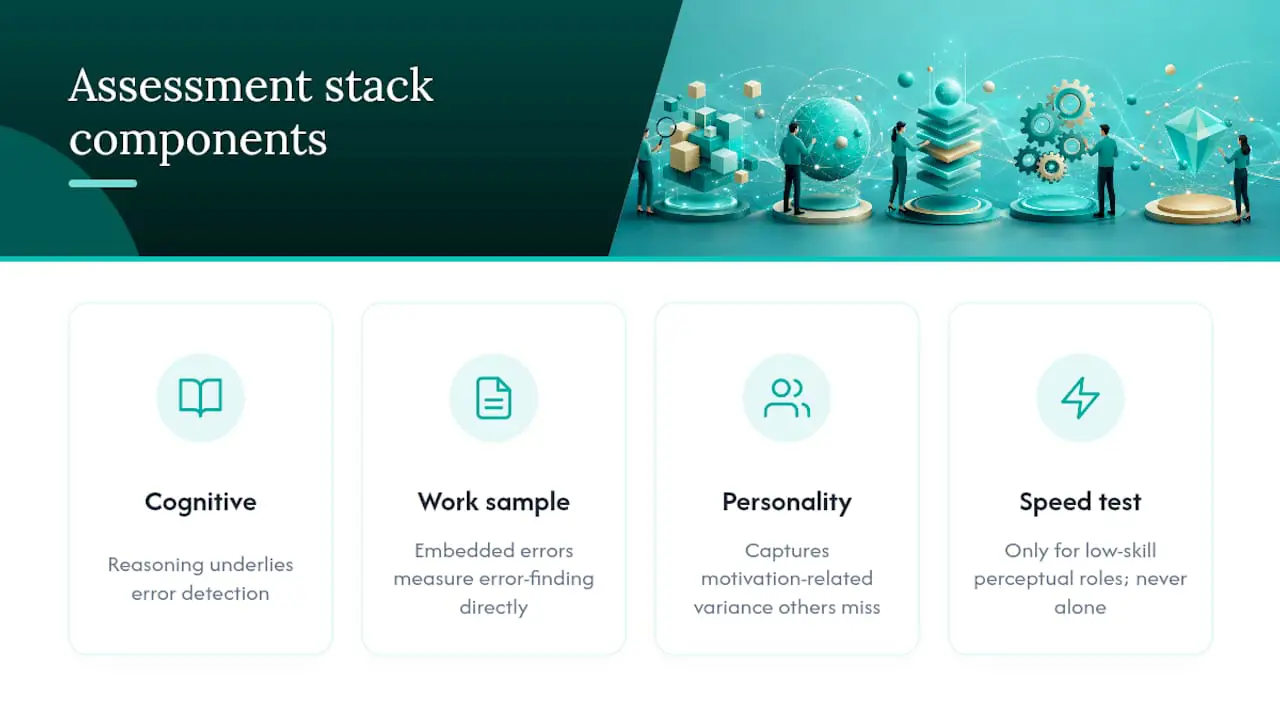
Cognitive ability testing comes first because reasoning underlies error detection. A candidate who can hold multiple data points in working memory while comparing them against a rule set will outperform one who is simply scanning for visual mismatches. Cognitive scores also strengthen the validity of whatever work sample follows, since candidates need baseline reasoning capacity to interpret instructions correctly.
Work samples with embedded errors carry the highest ecological validity of any method here, because they measure the target behavior directly instead of a proxy for it. A financial analyst candidate reviewing a spreadsheet with three planted formula errors tells you far more than an abstract puzzle ever could.
Conscientiousness or personality measures add a smaller but real layer, capturing motivation-related variance that cognitive and work-sample tests don’t fully explain. A narrow speed test is only defensible for low-skill perceptual roles like basic sorting or inspection line work, and even there it should never stand alone.
Pro Tip: Pair every cognitive or work-sample score with one structured behavioral question, such as “Tell me about a time you caught an error someone else missed.” It surfaces real incidents you can verify, unlike a self-rated scale.
How to Design Role-Specific Work Samples With Planted Errors
Building a work sample that actually predicts performance takes more than dropping typos into a document. Follow this sequence:
- Run a job analysis first. Identify the three to five tasks where errors carry the highest cost, and classify the common failure types: omission, transposition, substitution, or rule violation.
- Match the stimulus format to daily work. A finance role needs a spreadsheet with formula errors; a logistics role needs a shipping manifest; a legal-adjacent role needs a contract with altered clauses.
- Embed a deliberate mix of error types, not a single repeated pattern. Candidates who see only one kind of error can pattern-match their way to a high score without demonstrating real attentiveness.
- Set generous time limits. The goal is measuring accuracy, not speed, so give candidates enough time to complete a careful review rather than a rushed skim.
- Pilot with current incumbents before rolling the test out to candidates, and use their scores to set realistic detection-rate targets and estimate false alarm rates.
- Randomize item order and rotate multiple stimulus versions to cut down on memorization and answer-sharing between candidates.
A few design habits separate a strong work sample from a weak one:
- Match planted errors to the role’s actual failure modes rather than generic “spot the difference” items
- Keep instructions unambiguous. Confusing instructions inflate false alarm rates for reasons that have nothing to do with attentiveness
- Retire or rework items that every pilot participant gets either perfectly right or completely wrong. Neither extreme discriminates between candidates
Our guide to designing job-specific screening tests walks through this process with more examples, and our framework for choosing which skills to test helps you narrow down which error types matter most for a given role.
Scoring Systems That Separate Careful Candidates From Lucky Ones
Raw accuracy alone hides too much. A candidate who catches 9 of 10 planted errors but flags 15 non-errors as problems isn’t actually more careful than one who catches 7 out of 10 and flags none. This is exactly why a signal-detection lens matters: report both the detection rate (errors correctly identified) and the false alarm rate (non-errors incorrectly flagged) for every candidate, a practice supported by both academic and practitioner sources on attention-to-detail measurement.

A simple composite score can combine these into one number recruiters can act on. One workable formula: Composite Detail Score = 0.70 × accuracy + 0.30 × instruction fidelity, weighting raw accuracy higher while still rewarding candidates who follow task instructions precisely.
From there, convert composite scores into bands drawn from your own pilot data, not borrowed benchmarks:
| Band | Composite Score Range | Recommended Action |
|---|---|---|
| Hire | Top pilot quartile | Advance directly to final interview |
| Borderline | Mid-range, pilot-derived | Add a structured behavioral interview probe |
| Develop | Bottom pilot quartile | Screen out or route to a different role tier |
Suggested starting points and timing for common roles, including 10 to 25-minute work samples with 80 to 90 percent accuracy thresholds for accounting and QA roles, give you a reasonable baseline before your own pilot data replaces it. Present results to hiring managers in plain language: a band label plus two or three sample interview questions tied to the candidate’s specific error pattern.
Rolling Assessments Out Without Losing Fairness or Consistency
Consistency across candidates isn’t a nice-to-have, it’s what makes your scores comparable at all. Every candidate needs identical instructions, identical time allowances, and a comparable testing environment, with documented accommodation procedures for candidates who need them.
Anti-cheat measures come with real trade-offs worth weighing before you pick one:
- Browser lockdown prevents tab-switching but adds friction for candidates on older devices
- Session replay and webcam checks catch collaboration attempts but raise privacy considerations that need clear disclosure
- Randomized item versions reduce answer-sharing without requiring any monitoring at all
On the integration side, AI-generated summaries help reviewers triage large candidate pools quickly, but a human should always make the final call, especially on borderline scores. Run an adverse-impact analysis on your pilot data before full rollout, and keep documentation of your validation process on file. It’s the difference between a defensible hiring practice and one that collapses under a legal challenge.
Pro Tip: Keep a written record of every pilot cutoff decision and who approved it. If a hiring decision is ever questioned, that paper trail is what protects you.
What Recruiters Get Wrong About Attention-to-Detail Hiring
Most hiring teams treat attention to detail like a personality trait you can ask about directly. It isn’t, and treating it that way is why so many “detail-oriented” hires disappoint within the first ninety days. The honest answer buried in the validity research is that attention to detail is a demonstrated behavior under realistic task conditions, not a self-reported quality, and the only reliable way to measure a behavior is to observe it.
The conventional advice, “add a few spot-the-difference puzzles to your screening process,” actively works against good hiring. Those puzzles measure visual processing speed, a real but narrow skill that has little to do with catching a misapplied discount code or a mismatched patient record. Recruiters who lean on them end up selecting for fast scanners, not careful reasoners.
If you take one thing from this: prioritize building a work sample before you buy any off-the-shelf test. A generic assessment can’t know that your billing errors look different from your competitor’s. Job-specific error patterns are the entire point, and skipping that step undermines everything else in the stack.
— Jimmie
Try a Role-Specific Pilot With Talent Approved
Building this stack from scratch used to mean weeks of item-writing and a validation consultant on retainer. Talent Approved cuts that down to an afternoon, which matters most for recruiting teams that need a role-specific assessment live before the next requisition closes, not next quarter.
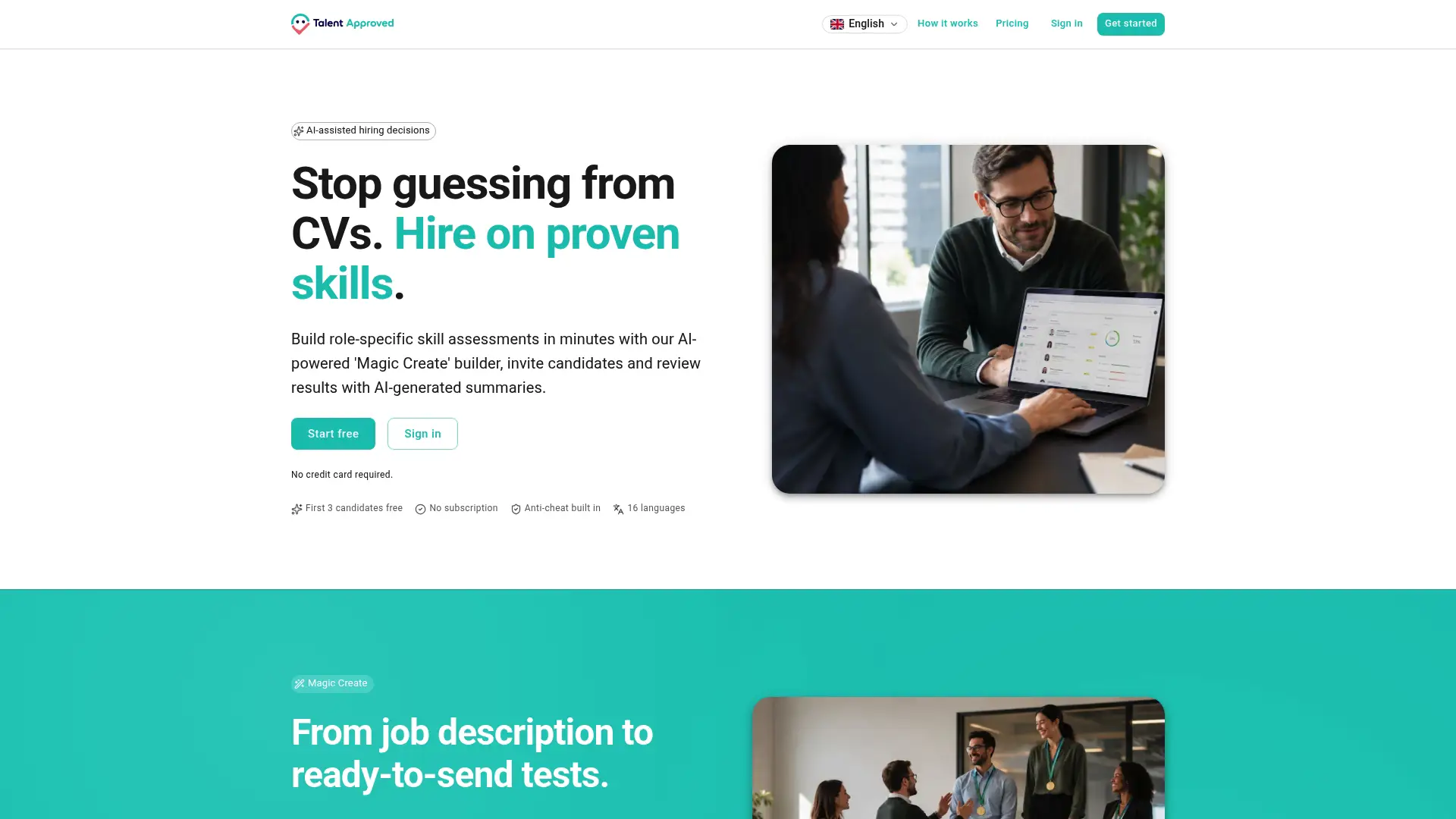
Here’s a workable pilot sequence using the platform. First, feed your job description into Magic Create and let it generate a first-draft assessment matched to the role. Second, review the draft and embed the specific error types your job analysis flagged, whether that’s transposition errors in a data-entry role or rule violations in a compliance checklist. Third, turn on the built-in anti-cheat monitoring and AI-generated summaries so your review team can triage results fast while keeping a full audit trail. Fourth, run the assessment with 10 to 30 incumbents before opening it to candidates, using their scores to set your hire, borderline, and develop bands.
For templates and design checklists as you build, our guides on administrative work-sample design and piloting assessments across an ATS workflow cover both in more depth. If you want structured follow-up questions once scores come in, NueCareer’s behavioral interview question generator is a solid companion tool.
Ready to see it in action? Start building your first assessment and have a pilot-ready test within the hour.
Sources
FAQ
What Skills Should an Attention-to-Detail Assessment Measure?
It should measure error detection under realistic task conditions, not visual scanning speed. The strongest assessments combine a validated cognitive ability test with a role-specific work sample containing planted errors like omissions, transpositions, or rule violations.
Are Self-Report Attention-to-Detail Questions Reliable?
No. Self-report questions like “Are you detail-oriented?” invite social-desirability bias and correlate poorly with actual on-the-job accuracy, which is why performance-based work samples remain the stronger choice.
How Long Should a Work-Sample Test Take?
Most role-specific work samples run 10 to 25 minutes, long enough for candidates to complete a careful review without turning the exercise into a speed test.
Can Talent Approved Build a Role-Specific Attention-to-Detail Test?
Yes. Talent Approved’s Magic Create tool generates a tailored assessment directly from a job description, and built-in anti-cheat monitoring plus AI-generated summaries support fast, defensible review.
What Is a Good Starting Accuracy Benchmark?
Many QA and accounting roles start pilot benchmarks around 80 to 90 percent accuracy, though the right threshold for your organization should come from piloting the test with your own incumbents first.