Three Legal Checks U.S. HR Needs Before Using Webcam Proctoring

Webcam proctoring for pre-employment skills tests is not automatically illegal, but it is far from unregulated. Federal law filters it through the EEOC’s rules on testing, the ADA’s accommodation mandate, and the FTC’s expectations around biometric data and privacy. The assessment workflow can be built around those three pressure points. The immediate next step for any HR team: validate the test itself, then put a documented accommodation and candidate-notice process in place before the first invite goes out.
TL;DR:
- Validating the test itself through content validation and tracking demographic impact helps minimize legal risks associated with bias or disparate impact.
- Employers must provide clear, documented accommodation processes for candidates with disabilities, including timely responses and multiple options.
- Webcam proctoring involves biometric data collection that requires compliance with privacy laws like BIPA, with strict retention and consent procedures.
- Recordkeeping should include test instruments, impact analyses, accommodation requests, and vendor data practices, retained for at least a year or longer if needed.
- Using AI-powered platforms can streamline compliance by generating role-specific assessments and supporting structured scoring and privacy best practices.
Table of Contents
- Does Webcam Proctoring Comply With Federal Employment Law?
- What Does the ADA Require for Webcam-Based Skills Tests?
- Privacy and Biometric Data: What the FTC Expects
- An Action Plan for Rolling Out Webcam-Proctored Assessments
- What Records Should HR Keep, and for How Long?
- Why Compliance Design Beats Compliance Paperwork
- A Compliance-Ready Way to Run Skills Tests
- Sources
- FAQ
Does Webcam Proctoring Comply With Federal Employment Law?
The EEOC does not single out webcam proctoring as a category. It treats any pre-employment skills test, proctored or not, as a “selection procedure” subject to Title VII. That means the test has to be job-related and consistent with business necessity, and it cannot produce a disparate impact on a protected group without solid justification.
This is where the Uniform Guidelines on Employee Selection Procedures (UGESP) come in. UGESP gives employers three validation paths: content validation, where you show each test item maps to a real job task; criterion-related validation, where you tie test scores to actual job performance data over time; and construct validation, used less often, which measures an underlying trait like reasoning ability. Most HR teams start with content validation because it does not require years of outcome data to defend.
The disparate impact risk with webcam proctoring specifically comes from what a reviewer sees, not just what the test measures. EEOC informal guidance has flagged that viewing video of applicants can introduce bias tied to appearance, accent, home environment, or disability, none of which belong in a hiring decision. A short internal checklist keeps this in check:
- Write down exactly which job skills the test measures and how each question ties back to a task in the role.
- Score responses against a rubric, not a general impression of the candidate.
- Route every test through more than one reviewer before a rejection decision is final.
- Track pass rates by demographic group at least quarterly to catch adverse impact early.
Statistic to know: UGESP has governed federal selection-procedure validation since the late 1970s, and it remains the enforcement backbone the EEOC applies to any modern hiring tool, video-based or not. Read the full framework in Talent Approved’s EEOC testing guidelines.
What Does the ADA Require for Webcam-Based Skills Tests?
The ADA requires employers to provide reasonable accommodations to applicants with disabilities unless doing so creates an undue hardship. For webcam proctoring, that duty shows up in very practical ways: a candidate with an anxiety disorder may need a human-monitored session instead of continuous AI facial tracking, a candidate with a visual impairment may need a screen-reader-compatible test format, and a candidate with limited home internet access may need extended time or a different testing location.
A workable accommodation process looks like this:
- State plainly in the test invitation that accommodations are available on request.
- Give candidates a simple way to ask, such as a reply email or a form field, with no burden of proving disability upfront.
- Offer real alternatives: phone interview, extended time, alternate format, or a proctor swap from AI to human review.
- Document the request, the accommodation given, and the reasoning, in writing, every time.
- Respond fast. The EEOC’s guidance on reasonable accommodation expects timely handling, and delay itself can become the basis for a complaint.
Pro Tip: Build the accommodation request field directly into your applicant tracking system instead of routing it through a separate inbox. Requests get missed far less often when they live inside the same workflow as the test invite.
Privacy and Biometric Data: What the FTC Expects
Webcam proctoring almost always touches biometric data, whether that is facial geometry for identity checks or behavioral signals like eye movement and typing rhythm. The FTC has made clear it is watching this space. Its policy statement on biometric information warns that unsubstantiated claims about a tool’s accuracy, “our AI detects cheating with near-perfect precision,” for example, can violate Section 5 of the FTC Act if the employer or vendor cannot back that claim up.

The agency’s May 2023 press release lists specific practices it wants businesses to follow: assess foreseeable harms before deploying biometric tools, never collect data surreptitiously, and vet third-party vendors handling that data. Several states layer their own biometric statutes on top of this, most notably Illinois’s Biometric Information Privacy Act (BIPA), which requires written consent before capturing biometric identifiers and sets strict retention limits.
A short privacy checklist for webcam proctoring compliance before launch:
- Disclose in plain language what is recorded (video, audio, keystrokes) and why.
- Capture affirmative consent, not a buried checkbox in terms of service.
- Retain recordings only as long as needed for scoring and dispute resolution.
- Confirm the vendor encrypts data in transit and at rest.
- Set a deletion policy and actually follow it.
Statistic to know: BIPA allows statutory damages of $1,000 to $5,000 per violation depending on whether the violation is negligent or intentional, which is why Illinois-based hiring pulls extra scrutiny. Talent Approved’s privacy checklist for online proctoring walks through how DPIA, CCPA, and BIPA obligations map onto a typical assessment workflow.
An Action Plan for Rolling Out Webcam-Proctored Assessments
Compliance here is not a one-time review, it is a sequence. Break it into three phases.
Before the test:
- Document a job analysis that names the specific skills the role requires.
- Select or build tasks that mirror real job activities, not generic trivia.
- Vet the proctoring vendor’s data practices, including a data protection impact assessment.
- Draft the candidate notice and consent language before the first invite goes out.
During the test: 5. Use standardized prompts for every candidate; do not improvise questions live. 6. Score with a blinded, multi-reviewer process where possible. 7. Store recordings behind access controls limited to people involved in the hiring decision.
After the test: 8. Run an adverse-impact check across demographic groups on a regular cadence. 9. Keep validation records on file, not just pass/fail results. 10. Respond to any accommodation request or complaint within days, not weeks.
Pro Tip: Treat the NYC Local Law 144 framework, bias audits plus advance candidate notice, as a national best practice even if you never hire in New York City. It is the clearest procedural template regulators have published so far. Talent Approved’s guide to how instant assessments work covers anti-cheat mechanics that support this workflow.
What Records Should HR Keep, and for How Long?
An audit-ready file is the difference between a five-minute response to an EEOC inquiry and a scramble through old email threads. Keep test instruments and scoring rubrics, demographic impact analyses run at regular intervals, every accommodation request with its outcome, and vendor documentation covering data handling and validation methodology.
EEOC recordkeeping guidance under UGESP and Title VII expects employers to retain application and hiring records long enough to support an impact analysis if a complaint arises, generally treated as at least one year past the employment action, though longer retention is common practice for defensibility.
Validation itself does not have to start complicated. Content validation, mapping each test item to a specific job task, is the fastest entry point and works for most skills assessments. Criterion-related validation, tying scores to actual on-the-job performance, becomes possible once enough hiring outcome data accumulates.
| Record type | Keep it because | Typical retention |
|---|---|---|
| Test instrument and rubric | Proves job-relatedness under UGESP | Life of the test version |
| Demographic impact analysis | Shows disparate-impact monitoring | Ongoing, reviewed quarterly |
| Accommodation requests and outcomes | Documents ADA compliance | Life of the applicant file |
| Vendor data-handling documentation | Supports FTC and state biometric compliance | Length of vendor relationship |
For a deeper walkthrough of running the impact analysis itself, see Talent Approved’s adverse impact testing playbook.
Why Compliance Design Beats Compliance Paperwork
Most employers treat webcam proctoring compliance as a paperwork problem: get a policy signed, file a disclosure, move on. That misses the actual risk. The EEOC’s own informal letters point to the real failure mode, a human reviewer watching video and forming an impression of a candidate that has nothing to do with the skill being tested. No consent form fixes that. Only structure does: blinded scoring, multiple reviewers, and prompts tied tightly to job tasks.
This is why assessments can be built around structured, role-specific tasks generated through an AI feature rather than open-ended video interviews. Anti-cheat monitoring can flag irregularities without turning the reviewer into a judge of the candidate’s face or home. AI-generated summaries help keep scoring focused on what the candidate actually produced, and privacy postures can align with DPIA, CCPA, and BIPA expectations rather than treating them as an afterthought. Multi-reviewer scoring on role-tied prompts is the mechanism that keeps a webcam-proctored test defensible under UGESP. If you want the fuller privacy mechanics, the checklist above walks through it in more detail.
— Jimmie
A Compliance-Ready Way to Run Skills Tests
There are platforms that give HR teams a way to run webcam-proctored skills tests without building a compliance program from scratch. Instead of assembling job-related tasks by hand and hoping the scoring holds up under scrutiny, AI-powered tools can build role-specific assessments from job descriptions in minutes, with anti-cheat monitoring and AI-generated summaries built into the workflow.
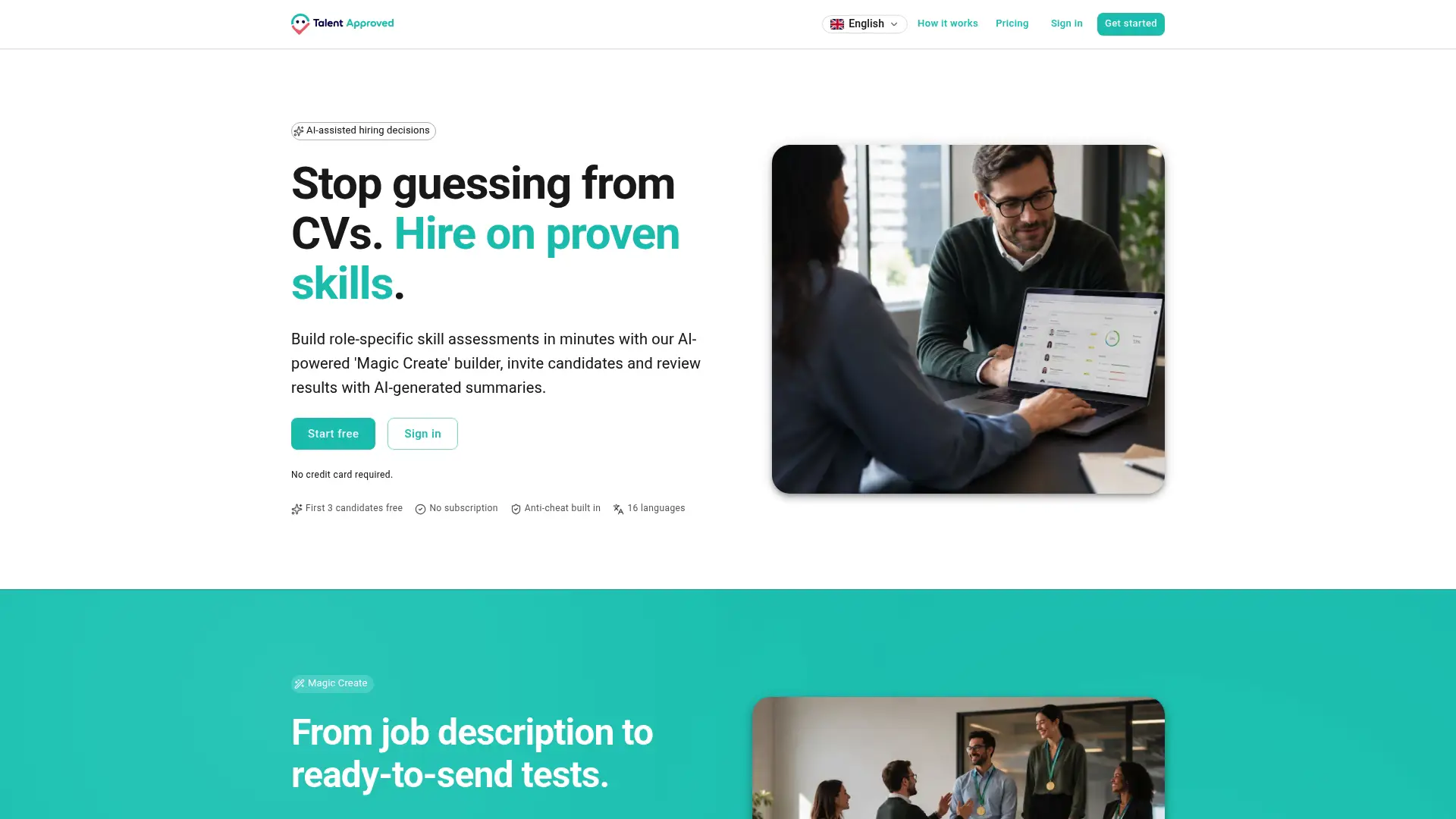
Pricing runs on a pay-as-you-go model at $5 per candidate who completes an assessment, with no subscription commitment sitting on top of it. That structure fits hiring volume that swings month to month, which is most hiring. Before your next round of skills testing, review the privacy checklist above, then visit the pricing and skill assessments page to see how the workflow maps to your own accommodation and recordkeeping needs.
Sources
- Employment tests and selection procedures | U.S. Equal Employment Opportunity Commission
- Policy statement of the FTC on biometric information and Section 5 of the FTC Act
- Automated employment decision tools: Frequently Asked Questions (NYC Local Law 144)
FAQ
Is Webcam Proctoring Legal for U.S. Employers?
Yes, webcam proctoring is legal for pre-employment skills tests, but it must meet EEOC nondiscrimination standards, ADA accommodation requirements, and applicable state biometric privacy laws. There is no blanket federal ban, but the EEOC treats it as a selection procedure subject to validation and disparate-impact review.
Does the ADA Require Alternatives to Webcam Testing?
Yes. Employers must offer reasonable accommodations, such as phone interviews, extended time, or human-monitored sessions, to candidates who request one, unless it creates undue hardship. The EEOC’s ADA guidance expects a timely, documented response to every request.
Do State Biometric Laws Apply to Hiring Assessments?
They can. Illinois’s BIPA requires written consent before collecting facial or behavioral biometric data and sets damages for violations, so employers hiring Illinois-based candidates need explicit consent language and clear retention limits.
How Does Talent Approved Handle Compliance Risk?
Talent Approved uses structured, role-specific test prompts generated through Magic Create, multi-reviewer scoring support, and anti-cheat monitoring designed around DPIA, CCPA, and BIPA-aligned privacy practices. Pricing runs at $5 per completed candidate with no subscription required.
What Records Should Employers Keep After a Webcam-Proctored Test?
Keep the test instrument, scoring rubric, demographic impact analysis, and every accommodation request with its outcome. EEOC recordkeeping expectations under UGESP call for retaining these long enough to support an impact analysis if a complaint arises.