
Avoid 40–60% Hidden Costs: Skills Assessment Pricing Playbook for HR

Most skills-assessment platforms price around $8 per completed candidate, with per-completed-candidate billing offering the most predictable budgeting for steady-volume hiring. That per-unit number tells you almost nothing on its own, though, because vendors define “completed” differently, and first-year costs typically run 1.4 to 1.6 times the listed fee once you add implementation and content work. Get the definition in writing before you calculate anything else.
TL;DR:
- Clarify in writing how vendors define a “completed” assessment, as different interpretations can significantly impact actual costs, especially for small hiring teams.
- Custom content, proctoring, integrations, and reviewer labor often cost more than the platform fee itself, making the true expense higher than the advertised per-candidate rate.
- Match your chosen pricing model to your hiring rhythm; pay-as-you-go models suit variable volumes, while subscriptions work better for steady, predictable hiring needs.
- Always negotiate contract terms, including assessment definitions, overage rates, and data ownership, to prevent unexpected costs and ensure clarity in billing.
Table of Contents
- Understanding Skills Assessment Pricing Models
- What Actually Drives Your Total Assessment Cost
- How Do You Calculate Your Real Assessment Cost?
- Contract Terms That Protect Your Budget
- Typical Payment Terms and Billing Cycles
- Comparing Pricing Models by Vendor Size and Market
- What Pricing Approaches Look Like in Practice
- Is the Price You’re Being Quoted Actually Fair?
- Choosing the Right Pricing Approach for Your Hiring Cadence
- Why Talent Approved Prices Per Completed Assessment
- Sources
- FAQ
Understanding Skills Assessment Pricing Models
Five pricing structures cover nearly every vendor on the market, and picking the wrong one for your hiring volume is the single most common budgeting mistake HR teams make.
- Per-completed-candidate: You pay only when a candidate finishes the test. This is the most common structure for teams with steady but moderate volume, and it keeps costs tied directly to hiring activity instead of headcount or seats.
- Per-assessment credit: You buy a bundle of credits upfront (say, 500 tests) and draw down from that pool. It suits teams that want to lock in a rate but don’t hire on a predictable schedule.
- Subscription (flat monthly/annual fee): You pay a set fee regardless of usage, often with a usage cap. This works best for high-volume recruiting where the flat rate beats the sum of per-unit charges.
- Seat-based: Pricing scales with the number of recruiters or hiring managers using the platform, not with candidate volume. It fits teams running many small hiring loops across departments.
- Enterprise tier: Custom pricing bundled with dedicated support, integrations, and volume discounts, typically for organizations screening thousands of candidates a year.
The detail that trips up more buyers than any pricing tier itself is how a vendor counts a “completed” test. Some charge per candidate invited, whether or not the person ever opens the assessment. A small hiring team running 20 assessments a month can see its effective cost swing by hundreds of dollars depending on which definition the contract uses. Get this in writing before you sign anything, not after your first invoice looks wrong.
What Actually Drives Your Total Assessment Cost
The advertised per-candidate rate is the smallest line item in most first-year budgets. Custom content, proctoring, integrations, and reviewer time usually cost more combined than the base platform fee.
- Custom content development. Building role-specific tests from scratch, rather than using template libraries, often carries a one-time fee per role or skill category. Reusable question libraries cut this cost substantially for teams hiring the same roles repeatedly.
- Proctoring and anti-cheat monitoring. Screen and webcam monitoring, plus session replays, sometimes bill separately from the base assessment fee, either per session or per hour of review footage stored.
- Integrations. Connecting the assessment platform to your applicant tracking system frequently carries setup fees, and some vendors charge ongoing API access fees on top of that.
- Reviewer labor. Someone has to read results, watch flagged sessions, and make a call, a process improved by insights on how AI reduces reviewer time and improves hiring efficiency in HR teams like those discussed in this AI in hiring efficiency guide. If your team spends 15 minutes per candidate manually reviewing scores, that’s real payroll cost hiding outside the vendor invoice, even though it never appears on the bill.
- Implementation and onboarding. Initial setup, template configuration, and training time add a fixed cost in month one that easily gets missed in month-to-month comparisons.
When a vendor pitches “all-inclusive” pricing, ask them to define exactly what’s included in writing, especially proctoring hours and integration scope. Clarify whether proctoring fees apply per session or per hour, and whether session replays come standard or cost extra. These are exactly the line items that surface as disputes six months into a contract.
Pro Tip: Ask for a sample invoice from an existing customer at your approximate volume, not just a rate card. Rate cards hide the add-ons; invoices don’t.
How Do You Calculate Your Real Assessment Cost?
Run this formula before comparing any two vendors head to head:
Monthly cost = (completed candidates × unit price) + implementation (amortized) + custom content + integrations + reviewer labor
First-year TCO ≈ monthly cost × 12 × 1.4 to 1.6
That multiplier range comes from pricing benchmark research tracking how implementation, integration, and early content costs stack on top of the listed platform fee. Here’s what that looks like at two different volumes.
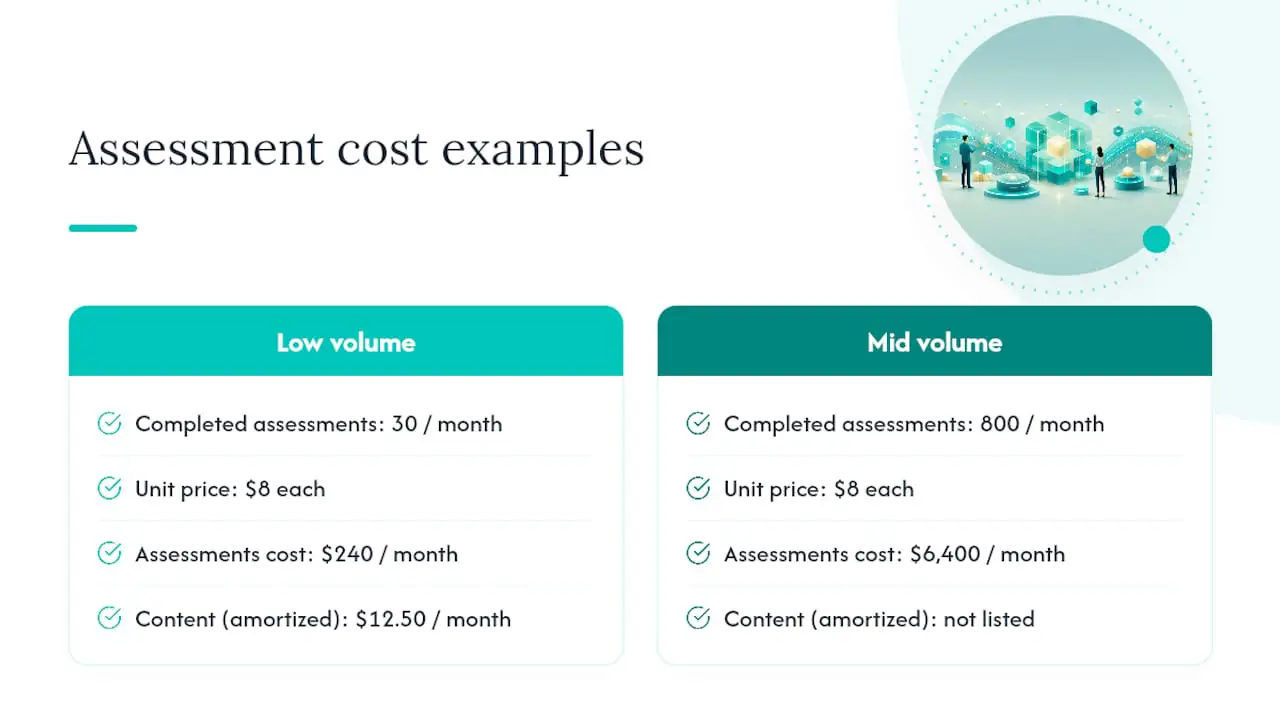
Example A: Low-volume, pay-as-you-go. A 20-person company hiring for one open role runs 30 completed assessments a month at $8 each: $240. Add a modest one-time content setup fee of $150, amortized at $12.50 a month over a year, and no integration cost since they’re not connecting an ATS yet. Monthly cost lands around $253. Estimate first-year total cost by applying the typical multiplier for implementation and other fees.
Example B: Mid-volume, subscription or enterprise threshold. A regional retailer hiring seasonal staff runs 800 completed assessments a month. At $8 per unit, pay-as-you-go pricing would hit $6,400 monthly, which is exactly the volume where most vendors push buyers toward a flat subscription or enterprise tier instead. A negotiated flat rate, plus integration and reviewer labor costs, brings monthly cost to several thousand dollars. First-year total costs multiply accordingly.
Before plugging your own numbers in, confirm exactly how the vendor counts a “completed” assessment.
Contract Terms That Protect Your Budget
A pricing model only stays predictable if the contract defines it precisely. Before signing, nail down the following:
- Billable unit definition: Exactly what counts as a completed assessment, in writing, not verbally confirmed by a sales rep.
- Proof of completion: How the vendor documents and reports which candidates triggered a charge, so your invoices are auditable.
- Overage rates: What happens, and what you pay, if you exceed a credit pool or subscription cap mid cycle.
- Pilot credits and conversion terms: How trial credits convert to paid usage, and whether pilot volume counts toward future volume discounts.
- Data ownership and retention: Who owns candidate response data and session recordings after the contract ends.
- Anti-cheat SLA: Clear service commitments on proctoring uptime and flagged-session turnaround time.
Negotiate a cap on overage rates before you need one, and ask for trial credits that convert cleanly into your first paid tier. Red flags worth walking away from: vendors that won’t put the completion definition in writing, mandatory add-ons bundled into “starter” packages, and implementation quotes that arrive only after you’ve signed the main contract.
Typical Payment Terms and Billing Cycles
Most skills-assessment vendors bill monthly, in arrears, based on actual completed assessments during that period. That structure fits pay-as-you-go pricing naturally, since you’re charged for verified usage rather than a forecast.
Subscription and enterprise tiers more often bill annually or quarterly upfront, sometimes with a discount for committing to a full year. That upfront structure gives the vendor predictable revenue and gives you a lower effective rate, but it removes the flexibility to scale down if hiring slows.
Credit-based pricing sits in between: you pay upfront for a block of credits, then draw down against that balance with no recurring invoice until you need to top up. Ask whether unused credits expire, and if so, on what timeline. A 12-month expiration is common; anything shorter can quietly waste budget if your hiring pace is seasonal.
Net payment terms (net 30 being standard for B2B SaaS) usually apply regardless of billing cycle, though annual contracts sometimes require payment in full at signing rather than net terms. If your finance team needs predictable monthly outflow for planning purposes, a monthly pay-as-you-go arrangement with net 30 terms is generally easier to forecast than a large annual prepayment, even when the annual option is cheaper per unit.
Comparing Pricing Models by Vendor Size and Market
Vendor size shapes which pricing model gets pushed hardest, and it’s worth knowing that going in.
| Pricing model | Cost predictability | Best for | Typical price range | Hidden/add-on costs |
|---|---|---|---|---|
| Per-completed-candidate | High, if unit is clearly defined | Small to mid-size teams with steady volume | Around $8 per completed test on average | Content setup, proctoring, integrations |
| Credit bundles | Moderate | Teams with irregular hiring cadence | Bulk discount off per-unit rate | Credit expiration, unused balance |
| Subscription | High for budgeting, low for scaling down | High-volume recruiting, seasonal hiring surges | Flat monthly fee, negotiated by volume | Overage charges above cap |
| Seat-based | High | Multi-department teams with many small hiring loops | Per-recruiter monthly fee | Extra seats, admin access tiers |
| Enterprise tier | High, contractually locked | Large organizations, thousands of hires yearly | Custom, volume-negotiated | Dedicated support, custom SLAs |
Smaller, newer vendors lean toward per-completed-candidate and credit models because they’re easier to sell without a procurement cycle. Larger, established platforms push subscription and enterprise tiers because predictable recurring revenue matters more to their business model than it does to yours. Neither preference is wrong, but recognize whose interest the pricing structure actually serves before you accept the vendor’s recommended tier as the obvious fit for your program.
What Pricing Approaches Look Like in Practice
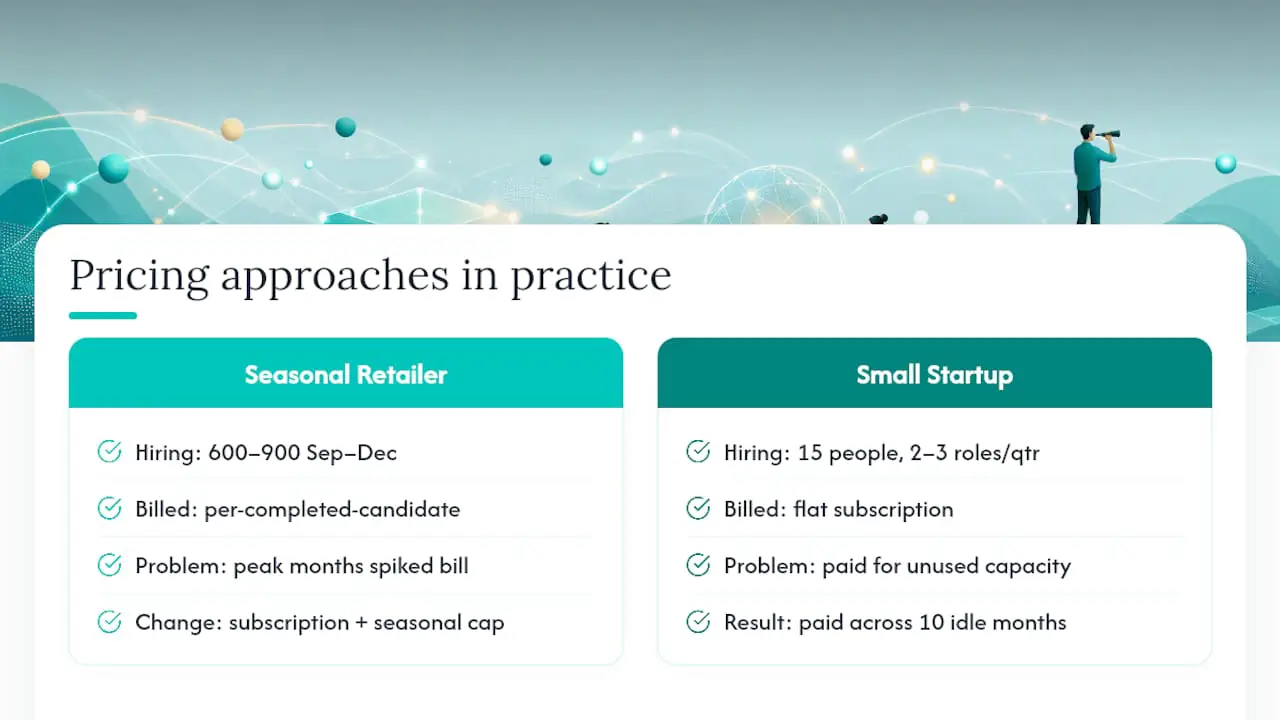
A seasonal retailer hiring 600 to 900 warehouse associates between September and December initially signed up for per-completed-candidate billing, assuming steady year-round volume. The spike months pushed their bill well past what a flat subscription would have cost for that quarter, while the off-season months sat nearly idle. Switching to a subscription with a seasonal usage cap, negotiated specifically around their hiring calendar, cut their annualized cost by avoiding the pay-as-you-go premium during peak months.
A 15-person startup hiring for two or three technical roles a quarter took the opposite lesson. They started on a subscription because a vendor’s sales team recommended it as the “professional” tier, and ended up paying for capacity they never used across ten unused months.
The pattern in both cases: the right pricing model tracks your actual hiring rhythm, not the tier a sales rep defaults to. Teams with volume that spikes and dips benefit from flexible, usage-based billing even if the per-unit rate looks higher on paper. Teams with flat, predictable hiring volume close to a subscription’s break-even point often save more locking in a flat rate. Neither case study argues for one universal winner. It argues for matching the model to your actual calendar, which is a five-minute exercise most buyers skip.
Is the Price You’re Being Quoted Actually Fair?
A fair price isn’t the cheapest per-unit rate. It’s the rate that reflects what you’re actually using, billed against a definition you agreed to in writing.
Start by comparing quoted rates against the market median. At roughly $8 per completed assessment as a benchmark, a quote significantly above that number should come with a clear justification, whether it’s proctoring depth, integration complexity, or reporting detail you specifically need. A quote significantly below that number deserves scrutiny too. Ultra-low per-unit pricing sometimes hides an aggressive completion definition (billing on invitation, not completion) or strips out anti-cheat features you’ll end up paying for separately.
ROI on a skills assessment isn’t just about the invoice. Weigh the per-candidate cost against what a bad hire actually costs your organization in retraining, turnover, and lost productivity. A $8 to $15 assessment that catches a mismatch before an offer goes out is cheap insurance against a hiring mistake that costs thousands to unwind. Ask vendors for their reporting depth, not just their rate. A platform that hands your reviewers a raw score gives you less value per dollar than one generating a structured summary that shortens your decision time, even at an identical unit price.
Choosing the Right Pricing Approach for Your Hiring Cadence
The mistake I see most often isn’t picking the wrong pricing model. It’s picking a model that fit last year’s hiring pace and never revisiting it. If your monthly candidate volume swings by more than 30% between your slowest and busiest months, pay-as-you-go per-completed-candidate pricing will almost always beat a subscription, even at a higher per-unit rate. Steady, predictable volume flips that math toward subscriptions or enterprise thresholds.
The operational habit procurement teams skip: get the completion definition in writing before you sign, and add your reviewers’ actual time into your TCO math. A rate card never shows you that second number, but it’s real money every month.
— Jimmie
Why Talent Approved Prices Per Completed Assessment
Talent Approved charges a fee per completed candidate assessment, without requiring a subscription, seat fees, or minimum commitments. That structure exists specifically for the budgeting problem this article walks through: you pay for hiring activity, not for platform access you might not use every month, and you know your exact billable unit before you ever get an invoice.
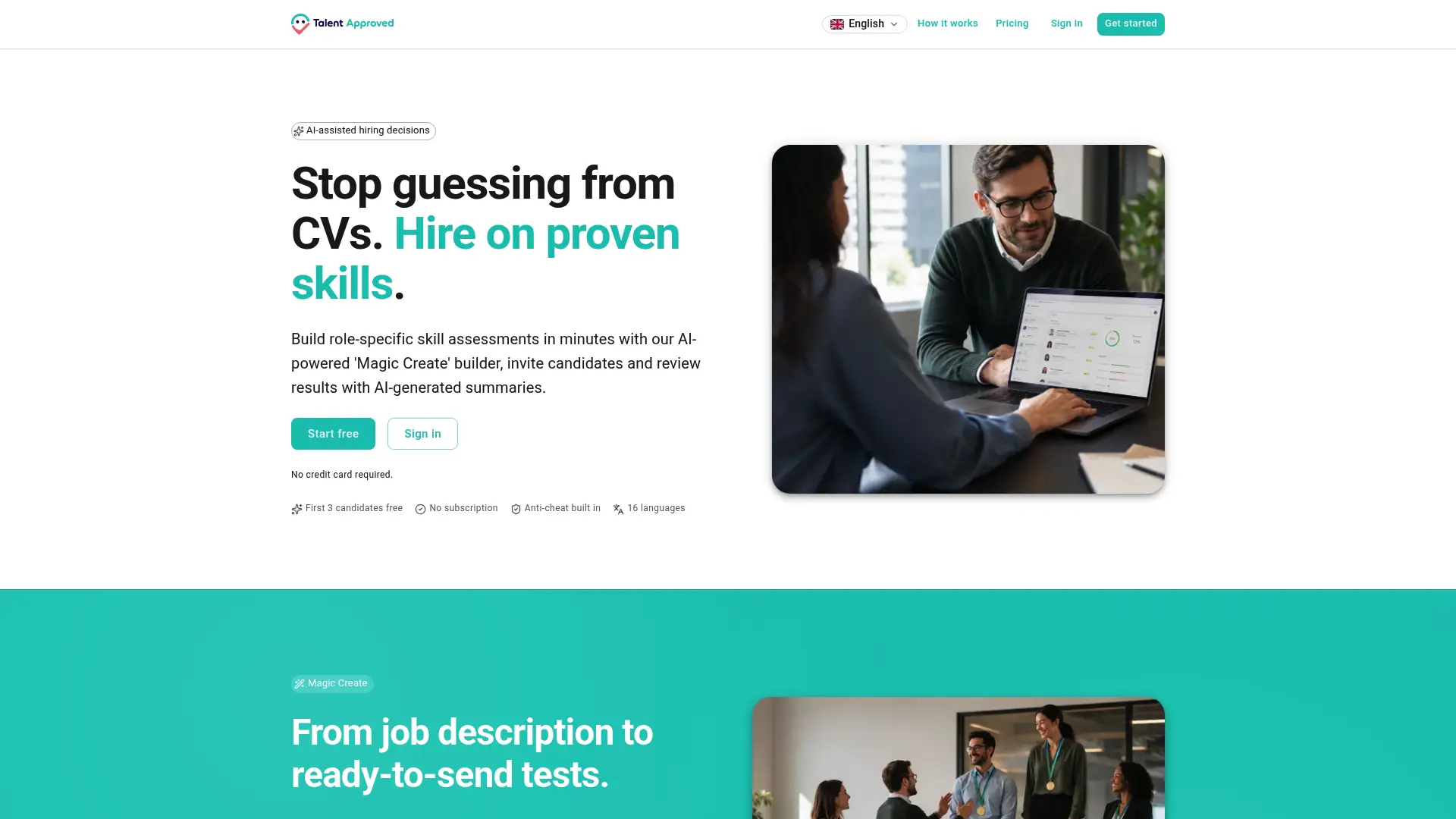
Three features built into that pricing directly reduce the hidden costs covered above. A feature builds role-specific assessments quickly from job descriptions, reducing custom content costs that increase most vendors’ first-year total cost of ownership. Anti-cheat monitoring, including screen and webcam tracking with session replays, is included as part of the platform rather than billed separately. AI-generated candidate summaries help reduce the reviewer time involved in manual scoring, addressing a labor cost often overlooked in pricing.
If you’re weighing this against a subscription or credit model, the validity audit guide walks through how the $5 figure holds up against real assessment volume. Visit the Talent Approved landing page to see current assessment templates and calculate your own numbers against the formula above.
FAQ
What Is the Average Cost of a Skills Assessment?
Skills assessments typically run around $8 per completed candidate on the open market, though rates vary by proctoring depth, content customization, and vendor size. Talent Approved prices at $5 per completed assessment with no subscription required.
What Pricing Model Is Most Predictable for Steady Hiring Volume?
Per-completed-candidate billing offers the most predictable costs for teams with steady monthly volume, since charges track actual hiring activity rather than platform access. Subscriptions become more predictable once volume is high and consistent enough to justify a flat rate.
How Do Vendors Define a “Completed” Assessment?
Vendors define completion differently: some bill on candidate invitation, others on full test submission, and others on a minimum completion threshold. Confirm this definition in writing before signing any contract.
Why Is First-Year Cost Higher Than the Advertised Rate?
First-year total cost of ownership typically runs 1.4 to 1.6 times the listed platform fee once implementation, custom content, and integration costs are added. Budget for that multiplier rather than the headline per-unit price alone.
Does Talent Approved Charge Extra for Anti-Cheat Features?
No. Talent Approved’s anti-cheat monitoring, including screen and webcam tracking with session replays, is included in its $5-per-completed-assessment pricing rather than billed as a separate add-on.
How Do I Estimate My Program’s Monthly Cost?
Multiply expected completed candidates by the per-unit price, then add amortized implementation, custom content, integration, and reviewer labor costs, using the formula covered in the calculation section above.