
3 Spreadsheet Formulas for Partial Credit Scoring and Rasch

Partial credit scoring assigns points along a range rather than an all-or-nothing outcome, rewarding a test taker for the portion of an answer that is correct. Educators use it because it measures partial knowledge that dichotomous, right-or-wrong scoring throws away, and well-designed partial-credit functions suppress the payoff from random guessing. It fits best on multipart items, multiple-response questions, and constructed responses graded against a rubric, especially when you need finer-grained diagnostic information than a simple pass/fail score can give you.
TL;DR:
- Partial credit scoring better captures student knowledge on multipart, multiple-response, and constructed-response items than simple right-or-wrong approaches.
- Methods like subset-selection and linear penalty control guessing but require clear instructions and can introduce complexity in scoring and rater training.
- Empirical research shows partial credit improves reliability and discrimination, especially at scale or with multiple-response items prone to guessing.
- Most classroom assessments do not need advanced models like Rasch partial credit, which are reserved for large-scale testing programs and certification exams.
- Using dedicated tools that automate rubric application, rater consistency, and scoring transparency simplifies implementation and ensures fair, consistent partial credit evaluation.
Table of Contents
- What Partial Credit Scoring Means and When to Use It
- Common Partial-Credit Scoring Methods
- How to Calculate Partial Credit: Worked Examples
- Statistical Models and IRT: The Rasch Partial Credit Model
- Implementation Best Practices: Design, Configuration, and Reporting
- Reliability, Validity, and Guessing Suppression
- Scoring Templates for Multiple-Response Items
- Practitioner Governance Checklist Before You Scale
- When Partial Credit Earns Its Complexity
- Build Partial-Credit Assessments Without Building the Infrastructure Yourself
- Sources
- FAQ
What Partial Credit Scoring Means and When to Use It
Dichotomous scoring treats an answer as either fully right or fully wrong, worth one point or zero. Partial credit scoring breaks that binary open. A student who selects three of four correct options on a multiple-response item, or who nails the setup of a multistep problem but flubs the final calculation, gets credit proportional to what they actually demonstrated.
The case for partial credit rests on three practical outcomes. First, it captures partial knowledge that a strict right/wrong rule erases, which matters most on items with several defensible sub-answers. Second, properly built scoring functions can make the expected value of a random guess negative, so guessing stops being a rational strategy, an effect formally modeled in scoring-function research. Third, empirical comparisons on multiple-response items found that partial-credit methods improved both reliability and item discrimination relative to dichotomous scoring.
You do not need partial credit everywhere. A vocabulary quiz with single correct answers gains nothing from it and only adds scoring complexity. Reach for partial credit when items are genuinely multipart, when multiple-response questions have more than two plausible selections, or when a constructed response can be decomposed into a rubric with distinct, gradable components.
Common Partial-Credit Scoring Methods
No single formula wins across every context. Classic reviews of the field catalog a range of methods and consistently find trade-offs rather than a universal winner, so the right choice depends on item format and what you are trying to protect against, whether that is guessing, rater inconsistency, or scoring complexity itself.
- Proportional (number-correct) scoring. Points equal the fraction of correct selections out of total possible selections. Simple to compute, easy to explain to students, but vulnerable to gaming on multiple-response items where selecting everything guarantees a baseline score.
- Subset-selection (SS) scoring. Full credit only when the exact correct subset is chosen; partial credit awarded for subsets that are proper matches of the key, with penalties for included distractors. Better guessing control than pure proportional scoring, at the cost of a slightly more complex rule to explain.
- Modified Zapechelnyuk-style functions. These use a mathematically derived penalty structure designed so the expected value of blind guessing turns negative, directly addressing the guessing problem rather than just tolerating it.
- Linear-penalty models. Score equals the number of correct selections minus a weighted count of incorrect selections. Tunable by adjusting the penalty weight, which lets you calibrate how aggressively you want to discourage over-selection.
- Rubric-based fractioning. Constructed responses get scored against an ordered rubric (0 to 4, for example), then converted into a fraction of total item points. This is the standard approach for essays, multistep math problems, and lab reports.
Proportional scoring fits multiple-select and multi-blank items where the format is straightforward and guessing risk is low. Subset-selection and linear-penalty models fit multiple-response items where distractors are attractive enough that random selection could inflate scores. Rubric-based fractioning is really the only sound option for open-ended constructed responses, since there is no discrete “number correct” to divide.
The trade-off pattern is consistent across methods: simpler formulas (proportional scoring) are easiest for students and instructors to understand but weakest against guessing, while penalty-based and subset methods control guessing better but demand clearer instructions so students understand how selections are weighed. Rubric-based scoring carries a different risk entirely: rater inconsistency, which no formula can fix on its own.
How to Calculate Partial Credit: Worked Examples
The formulas above are useless until you can run the numbers yourself. Here are three worked examples you can transfer directly into a spreadsheet.
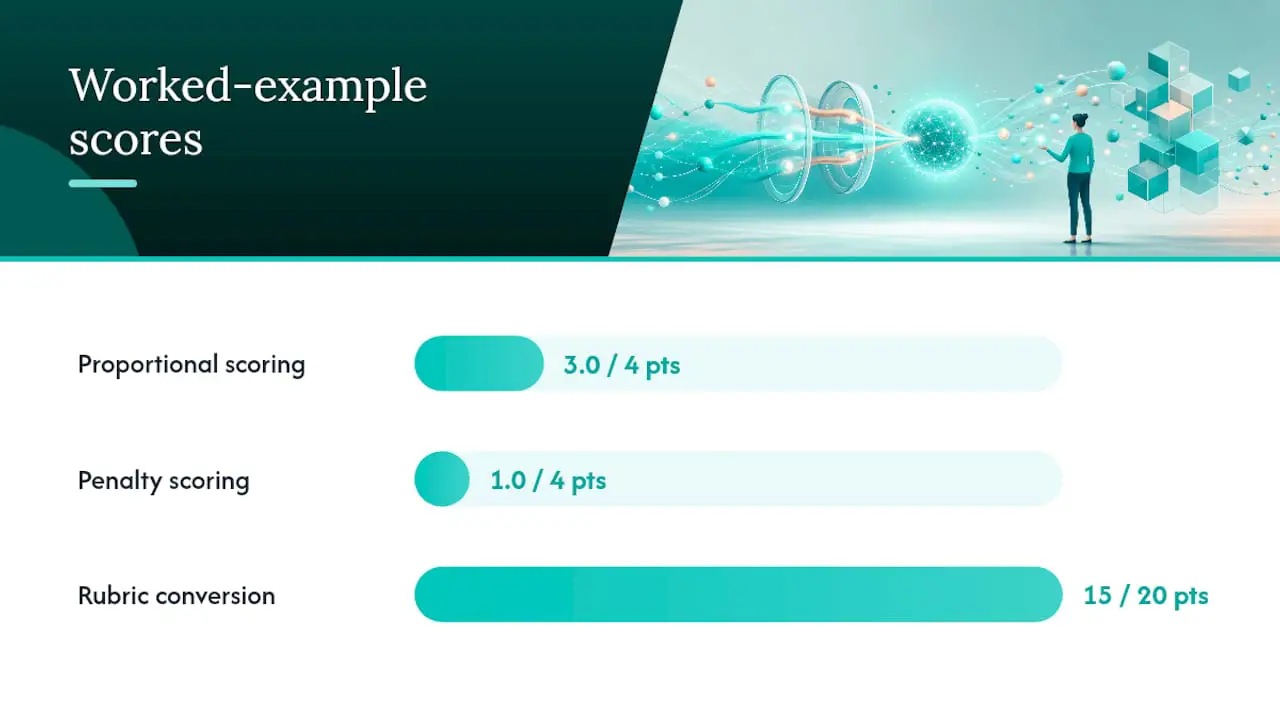
1. Proportional scoring on a four-option multiple-select item.
Suppose an item has four correct options out of six total choices, worth 4 points. A student selects 3 of the 4 correct options and 0 distractors.
Score = (correct selections / total correct options) × item points Score = (3 / 4) × 4 = 3.0 points
2. Subset-selection with a distractor penalty.
Same item: 4 correct options, 2 distractors, 4 points total. This time the student selects 3 correct options and 1 distractor.
Score = [(correct selected / total correct) − (distractors selected / total distractors)] × item points, floored at zero Score = [(3/4) − (1/2)] × 4 = [0.75 − 0.5] × 4 = 1.0 point
Compare that to the proportional-only method, which would have ignored the distractor entirely and awarded 3.0 points for the identical response. That gap is the entire argument for penalty-based methods on items where distractors are genuinely tempting.
3. Rubric-to-fraction conversion on a 20-point question.
A multistep math problem is graded on a 0 to 4 rubric: 0 (no valid approach), 1 (correct setup only), 2 (correct method, major error), 3 (correct method, minor error), 4 (fully correct). The question is worth 20 points total.
Fractional score = (rubric points earned / max rubric points) × item points A student who earns a 3 on the rubric gets: (3/4) × 20 = 15 points
Run that conversion across a class roster and you get a distribution that looks nothing like a simple percent-correct histogram: scores cluster around rubric bands (0, 5, 10, 15, 20) rather than spreading continuously, which is worth knowing before you build a grade curve around it.
Pro Tip: Build these three formulas as named functions in a shared spreadsheet template before the exam window opens. Retrofitting a scoring formula after students have already submitted responses is where most scoring disputes start.
Statistical Models and IRT: The Rasch Partial Credit Model
Fractional scoring formulas answer “how many points did this response earn.” Item response theory (IRT) answers a different question: “how much ability does this response actually indicate, once we account for how difficult each response category is to reach.” That distinction matters once you move from single-classroom grading to any context where scores need to be compared across forms, cohorts, or years.
The Rasch partial credit model, developed by Geoff Masters, extends the standard dichotomous Rasch model to items with ordered response categories. Instead of treating “step 2 of 4” as simply worth half of “step 4 of 4,” the Rasch PCM estimates a separate threshold parameter for the transition between each pair of adjacent categories. Moving from a score of 1 to 2 on a rubric might require considerably more demonstrated ability than moving from 2 to 3, and the model captures that instead of assuming every step is equal.

The practical payoff is parameter separability: an examinee’s estimated ability and an item’s category thresholds can be estimated independently of each other, which is what makes cross-form comparisons statistically defensible in the first place.
When does the added complexity earn its keep?
- Large-scale testing programs, where thousands of responses need consistent interpretation across multiple exam forms.
- Linking and equating, when different groups of students take different versions of a test and scores must mean the same thing on each.
- Precise item calibration, when you need to know exactly how much ability separates a “2” from a “3” on a rubric, rather than assuming equal spacing.
- Differential item functioning checks, where you need to confirm an item’s partial-credit steps behave consistently across demographic groups before trusting the aggregate score.
A single classroom quiz almost never needs Rasch calibration. A certification exam administered nationally, reused across testing windows, and relied on for pass/fail decisions with real consequences almost always does. The line between “use a spreadsheet formula” and “use IRT software” is really a line about stakes and scale, not about item format.
Implementation Best Practices: Design, Configuration, and Reporting
Getting partial credit right starts well before any student sees the item, and it does not end when scores are generated. Three phases deserve deliberate attention: design, platform configuration, and reporting.
Design checklist. Before you write a single item, settle the scoring rule, not after piloting reveals inconsistency.
- Write the rubric or point-allocation rule at the same time you write the item, not after.
- Use a consistent point scale across similar items so students can predict how partial credit is distributed.
- Pilot new rubrics on a small sample of real or practice responses before deploying them at scale, and adjust anchor descriptions where two raters disagree.
- Define 3 to 5 anchor responses per score band for constructed-response rubrics, a practice supported by research on rubric-based partial credit scoring that recommends training raters against exemplar scripts to reach acceptable inter-rater agreement.
LMS and platform configuration. Most learning management systems bury partial-credit settings inside item-level options rather than exam-level settings, so check each question type individually rather than assuming a global toggle covers everything. Confirm whether feedback shown to students displays the fractional score, the rubric level, or both, since showing only a rounded total can obscure exactly where points were lost. Export raw, unrounded scoring data whenever possible. Rounding early and recalculating later is one of the fastest ways to introduce silent grading errors across a large roster.
Reporting. Report both the raw fractional score and the rounded total, and say so explicitly in whatever score report reaches the student. A student who sees “15/20” with no context has no way to know whether they lost 5 points to one big error or several small ones. A one-line explanation of how partial credit was calculated, attached to the score report, resolves most disputes before they start. Teams building out scoring rubrics for structured assessments can find additional rubric design guidance and templates that pair directly with fractional scoring approaches.
Reliability, Validity, and Guessing Suppression
Reliability is the question that decides whether partial credit was worth the added complexity. If a scoring change does not measurably improve your assessment’s consistency, the extra rater training and calculation overhead are hard to justify.
The empirical record leans favorably here. Comparative studies of scoring methods on multiple-response items found that partial-credit approaches improved reliability and discrimination compared with simple dichotomous scoring, particularly for items with more than two response options where a right/wrong split throws away meaningful variation. Separately, theoretical work on scoring functions designed around negative expected guessing value found that these functions tend to improve both reliability and discriminating power relative to plain right-or-wrong scoring, especially once a guessing penalty is built in.
Three practical checks tell you whether the switch is paying off in your own data:
Item-total correlation. Recalculate it after switching to partial credit. An item whose correlation with the total score improves is now doing a better job separating strong performers from weak ones under the new scoring rule.
Cronbach’s alpha before and after. Run the same test dataset through both scoring rules and compare alpha values directly. A meaningful increase is a strong signal that partial credit captured information the binary version discarded.
IRT fit statistics, where a Rasch or other IRT model is already in use. Category thresholds that come out disordered, meaning a higher rubric score doesn’t correspond to a higher estimated ability, flag a rubric that needs revision regardless of what the raw reliability numbers say.
None of this comes free. Scoring complexity rises with every added formula variant, rater variability becomes a live concern the moment you introduce any rubric-based component, and administrative cost climbs when you need software or spreadsheet infrastructure beyond a simple answer key. Weigh those costs against your actual stakes. A weekly quiz rarely justifies the overhead; a certification exam almost always does.
Scoring Templates for Multiple-Response Items
Multiple-response items, where a student selects several options from a longer list, are where guessing does the most damage to a test’s validity. A student who selects every option on a “choose all that apply” item with four correct answers out of six choices will always get partial credit under naive proportional scoring, whether they know anything or not.
The fix is a scoring template built around expected value. A common structure: award p1 points when the student selects exactly the key (the full correct set) or, in some formulations, when every distractor is correctly excluded; otherwise apply a pc − m formula, where pc is the proportion correct and m is a penalty scaled to selections outside the key. The goal, as formal scoring-function research lays out, is making sure the math itself discourages careless over-selection.
- Size the penalty (m) so the expected value of selecting every option, or selecting at random, comes out negative or at worst zero.
- Test your penalty against a “select everything” response before deploying the item. If that response scores above zero, the penalty is too small.
- Test it against a genuinely honest partial-knowledge response too. If a student correctly identifies 3 of 4 correct options, and rules out both distractors, but scores worse than someone who guessed broadly, the penalty is too large.
Item phrasing matters as much as the formula behind it. Instructions that read “select all correct answers” without any guidance on penalties push students toward guessing, since there is no downside signal in the wording itself. Add a short line stating that incorrect selections reduce the score, and you get more honest partial-knowledge reporting, because students no longer have an incentive to select options they are unsure about just to hedge.
Practitioner Governance Checklist Before You Scale
Before rolling partial credit out beyond a pilot group, run these four checks:
- Rubric clarity. Confirm every rubric level has a distinct, observable anchor description, not just a vague label like “mostly correct.”
- Inter-rater reliability. Have two raters independently score the same 20 to 30 sample responses and check agreement before trusting a single rater’s scores at scale.
- Pilot comparison. Score the same response set under both the old scoring rule and the new partial-credit rule, and compare reliability and grade distribution side by side.
- Sensitivity analysis. Nudge your penalty weights or point allocations slightly and rerun the analysis. Scoring-model guidance recommends this step because small weighting changes can flip reliability results or reorder candidate rankings entirely.
Document every scoring decision, including why a particular formula or penalty size was chosen, in a format stakeholders can review later. That record is what turns a defensible pilot into a defensible policy.
When Partial Credit Earns Its Complexity
Partial credit is a measurement upgrade with a real administrative price tag, and pretending otherwise does a disservice to anyone piloting it for the first time. The gain in reliability and discrimination is well documented, but so is the added burden: more rater training, more complex formulas, more room for disagreement about what “partial” actually means on a given item.
My honest read on the research is that most classroom-level assessments do not need Rasch calibration, subset-selection penalties, or any of the more elaborate machinery covered above. A clear rubric and proportional fractioning covers the majority of real classroom needs. Where partial credit earns its complexity is at scale: certification exams, multi-form testing programs, and any assessment where a wrong scoring assumption compounds across thousands of test takers instead of thirty.
The operational burden is exactly where good platform tooling changes the calculus, especially if you want to automate global hiring and reduce compliance risks. A tool that automates rubric application, tracks rater consistency, and logs scoring decisions removes most of the friction that keeps educators from piloting partial credit at all. Pilot first, measure the reliability gain against the added cost, and only scale the approach once the numbers actually justify it.
— Jimmie
Build Partial-Credit Assessments Without Building the Infrastructure Yourself
Most of the friction in partial credit scoring is not the math. It is the infrastructure: writing consistent rubrics, keeping raters aligned, and trusting that nobody gamed the test. Talent Approved is built around a pay-as-you-go model with no subscription, so you only pay per completed candidate assessment, and skip the overhead of licensing scoring software you may only need occasionally.

The platform’s Magic Create feature builds a role-specific, rubric-ready assessment directly from a job description or skill list, which cuts out the manual item-writing phase entirely. Built-in anti-cheat tools, including screen and webcam monitoring with session replays, protect the integrity of partial-credit results the same way rater training protects a constructed-response rubric. AI-generated performance summaries turn fractional scores into readable candidate rankings without forcing your team to interpret raw rubric math by hand.
If you are evaluating skills rather than grading students, and want partial-credit style scoring without owning the scoring infrastructure, check the Skill assessments pricing page and see what a pilot assessment would cost for your next hiring round.
Sources
- Evaluating Different Scoring Methods for Multiple Response Items Providing Partial Credit
- Theoretical evaluation of partial credit scoring of the multiple-choice test item
- Partial-Credit Scoring Methods for Multiple-Choice Tests. - ERIC
FAQ
How Do You Calculate Partial Credit?
Divide the points earned (correct selections, rubric level, or subset match) by the maximum possible points for that item, then multiply by the item’s total point value. Subset-selection and linear-penalty methods subtract a weighted penalty for incorrect selections before that final multiplication.
What Are the Three Main Types of Credit Scoring Approaches?
In assessment design, the three broad approaches are dichotomous (right/wrong) scoring, partial-credit scoring (proportional, subset-selection, or penalty-based formulas), and rubric-based fractional scoring for constructed responses. Each fits different item formats, and no single approach is superior across every context.
What Most Often Undermines a Partial-Credit Scoring System?
Unclear rubric anchors and inconsistent rater training are the most common failure points, since they introduce disagreement between scorers that no formula can correct after the fact. A close second is a penalty term sized too small, which leaves random guessing statistically profitable instead of suppressed.
Does Partial Credit Actually Improve Test Reliability?
Empirical comparisons on multiple-response items found that partial-credit scoring improved both reliability and discrimination compared with dichotomous scoring, particularly when the scoring function penalizes incorrect selections. The gain is not automatic. It depends on rubric clarity and penalty sizing.
Can a Platform Handle Partial-Credit Scoring for Skill Assessments?
Yes. Talent Approved supports rubric-based scoring alongside its Magic Create assessment builder and anti-cheat monitoring, letting hiring teams apply fractional scoring logic without building the calculation infrastructure themselves. Current pricing is listed on the Skill assessments page.