
Avoid Legal Risk: HR's Multilingual Assessments Validation Checklist

Multilingual assessments are role-specific skill tests, not language exams, translated and localized into the languages your candidates actually work in. Localization is a measurement task, not a translation task: a version that reads well in Portuguese but scores differently than the English original has failed its job. Before you send a localized test to a single real candidate, pilot it, run the equivalence checks, and document what you find.
TL;DR:
- Validation should begin with a thorough job analysis and clear competency definitions to ensure the assessment measures relevant skills for the role.
- Pilot testing in multiple languages using bilingual respondents helps identify equivalence issues early and prevents flawed hiring decisions.
- Validation methods like DIF analysis, ANCOVA, and item difficulty tracking are essential to confirm that different language versions function similarly.
- Employers must document validation efforts, pilot results, and scoring decisions to defend against legal challenges related to adverse impact or non-equivalence.
- Fully validated assessments require disciplined workflows, including simplification, independent translations, bilingual expert review, and revalidation at set intervals.
Table of Contents
- What “Multilingual Assessments” Actually Means for Hiring
- How Do You Validate a Localized Assessment?
- What Does a Localization Checklist Look Like in Practice?
- What Are the Legal Risks of Multilingual Hiring Tests?
- What HR Teams Consistently Get Wrong About Localization
- How Talent Approved Simplifies Multilingual Assessment Rollouts
- Sources
- FAQ
What “Multilingual Assessments” Actually Means for Hiring
A multilingual assessment measures whether a candidate can do the job, in whatever language they think in. It is not a test of how well someone speaks or writes English, Spanish, or Mandarin. That distinction sounds obvious until you look at how many employers blur it. A coding test with dense English instructions doesn’t just check coding skill; it also checks reading speed in a second language, and that second, unintended measurement is exactly what gets employers into trouble.
The EEOC is explicit that a translated or localized skill test is still a selection procedure. Employers stay responsible for proving it’s job-related and validated, in every language it’s offered in. The upside of doing this correctly is real: you open your pipeline to qualified candidates who would otherwise get filtered out by language friction that has nothing to do with the role. The risk of doing it carelessly is just as real.
- Construct drift: the localized version quietly measures something other than the intended skill.
- Nonequivalence: candidates who are equally capable score differently depending on the language version they took.
- Adverse impact: one language group passes at a noticeably lower rate, which can trigger legal exposure under UGESP.
Empirical research backs this up directly: studies evaluating translated workplace surveys across languages and cultures have found measurable structural differences between versions that looked identical on paper.
How Do You Validate a Localized Assessment?
Validation starts before translation, not after. Run a job analysis first: define exactly which competencies the role requires and write operational definitions for each one. That step gives you content validity, the foundation UGESP asks employers to demonstrate under 29 CFR Part 1607.
Which validation strategy you lean on depends on how the test gets used. A pass/fail screening test for an entry-level role can often rely on content validity alone, tied tightly to job tasks. A test used to rank finalists for a high-stakes role deserves criterion-related or construct validity evidence, because the stakes of getting the order wrong are higher.
Translation itself needs guardrails. The ITC Guidelines for Translating and Adapting Tests recommend a specific sequence:
- Simplify the source item first. Strip idioms, culture-bound references, and unnecessary reading load before anyone translates a word.
- Commission independent forward translations, then reconcile differences with a second translator or team.
- Have bilingual subject-matter experts review the item for realism and job relevance, not just grammatical accuracy.
- Back-translate where the stakes justify the added time, then compare against the original for meaning drift.
- Pilot the finished version with bilingual respondents before it ever touches a real candidate pool.
The pilot is where equivalence gets tested, not assumed. Log completion time, item-level difficulty, and pass rate by language. Peer-reviewed methodology for evaluating language versions of credentialing exams uses tools like differential item functioning (DIF) analysis, multidimensional scaling, and ANCOVA to flag items that behave differently across versions, even when the wording looks like a clean translation.
Pro Tip: Run your pilot with at least a small group of bilingual employees who can flag when a “correct” translation still feels unnatural or ambiguous in context. Native fluency catches problems that back-translation alone misses.
Pilot testing with bilingual respondents and basic statistical checks catches most equivalence failures early, according to research on credentialing exam equivalence, well before a flawed item ever affects a real hiring decision. Keep a written record of every translation decision, every pilot result, and every score adjustment. If adverse impact ever gets questioned, that paper trail is what lets you defend the test rather than pull it.
What Does a Localization Checklist Look Like in Practice?
Most HR teams don’t need a psychometrics degree to run this well. They need a repeatable sequence and the discipline to follow it every time, including the fifth time when the deadline is tight and skipping a step feels tempting.
- Define the competency and build the scoring rubric before writing a single question.
- Decide the intended use up front: screening candidates in, or ranking finalists against each other.
- Simplify source items so they translate cleanly, removing idioms and dense jargon.
- Commission independent forward translations, then reconcile them with a bilingual review team.
- Add back-translation for high-stakes roles where a scoring error carries real consequences.
- Pilot with bilingual respondents and log completion time, item difficulty, and pass rate.
- Hold off on hard cut scores until pilot data shows the language versions behave consistently.
- Document every step and set a revalidation date, not a “someday” placeholder.
| Workflow stage | What you’re checking | Red flag to watch for |
|---|---|---|
| Job analysis | Competency matches actual job tasks | Test measures skills the role doesn’t need |
| Translation | Meaning survives, not just wording | Idioms or culture-specific references remain |
| Bilingual SME review | Item feels natural and job-relevant | Reviewer flags awkward or ambiguous phrasing |
| Pilot testing | Completion time, difficulty, pass rate by language | One language group takes notably longer or scores lower |
| Cut score decision | Scoring is consistent across versions | Same ability level, different outcome by language |
A vendor who won’t walk you through each of these stages, or can’t produce pilot data on request, is not offering a validated assessment. They’re offering a translated one, and those are not the same product. Talent Approved’s own assessment localization checklist walks through this sequence in more depth if you’re building the process internally.
What Are the Legal Risks of Multilingual Hiring Tests?
Using a vendor doesn’t transfer your legal responsibility. Under EEOC guidance, the employer administering the test stays accountable for showing it’s job-related and validated, regardless of who built it or which language it’s delivered in. OFCCP guidance reinforces the same point for federal contractors using cognitive tests, job simulations, and other scored selection tools.
Keep a defensible file for every localized test you deploy:
- The original job analysis and competency definitions.
- Validation evidence for each language version, not just the source language.
- Administration rules, including time limits and proctoring conditions.
- Pilot data: completion time, item difficulty, pass rate by language group.
- Vendor validation reports, if the test was purchased rather than built in house.
- The rationale behind your cut score, and any adjustments made after pilot review.
Ranking candidates carries more legal exposure than a simple pass/fail screen, because ranking amplifies small scoring differences into real hiring outcomes. If pilot data shows any gap between language versions, consider pass/fail thresholds instead of fine-grained rankings until you can prove equivalence. Automated scoring and AI-generated recommendations deserve the same scrutiny; a scoring algorithm that behaves differently across languages is still a selection procedure, and still your responsibility to monitor. Set a revalidation trigger, like a major job redesign or a shift in your applicant population, so the test doesn’t run untouched for years after the role has changed. Talent Approved’s guide to EEOC testing obligations breaks down what documentation typically holds up under scrutiny.
What HR Teams Consistently Get Wrong About Localization
Most HR teams treat translation as the finish line instead of the starting point. That instinct is understandable. Translation feels concrete and checkable. Equivalence testing feels abstract, and it’s easy to assume a well-translated item is automatically a well-functioning item.
It isn’t. A common integration pattern we see work well: pilot one role’s assessment in two languages with a small bilingual group before rolling it out company-wide, then compare completion time and pass rate before trusting the scores. That single pilot, even a modest one, catches most of the problems that would otherwise surface after a real candidate is rejected or hired based on a flawed comparison.
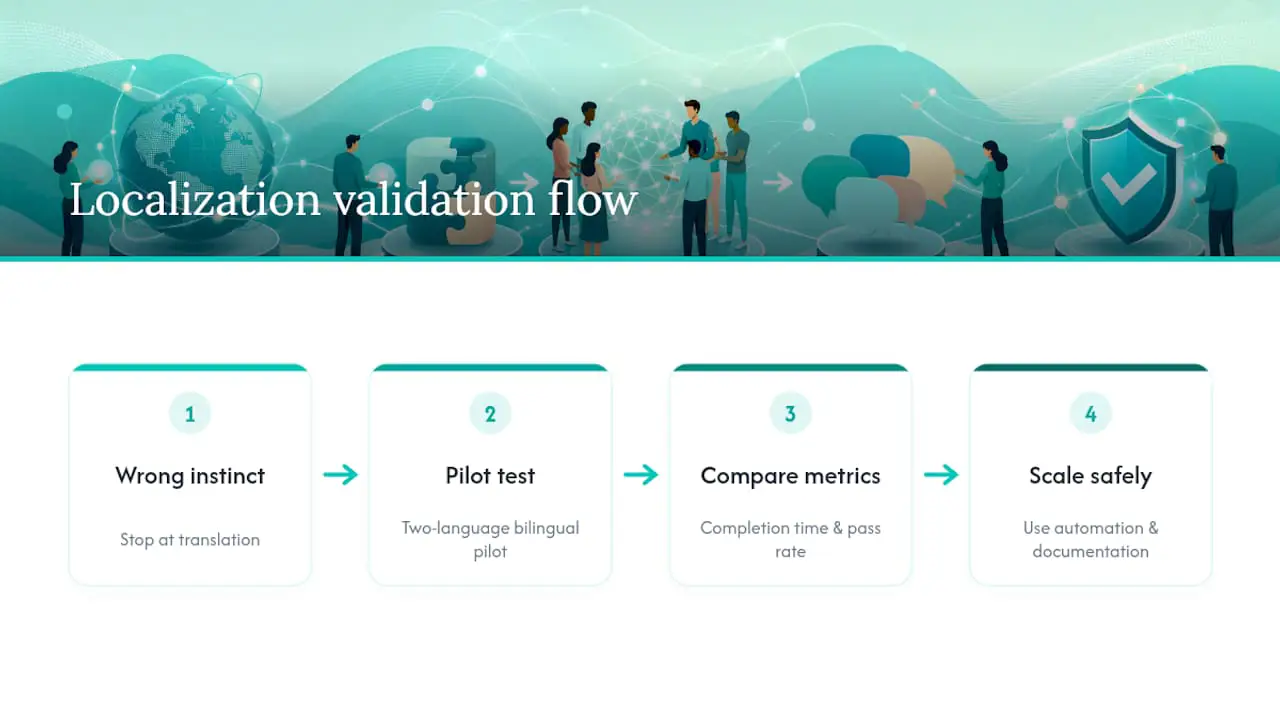
The real trade-off is depth of validation against speed to hire. Full construct-equivalence studies take time most hiring teams don’t have for every open role. What helps close that gap without cutting corners is automation that removes friction elsewhere, like anti-cheat monitoring and AI-generated summaries that cut reviewer workload, so the time saved on administration gets reinvested into the pilot and documentation work that actually protects the hire.
[brand_signal] [author_bio]
— Jimmie
How Talent Approved Simplifies Multilingual Assessment Rollouts
Building a validated, localized assessment from scratch takes weeks when you’re starting with a blank page and a spreadsheet. Talent Approved’s Magic Create feature builds a tailored, role-specific assessment in minutes from a job description or skill list, giving you a structured starting point instead of a blank one, which frees up your time for the pilot and equivalence work that actually matters.
Every assessment you run includes built-in anti-cheat monitoring, so you’re comparing candidate ability rather than access to search engines or a friend on speakerphone. AI-generated summaries condense results so reviewers aren’t manually parsing every response across every language version, cutting review time without cutting rigor. And because pricing runs pay-as-you-go at $5 per completed candidate with no subscription, you can pilot a single role in two or three languages without committing to a platform contract before you know the versions hold up.
Start with one role. Pilot it in the languages your candidate pool actually uses, collect completion time and pass rate data, and keep documenting as you go. Visit the skill assessments pricing page to set up your first localized assessment and see the results firsthand.
Sources
- Employment Tests and Selection Procedures | U.S. Equal Employment Opportunity Commission
- eCFR :: 29 CFR Part 1607 – Uniform Guidelines on Employee Selection Procedures (1978)
- Evaluating the equivalence of an employee attitude survey across languages, cultures, and administration formats
FAQ
What Is a Multilingual Skill Assessment?
It’s a role-specific test of job ability, such as coding, data analysis, or customer service scenarios, localized into a candidate’s language rather than a test of language proficiency itself. Each language version must be validated separately as its own selection procedure under EEOC guidance.
How Is Localization Different From Translation?
Translation converts words; localization confirms the test still measures the same skill after the words change. The ITC Guidelines call for simplifying source items, using bilingual SME review, and piloting each version before treating it as equivalent to the original.
What Statistical Checks Confirm Language Versions Are Equivalent?
Differential item functioning (DIF) analysis, ANCOVA, and multidimensional scaling are common methods used to compare how items perform across languages, alongside simpler metrics like completion time and pass rate by language group, as described in research on credentialing exam equivalence.
Does Talent Approved Support Multilingual Assessments?
Yes. Talent Approved offers multi-language support alongside its Magic Create feature, letting HR teams build role-specific assessments and deploy them across languages with built-in anti-cheat monitoring and AI-generated summaries. Pricing runs on a pay-as-you-go basis at $5 per completed candidate, with no subscription required.
Who Is Legally Responsible if a Localized Test Shows Adverse Impact?
The employer administering the test remains responsible, even when a vendor built it, according to EEOC guidance. Employers should keep job analysis records, pilot data, and validation evidence on file to demonstrate job-relatedness under UGESP standards.