
How to Build a Hiring Process as a Solo Business Owner

The fastest way to build a hiring process as a solo business owner is to follow seven steps: define the role with a one-page scorecard, complete legal and financial setup, source through referrals first, run a 15-minute filter call, administer a skill assessment, conduct a structured scored interview, then onboard with a 30/60/90 plan. Done in the right order, this sequence protects you from misclassification penalties, cuts screening time, and gives your first hire a clear path to productivity. According to FirstHR’s small-business hiring guide, the full process typically runs several weeks from posting to start date.
Your 7-step hiring checklist:
- Step 1: Define the role. Write a one-sentence mission and three measurable 90-day outcomes.
- Step 2: Complete legal setup. Get your EIN, register with your state, set up payroll, and confirm workers’ comp coverage.
- Step 3: Source candidates. Lead with referrals, then two targeted job boards.
- Step 4: Run a 15-minute filter call. Screen for salary fit, schedule compatibility, and communication.
- Step 5: Administer a role-specific skill assessment. Score objectively before the final interview.
- Step 6: Conduct a structured scored interview. Use a 3–5 criteria scorecard.
- Step 7: Extend an offer and launch the 30/60/90 onboarding plan.
Do this in the next 48 hours: Run a 30-minute role audit (list every task you want to hand off and confirm you can define what success looks like at 90 days). Then check your monthly revenue to confirm you can cover at least three months of the hire’s fully loaded cost before you post anything.
Key Takeaways
Building a hiring process as a solo business owner requires a one-page scorecard, legal setup completed before posting, a three-stage screening funnel, and a 30/60/90 onboarding plan calendared before Day 1.
| Point | Details |
|---|---|
| Start with the scorecard | Write a mission sentence, three 90-day outcomes, and three to five competencies before posting the job. |
| Complete legal setup first | Get your EIN from the IRS, register with your state, set up payroll, and confirm workers’ comp before the hire starts. |
| Use a three-stage funnel | Run a 15-minute filter call, then a skill assessment, then a structured scored interview to protect your time. |
| Budget beyond salary | Expect $335–$2,025 in per-hire costs beyond base pay; plan for full productivity at Day 90, not Day 30. |
| Talent Approved for assessments | At $5 per completed test, Talent Approved adds objective skill scoring to the funnel with no subscription required. |
Table of Contents
- Should you hire an employee or an independent contractor?
- What legal and financial setup do you need before posting the job?
- How do you define the role and build a scorecard that prevents bad hires?
- What sourcing channels work best for a solo founder?
- How do you screen and evaluate candidates without wasting your week?
- How do skill assessments fit into your hiring workflow?
- How do you structure the interview, make the offer, and onboard for success?
- What does hiring actually cost, and how long does it take?
- Templates and tools you can copy today
- What solo founders actually learn from their first hire
- Talent Approved fits directly into this hiring funnel
- Sources
- FAQ
Should you hire an employee or an independent contractor?
The direct answer: hire an employee when you control how, when, and where the work gets done. Hire an independent contractor when you’re buying a defined deliverable and the worker sets their own methods and schedule. ADP’s guidance for sole proprietors confirms that sole proprietors can legally hire both, but the classification must reflect the actual working relationship, not what’s convenient on paper.
Quick classification checklist:
- Does the worker set their own hours? Contractor signal.
- Do you provide the tools, software, or workspace? Employee signal.
- Is the work ongoing and central to your business operations? Employee signal.
- Is the engagement project-based with a defined end date? Contractor signal.
- Do you direct the process, not just the result? Employee signal.
Misclassifying an employee as a contractor exposes you to back payroll taxes, penalties, and potential liability for unpaid benefits. The IRS uses a behavioral control, financial control, and relationship-type test to make the determination. If you’re uncertain, file IRS Form SS-8 to request an official ruling before the hire starts.
Pro Tip: Even when a contractor looks cheaper on paper, a W-2 employee often costs less over 12 months for ongoing roles. Contractors typically price in their own taxes and benefits, so their effective hourly rate is higher. Run the math on a 20-hour-per-week role before defaulting to contractor status.
What legal and financial setup do you need before posting the job?
Complete these seven items before you publish a single job listing. Skipping any one of them can delay your hire’s start date or create compliance gaps on Day 1.
- Get your EIN. Your Employer Identification Number is required for payroll, tax filings, and opening a business bank account. The IRS online EIN application issues your number immediately after submission. Same-day task.
- Register as an employer with your state. Most states require a separate employer registration for state income tax withholding and unemployment insurance. Check your state’s Department of Revenue or Labor website. Allow 3–10 business days.
- Set up payroll. Choose a payroll provider (Gusto, ADP, or Paychex are common choices for small businesses) before your hire’s first day. Payroll setup takes 1–3 business days once you have your EIN.
- Secure workers’ compensation insurance. Required in most states for any W-2 employee, even part-time. Contact your business insurance provider or your state’s workers’ comp bureau. Allow 2–5 business days.
- Post required workplace notices. Federal law requires you to display posters covering minimum wage, OSHA, and anti-discrimination rights. The Department of Labor’s free poster advisor tool generates the correct set for your business type. Same-day task.
- Prepare I-9 and W-4 forms. Every new employee must complete a Form I-9 with acceptable identity and work-authorization documents within three business days of their start date. The W-4 determines federal income tax withholding. Have both forms ready before Day 1.
- Report the new hire to your state. Federal law requires employers to report new hires to the state within 20 days of the hire date. Most states accept online reporting through their new-hire registry.
Timing note: The EIN and workplace posters can be completed in a single afternoon. Workers’ comp and state registration need a few business days of lead time. Start both the moment you decide to hire, not after you’ve found a candidate.
Checkr’s small-business hiring guide also recommends confirming E-Verify enrollment at this stage if your industry or state requires it. E-Verify is a free federal system that cross-checks I-9 data against government records and takes about 15 minutes to set up.
How do you define the role and build a scorecard that prevents bad hires?
A one-page scorecard beats a two-page job description every time. The scorecard has four components: a one-sentence mission, three measurable 90-day outcomes, three to five required competencies, and the compensation range. That’s it.
Scorecard components:
- Mission (1 sentence): “This role exists to [do X] so that [business outcome Y] happens.” Example: “This role exists to handle all inbound customer inquiries so the founder can focus on client delivery.”
- 90-day outcomes (3 items): Measurable results the hire must own by the end of their first quarter. “Respond to all support tickets within 4 hours by Day 30.” “Reduce founder time on customer email from 10 hours/week to under 2 hours by Day 60.”
- Competencies (3–5): The skills and behaviors the role requires. Be specific: “written communication at a B2B professional standard,” not “good communicator.”
- Compensation range: Post the range. Nationalbusiness notes that including a salary range in the job description attracts better-matched applicants and reduces wasted screening time.
The scorecard feeds every downstream step. Your filter call questions come from the competencies. Your assessment tests the skills. Your interview scoring criteria map directly to the outcomes. Your 30/60/90 plan is the outcomes section expanded into weekly milestones.
What to omit from the job description: Years of experience as a proxy for competence, vague phrases like “self-starter” or “team player,” and a list of 15 responsibilities that belong to three different roles. Keep the posted description to 300–400 words, derived from the scorecard.
What sourcing channels work best for a solo founder?
Lead with referrals. Ask your existing clients, contractors, and professional network before you post anywhere. Referral candidates convert at a higher rate and tend to ramp faster because they arrive with context about your business and a built-in accountability relationship.
Recommended channel priority:
- Personal and professional referrals — message 10 people in your network with a one-sentence ask and a link to the scorecard.
- LinkedIn outreach — search for candidates with the specific job title and location, then send a short, direct message (under 75 words) explaining the role and outcome.
- Two targeted job boards — Indeed and LinkedIn Jobs cover the majority of active U.S. job seekers. For technical or specialized roles, add a niche board (We Work Remotely for remote roles, AngelList Talent for startup-adjacent hires).
- Passive pipeline — follow relevant professionals on LinkedIn and engage with their content before you need to hire. A warm relationship converts faster than a cold application.
Generic job posts on broad boards generate volume, not quality. For a solo founder with limited screening time, a smaller pool of better-fit candidates is worth far more than 200 applications to sort through.
Simple outreach template:
Keep the cadence simple: send referral asks on Day 1, post job boards on Day 2, begin LinkedIn outreach on Days 3–5. Revisit the passive pipeline weekly until the role is filled.
Pro Tip: For part-time or project-based roles, evaluating applicant skills quickly before investing in a full interview saves hours of founder time. A short assessment sent after the filter call is the most efficient filter in a small applicant pool.
How do you screen and evaluate candidates without wasting your week?
Use a three-stage funnel: a 15-minute filter call, a role-specific skill assessment, and a structured scored interview. Each stage removes candidates who don’t fit before you invest more time.
Stage 1: The 15-minute filter call
The filter call has one job: eliminate mismatches fast. Cover these four points only:
- Confirm the compensation range works for both sides.
- Confirm the schedule or availability matches the role.
- Ask one open question tied to the scorecard’s top competency.
- Explain the next step (assessment) and gauge enthusiasm.
Disqualify immediately on: salary mismatch outside your range, schedule incompatibility, inability to articulate what they’d do in the role, or a dismissive reaction to the assessment step.
Stage 2: Skill assessment
After the filter call, send a short, role-specific assessment before scheduling the full interview. SHRM’s research on recruiting difficulty and skills gaps underscores that structured, skills-based screening reduces mis-hires in roles where technical capability is hard to verify from a resume alone. A 20–30 minute assessment is enough to surface real capability differences between finalists.

Stage 3: Structured scored interview
Build a simple scorecard with 3–5 criteria drawn directly from your role scorecard. Score each criterion 1–5 during the interview. Example criteria for an operations coordinator role:
- Process thinking (can they describe a workflow they built or improved?)
- Written communication (ask them to draft a short email live or review a sample)
- Reliability signals (how do they describe past deadline management?)
- Culture fit (do their working preferences match how you operate?)
Score immediately after the call, before you discuss the candidate with anyone else. Delayed scoring introduces recency bias.
Background and reference checks: Run a background check through a service like Checkr after the final interview and before extending an offer. Call two references with a single structured question: “What would this person need to improve to be successful in a role that requires [top competency]?” The answer tells you more than any praise will.
How do skill assessments fit into your hiring workflow?
Insert the skill assessment after the 15-minute filter call and before the final interview. That placement removes candidates who can’t perform the core function before you invest 60 minutes in a structured conversation.
Step-by-step workflow:
- Filter call passes — candidate clears salary, schedule, and communication bar.
- Send the assessment — give a 48-hour window to complete it. Keep it under 30 minutes.
- Review scores and AI summary — rank candidates by assessment score before scheduling interviews.
- Interview only top scorers — typically the top 2–3 from the assessment pool.
- Combine scores — add the assessment score to the interview scorecard for a composite ranking.
Talent Approved fits directly into this workflow. Its Magic Create feature generates a role-specific assessment from your job description in minutes, so you’re not building questions from scratch. The platform’s anti-cheat screen recording and proctoring ensures results reflect the candidate’s actual ability, and the AI-generated performance summaries let you compare finalists at a glance rather than reviewing raw responses one by one.
Example use case: A solo founder hiring an operations coordinator posts the scorecard, runs filter calls, then sends a Talent Approved assessment covering process documentation, prioritization, and written communication. Three candidates complete it. The AI summary flags one as a clear top performer based on structured scoring. The founder interviews that candidate first and extends an offer within the week.
For designing job-specific screening tests, the key is matching test content to the 90-day outcomes on your scorecard, not testing general intelligence or personality. Role-specific tests predict performance; generic tests predict test-taking.
Interpreting results: Use the assessment score as a filter, not a final verdict. A candidate who scores in the top third on the assessment and performs well in the structured interview is a strong hire. A high assessment score paired with poor interview answers warrants a second look at the role definition, not an automatic offer.
How do you structure the interview, make the offer, and onboard for success?
Move fast once you’ve identified your top candidate. Delay between the final interview and the offer is one of the most common reasons solo founders lose good candidates to larger employers.
Interview agenda (60 minutes):
- 0–5 min: Brief context on the business and the role
- 5–25 min: Behavioral questions tied to scorecard competencies (use “Tell me about a time when…” framing)
- 25–45 min: Work sample or scenario question (give them a real problem from your business)
- 45–55 min: Candidate’s questions
- 55–60 min: Explain next steps and timeline
Offer letter checklist (must-have terms):
- Job title and start date
- Compensation (salary or hourly rate) and pay frequency
- Employment type (full-time, part-time, at-will)
- Benefits summary (health, PTO, or contractor terms if applicable)
- Contingencies (background check, I-9 verification per USCIS requirements)
- Offer expiration date (give 48–72 hours)
Extend the verbal offer within 48 hours of the final interview. Send the written offer within five business days. Send a pre-boarding welcome message the same day the offer is signed, with the first-week schedule and any pre-reading.
30/60/90 onboarding template:
| Phase | Milestone | Check-in |
|---|---|---|
| Days 1–30 | Learn the tools, processes, and key relationships. Complete first solo task. | Day 7 and Day 30 |
| Days 30–60 | Own a defined workflow end-to-end. Identify one process improvement. | Day 60 |
| Days 60–90 | Deliver the first measurable outcome from the scorecard. Flag blockers. | Day 90 |
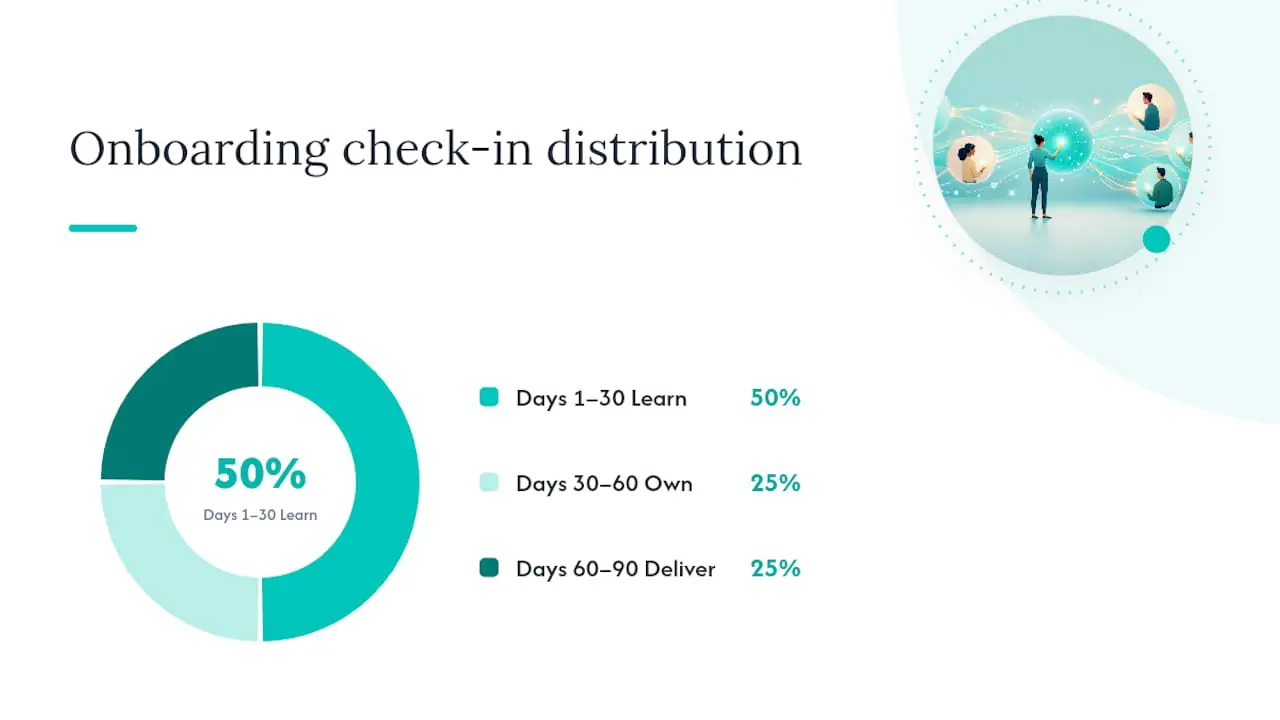
Calendar all four check-ins (Day 7, 30, 60, 90) before the hire’s first day. The 30/60/90 plan is the single most reliable predictor of whether a new hire succeeds or stalls in a small team.
What does hiring actually cost, and how long does it take?
Expect 3–6 weeks from job posting to start date for most small-business roles, per FirstHR’s hiring process guide. Budget beyond salary for the line items below.
| Cost Item | Estimated Range | Notes |
|---|---|---|
| Job board ads | $0–$300 | Indeed and LinkedIn offer free posts; sponsored posts run $5–$10/day |
| Background check | $30–$75 per candidate | Services like Checkr charge per report |
| Skill assessment | $5 per completed test (Talent Approved) | Pay-as-you-go; no subscription required |
| Paid trial project | $100–$300 | Pay fairly; treat it as a real work sample |
| Onboarding equipment | $200–$600 | Laptop, software licenses, peripherals |
| Payroll setup | $0–$100 | Many providers waive setup fees for small accounts |
| Total beyond salary | $335–$2,025 | Add a 15–20% buffer for unexpected costs |
The hidden cost most solo founders underestimate is their own time: sourcing, screening, and interviewing a single hire typically consumes 15–25 hours of founder time. A structured funnel with a filter call and assessment up front cuts that number significantly by concentrating your effort on the final two or three candidates.
Plan for the hire to reach full productivity at Day 90, not Day 30. Budget for reduced output during the ramp period and build that into your cash-flow projections before you post the role.
Templates and tools you can copy today
Three templates to build this week, in priority order:
- One-page scorecard — mission sentence, three 90-day outcomes, three to five competencies, compensation range. Use this to write the job description, build the assessment, and score interviews.
- Offer letter — use the checklist from the interview section above. Keep it to one page. Include the contingency clause for background check and I-9.
- 30/60/90 plan — use the table from the onboarding section. Customize the milestones to the specific outcomes on the scorecard.
Recommended tools for a solo owner:
- Applicant tracking (ATS-lite): Notion or Airtable work well for tracking 5–20 applicants without a paid ATS. Upgrade to a dedicated tool like Breezy HR or Workable when you’re hiring more than twice a year.
- Interview scheduling: Calendly eliminates the back-and-forth for filter calls and final interviews.
- Payroll: Gusto is the most common choice for U.S. small businesses under 10 employees. ADP and Paychex are solid alternatives with more compliance support.
- Skill assessments: Talent Approved’s pay-as-you-go model ($5 per completed test) fits a solo owner’s budget. You can create a skill test with AI from your job description in minutes, with no subscription required.
- Background checks: Checkr integrates with most ATS tools and returns results in 1–3 business days.
Pro Tip: Don’t buy an ATS before your third hire. Notion or a shared Google Sheet handles tracking for one or two open roles without adding a monthly subscription to your overhead. Invest in the assessment and background check tools first — those protect you from the costliest mistakes.
What solo founders actually learn from their first hire
The most important lesson from hiring as a solo founder is this: the process fails at the role definition stage, not the interview stage. Most bad hires trace back to a vague or wishful job description, not a poor interview technique.
Three things that hold up in practice:
- Write the 30/60/90 plan before you post the job. If you can’t define what success looks like at 90 days, you’re not ready to hire. The plan forces clarity that the job description alone never does.
- Run a paid trial project for any role that involves execution. A two-hour paid task reveals more than three rounds of interviews. Pay fairly, give a real problem, and evaluate the output against your scorecard outcomes.
- Don’t hire to escape loneliness or overwhelm. Hire to remove a specific bottleneck you’ve already identified. A hire made from exhaustion usually creates more work before it creates less.
Dos and don’ts:
- Do score the interview immediately after the call, before discussing the candidate.
- Do send the 30/60/90 plan with the offer letter, not on Day 1.
- Don’t skip the filter call to save time. It saves more time than any other step.
- Don’t hire someone whose assessment score is strong but whose interview answers don’t connect to your actual outcomes. The assessment is a filter, not a guarantee.
- Don’t delay the offer. Good candidates are interviewing elsewhere.
Talent Approved fits directly into this hiring funnel
Objective screening is where most solo founders lose time and make avoidable mistakes. Talent Approved gives you a concrete way to fix that: after the filter call, send a role-specific assessment built from your job description in minutes using the Magic Create AI test generator. Each completed test costs $5 with no subscription, so a pilot for three finalists costs $15 total.
The platform’s AI-generated summaries and candidate ranking let you compare finalists in under 10 minutes instead of re-reading raw responses. Anti-cheat proctoring means the scores reflect real ability. For a solo founder hiring an operations coordinator or a client-facing specialist, that combination cuts the final interview pool from six to two before you spend an hour on a call.
Review how Talent Approved works and run your first assessment for your next open role. The setup takes less time than a single filter call.
Sources
Compliance and legal setup:
- The Hiring Process: Guide for Small Business | FirstHR
- How to Hire Employees for Small Business | Checkr
- Can A Sole Proprietor Have Employees? - ADP
- Apply for an Employer Identification Number (EIN) Online | IRS
- Form I-9 Acceptable Documents | USCIS
Process and practical guidance:
Templates and tools:
FAQ
Can a sole proprietor hire an independent contractor?
Yes. Sole proprietors can engage both W-2 employees and independent contractors, but the classification must reflect the actual working relationship. The IRS uses behavioral control, financial control, and relationship type to determine the correct classification.
What is the 70/30 rule in hiring?
Structured assessments and scored interviews help apply the split consistently.
What are the 5 C’s of hiring?
One widely cited version covers Competence, Character, Communication, Culture fit, and Commitment. These map closely to the scorecard competencies covered in this guide, though the specific framing varies by source.
How long does hiring take for a small business?
Most small-business roles take 3–6 weeks from job posting to start date, according to FirstHR’s hiring process research. Roles requiring specialized skills or security clearances typically run longer.
How much does it cost to hire one person beyond their salary?
Expect $335–$2,025 in additional per-hire costs covering job board ads, background checks, skill assessments, a paid trial project, onboarding equipment, and payroll setup.