
Hiring Teams: 10 Question Accounting Skills Test with Rubric and AI

A short, role-specific work-sample test paired with a fundamentals quiz remains the fastest, most reliable way to screen accounting candidates. This combination resolves the questions that resumes can’t answer: can this person actually reconcile an account, classify a transaction correctly, and use judgment when something looks off? Run a 10 to 20 minute test now, or build one from a quick job analysis if your role has unusual requirements.
TL;DR:
- A work-sample test with real tasks predicts on-the-job performance better than simple knowledge quizzes, especially for roles involving reconciliation and transaction classification.
- For most roles, a 15 to 25 minute combined test of fundamentals and one work-sample task effectively screens candidates without overburdening them.
- Testing should focus on technically critical skills, like accounting reconciliation and journal entries, rather than easily Googled facts, to ensure practical competence.
- Building role-specific assessments based on actual job tasks and clear rubrics improves validity and reduces scoring drift over time.
- Administer tests with consistent timing and platform support, and combine scores with structured interviews and reference checks for a comprehensive decision.
Table of Contents
- What Is the Best Accounting Skills Test Format?
- What to Test by Role: Bookkeeper to Senior Accountant
- A Sample 10-Question Accounting Screening Test
- Answer Key and Scoring Rubric
- How to Design a Role-Specific Accounting Test
- Running the Test Fairly: Timing, Platforms, and Anti-Cheat
- Using Test Results to Make the Hiring Call
- How Talent Approved Builds Hire-Ready Accounting Tests Fast
- What Actually Moves the Needle in Accounting Hiring
- Start Testing Accounting Candidates the Smart Way
- Sources
- FAQ
What Is the Best Accounting Skills Test Format?
Not every test format tells you the same thing. A trivia-style quiz on debits and credits confirms someone memorized a textbook. A work-sample test, where a candidate reconciles a mock bank statement or classifies real-looking transactions, shows you how they’ll perform on day one. That distinction drives everything else in this guide.
Work-sample tests predict on-the-job performance better than knowledge quizzes because they mirror actual tasks rather than isolated facts. A candidate who can define “accrual accounting” perfectly might still fumble a messy general ledger. The documented job analysis approach behind most credible accounting assessments backs this up: tests built around real job tasks, scored with a written rubric, consistently outperform generic knowledge checks.
Four formats cover almost every hiring need:
- Multiple-choice fundamentals: Fast to score, useful for confirming baseline knowledge (debits/credits, financial statement structure, basic tax categories). Best as a 5 to 10 minute screen before a deeper test.
- Spreadsheet tasks: Candidates build a formula, reconcile a balance, or clean up a broken worksheet in Excel or Google Sheets. This format catches technical fluency gaps that interviews never surface.
- Simulated client files: A short set of transactions, invoices, or a mini trial balance that candidates need to categorize or correct. Ideal for bookkeeper and staff accountant roles.
- Situational judgment items: A short scenario (“a client wants to expense a personal purchase, what do you do?”) that reveals ethics and decision-making under ambiguity.
For most hiring pipelines, a 15 to 25 minute test that blends a short fundamentals section with one work-sample task hits the sweet spot. Save the 60 to 90 minute deep-dive simulations for finalist rounds, not the first screen. If your role leans heavily on client-facing judgment, weight your test toward situational items; if it’s a high-volume data-entry position, weight it toward spreadsheet accuracy.
What to Test by Role: Bookkeeper to Senior Accountant
Different roles need different competency weightings, and testing the wrong ones wastes everyone’s time. A bookkeeper doesn’t need to explain deferred tax assets. A senior accountant candidate who can’t reconcile a bank statement quickly is a bigger red flag than one who fumbles an obscure tax question.
Bookkeeper
- Transaction categorization (day-one skill, test directly)
- Bank and credit card reconciliation (day-one skill)
- Basic invoicing and accounts payable/receivable entries (day-one skill)
- Data entry accuracy under time pressure (day-one skill)
- Software fluency in QuickBooks or Xero (trainable, but test familiarity)
- Sample item: “Reconcile this mock checking account and flag any discrepancies.”
Staff Accountant
- Journal entries and month-end close tasks (day-one skill)
- Accrual vs. cash accounting judgment (day-one skill)
- Basic financial statement preparation (day-one skill)
- Fixed asset and depreciation schedules (trainable with oversight)
- Intercompany or multi-entity awareness (trainable)
- Sample item: “Prepare the adjusting entries for this list of month-end transactions.”
Senior Accountant
- Financial reporting under GAAP (day-one skill)
- Variance analysis and management reporting (day-one skill)
- Audit prep and internal controls awareness (day-one skill)
- Tax provision review (trainable depending on prior exposure)
- Team review and mentoring judgment (day-one, test via scenario)
- Sample item: “Review this draft income statement and identify three issues a controller would flag.”
Notice the pattern: technical mechanics tend to be day-one requirements, while software-specific or company-specific processes are trainable. Test hard on the former, ask about familiarity (not mastery) on the latter.
A Sample 10-Question Accounting Screening Test
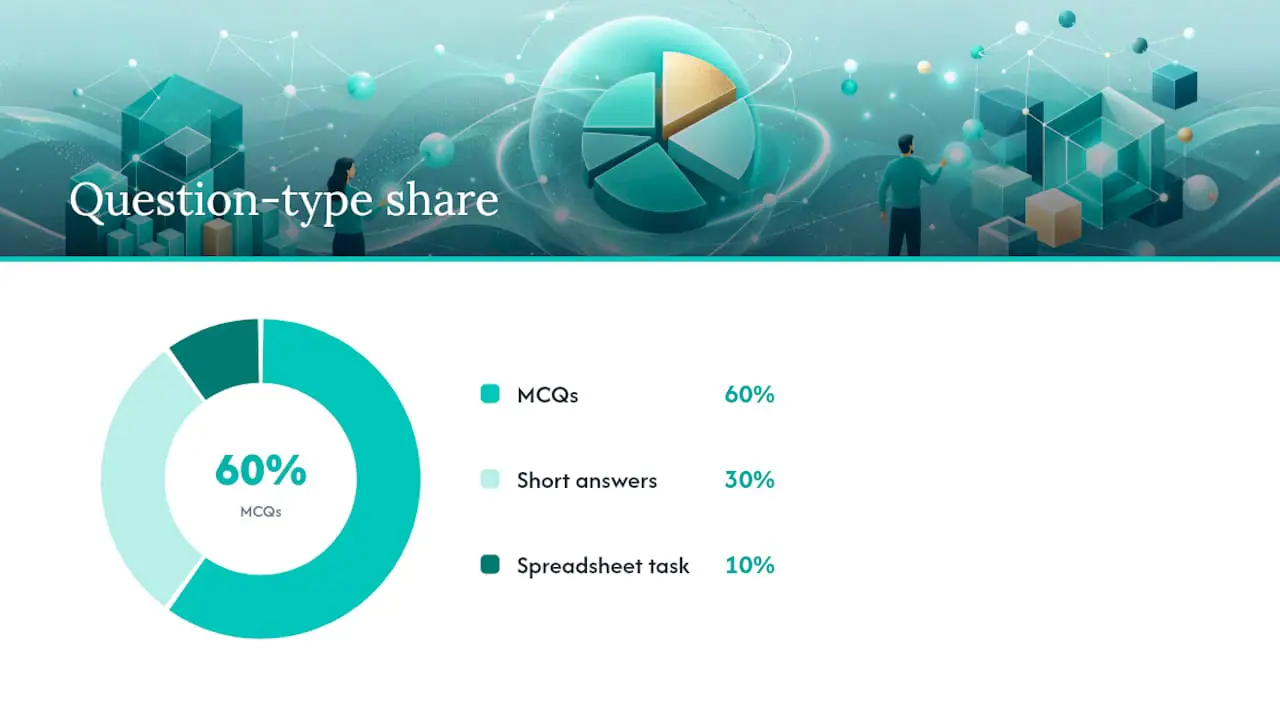
Here’s a ready-to-use mini test you can paste into an applicant tracking system or a standalone assessment tool. It runs 15 to 20 minutes and covers fundamentals, transaction classification, a spreadsheet task, and one judgment scenario.
Instructions for candidates: You have 20 minutes. Answer all questions. Questions 1 through 6 are multiple-choice. Questions 7 through 9 require short written answers. Question 10 is a brief spreadsheet task; submit the file or describe your formula approach.
- Which financial statement shows a company’s assets, liabilities, and equity at a single point in time?
- A company pays $1,200 for a one-year insurance policy. Under accrual accounting, how much expense should it record in the first month?
- Which of the following is a liability: accounts payable, accounts receivable, inventory, or prepaid rent?
- A business receives cash for services not yet performed. What account should be credited?
- What does “reconciling a bank statement” primarily verify?
- Which depreciation method allocates equal expense across an asset’s useful life?
- A vendor invoice arrives for $4,500 dated December 28, but the goods arrive January 3. Which period should record the expense, and why?
- A client asks you to record a personal vacation as a “business travel” expense. What do you do, and why?
- Explain, in two or three sentences, the difference between accounts payable and accrued expenses.
- Using the attached spreadsheet of 15 transactions, calculate the ending cash balance and flag any transaction that appears miscategorized.
This mix intentionally avoids obscure trivia. Every item ties to a task the hire will actually perform, which is the design principle behind most credible accounting skills assessments.
Answer Key and Scoring Rubric
Scoring only works if you separate “got the calculation right” from “understood the concept” from “communicated clearly.” Lumping those together hides exactly the signal you need.
Model answers:
- Balance sheet.
- $100 ($1,200 divided by 12 months), reflecting accrual matching.
- Accounts payable.
- Unearned revenue (a liability, not immediate income).
- That the company’s recorded cash balance matches the bank’s records, surfacing errors or fraud.
- Straight-line depreciation.
- January, because the expense should match when goods are received (matching principle), not the invoice date.
- Decline and flag it to a supervisor; mixing personal and business expenses raises ethical and tax-compliance concerns.
- Accounts payable are billed obligations; accrued expenses are incurred but not yet billed or recorded through an invoice.
- Correct ending balance plus at least one flagged miscategorized entry (exact numbers depend on the spreadsheet you build).
A 100-point scorecard for a full-length practical test typically allocates 25 points to accuracy, 20 to technical treatment, 15 to judgment and issue recognition, 15 to documentation, 10 to instruction-following, 10 to written communication, and 5 to efficient tool use, based on the scoring model used in accounting-specific assessments. For a 10-question screening test like the one above, scale those weights down proportionally, roughly 5 points per multiple-choice item and 10 to 15 points per written or spreadsheet item.
- 85 to 100: Strong candidate, fast-track to interview.
- 65 to 84: Solid baseline, proceed with a technical interview focused on gaps.
- 45 to 64: Borderline, only advance if other signals (references, portfolio) are strong.
- Below 45: Screen out for roles requiring immediate independence.
Pro Tip: Score the written and judgment items (questions 7 through 9) separately from the multiple-choice items. A candidate who nails the calculations but writes a vague explanation for question 9 often struggles with documentation on the job, a gap worth probing in the interview.
How to Design a Role-Specific Accounting Test
Building your own test instead of using a generic one starts with a simple question: what will this person actually do in their first 90 days? That’s your job analysis, and it doesn’t need to be complicated.
Start by pulling the three to five tasks that consume most of the role’s time. Talk to whoever currently does the job, or review recent work product if the position is newly created. The U.S. approach to job analysis treats this step as the foundation of any legally defensible selection tool, and skipping it is the single most common reason accounting tests end up testing the wrong things.
From there:
- Translate each top task into one test item; don’t test tasks the role rarely touches.
- Use sanitized but realistic data (real-looking vendor names, believable dollar amounts) rather than obviously fake placeholder numbers, which candidates tend to breeze past without engaging.
- Write the scoring rubric before you administer the test to anyone, not after you see the first few submissions.
- Give every candidate identical instructions, time limits, and file formats to keep scoring comparable.
- Build in accommodation options (extended time, screen-reader-compatible files) for candidates who request them, and document that the accommodation process is available.
- Keep a record of why each item was included, tied back to the job analysis; this documentation matters if a hiring decision is ever challenged.
One overlooked design mistake: testing for skills that are easy to Google but calling them “knowledge” items. If a candidate can look up the answer in 30 seconds, it’s not testing knowledge, it’s testing typing speed. Reserve fundamentals questions for concepts that require understanding, not lookup, and lean on work samples for everything else. For a deeper walkthrough of translating job descriptions into test content, this guide on choosing the right skills to test covers the mapping process in more detail.
Running the Test Fairly: Timing, Platforms, and Anti-Cheat
A well-designed test can still fail if the administration is inconsistent or the candidate experience feels punishing. A few operational choices make the difference between a smooth screen and a mess of disqualified data.
Platform checklist:
- Supports both multiple-choice and file-upload or spreadsheet-based items.
- Times each section independently so a candidate can’t burn 40 minutes on question one.
- Works on standard browsers without requiring unusual plugins.
- Logs completion time so you can spot outliers (either suspiciously fast or a candidate who ran far over time).
Anti-cheat trade-offs: Full webcam and screen proctoring catches more misconduct but adds friction and can feel invasive for a mid-level hire. Randomizing transaction data per candidate (so no two people get identical numbers) discourages answer-sharing without any monitoring at all. Session recording splits the difference: less intrusive than live proctoring, still reviewable if a score looks anomalous.
- Communicate the time limit and format before the test starts, not as a surprise.
- Send a brief acknowledgment immediately after submission; silence for a week hurts your employer brand.
- Share at least a high-level outcome (advancing, not advancing) within a reasonable window rather than leaving candidates in limbo.
Pro Tip: Short tests with clear timing and prompt feedback measurably reduce candidate drop-off, especially for passive candidates who are still weighing whether your role is worth their time. A test that respects candidates’ time is also a recruiting tool, not just a filter.
Using Test Results to Make the Hiring Call
A test score is one input, not the whole decision. Treat it as the fastest, most objective filter in your process, then layer in the context that a rubric alone can’t capture.
- Pair the technical score with at least one structured interview focused on the lowest-scoring subcategory (if documentation was weak, ask them to walk through their reasoning on question 9 out loud).
- Check references specifically on judgment and reliability, since those are hard to fake on a test but easy to verify with a former manager.
- Read subscore patterns, not just totals: a strong accuracy score with a weak judgment score suggests someone who’s technically sharp but needs closer supervision early on, useful information for structuring their first 90 days.
- For borderline scores (the 45 to 64 range mentioned earlier), consider a short supervised practical follow-up, ten minutes of live screen-share problem-solving, before making a final call.
- Weight the work-sample and judgment items more heavily than the multiple-choice fundamentals when scores conflict; fundamentals confirm baseline knowledge, but work samples predict actual performance.
Soft skills still belong in this evaluation. Research on hiring signals consistently shows that communication and judgment measured alongside technical tasks improve hiring accuracy, which is exactly why the written-answer items in the sample test matter as much as the calculations.
How Talent Approved Builds Hire-Ready Accounting Tests Fast
Building the test described above from scratch, job analysis, item writing, rubric design, takes real time. Some platforms offer features that compress that process: paste in a job description or a list of target skills, and they generate a structured, role-specific assessment in minutes rather than hours.
Such platforms include anti-cheat tools like screen and webcam monitoring plus session replays, enabling review of flagged submissions. AI-generated summaries condense each candidate’s performance into a quick read, cutting review time without relying on a black box. Many operate on a pay-as-you-go model with fees per completed candidate assessment and no subscription commitment. For teams that need their process to hold up to scrutiny, audit-ready validity resources walk through documenting job-task alignment the same way this guide recommends.
What Actually Moves the Needle in Accounting Hiring
Three rules have consistently separated good accounting hires from bad ones in the hiring processes I’ve studied closely: test small before you test big, weight work samples over trivia, and lock in your rubric before you see a single submission.
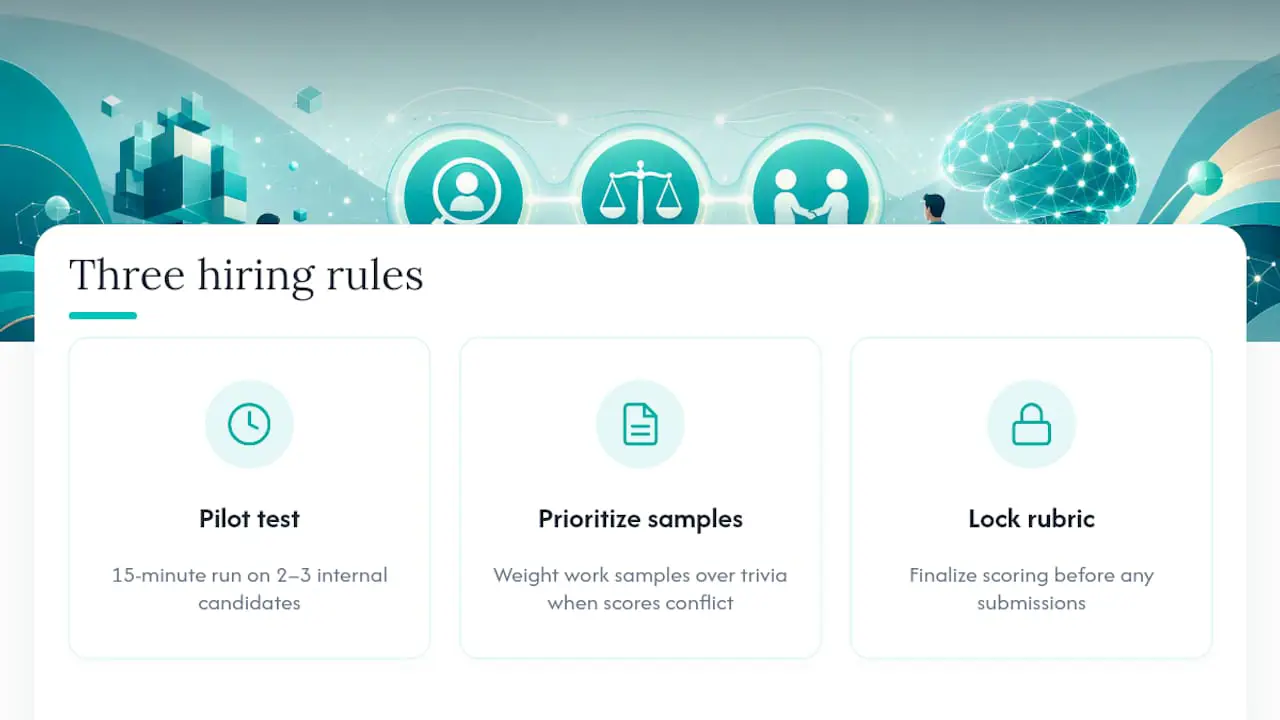
Test small first. A 15 minute pilot test run on two or three internal candidates (or even a willing current employee) catches ambiguous wording before it costs you real applicants. One hiring manager I’ve seen described in case studies discovered her “simple” reconciliation task took candidates twice as long as expected, because the mock bank statement had a typo that created a phantom discrepancy. She caught it in the pilot, not after 40 candidates flagged it.
Weight work samples over trivia every time scores conflict. And write the rubric first. Scoring drift between candidate one and candidate forty is the single most common reason accounting tests get challenged later.
— Jimmie
Start Testing Accounting Candidates the Smart Way
Talent Approved turns the entire approach in this guide, job analysis, work samples, a defensible rubric, into something you can build in one sitting instead of one week. Where a generic multiple-choice quiz tells you who memorized a textbook, Magic Create builds a role-specific test from your actual job description, so the questions match the job you’re hiring for, not a generic template.
Start with a pilot: build a 10 to 15 minute test for your open role, run it against two or three candidates already in your pipeline, and compare the results against your gut read from their resumes. Pull a rubric template from the role-specific test design guide if you want a structure to start from rather than a blank page. Since some platforms charge per completed assessment rather than a subscription, testing a small batch can be cost-effective to try. Visit Talentapproved to build your first assessment today.
Sources
The guidance above draws on established hiring and assessment practices worth reviewing directly:
- Accounting Skills Assessment Test for CPA Firms
- Why soft skills are important (SHRM)
- Business Financial Health Assessment | Free Bookkeeping Review
- 35 Basic Accounting Test Questions (NetSuite)
For readers building tests internally, designing job-specific screening tests walks through the process step by step, and teams hiring across borders may find hiring accountants in South Africa useful for market-specific context.
FAQ
Is the CPA Exam Really Hard?
Yes. Pass rates for each section of the CPA Exam typically hover in the 45 to 60 percent range, which is why CPA licensure alone doesn’t guarantee day-one competency on the specific tasks your role requires, a work-sample test still adds value even for licensed candidates.
Can You Make $500,000 a Year as an Accountant?
It’s uncommon at the staff or senior accountant level, but possible for partners at large firms, CFOs at sizable companies, or accountants who build a specialized consulting practice; base compensation for most in-house accounting roles falls well below that figure.
What Are the Four Accounting Tests?
There’s no single standardized “four tests,” but most accounting skills assessments cover four core areas: financial reporting and statement preparation, transaction classification and journal entries, reconciliation and accuracy checks, and judgment or ethics scenarios.
What Are Some Basic Accounting Skills?
Core skills include transaction categorization, bank reconciliation, journal entries, basic financial statement reading, accrual versus cash accounting judgment, and spreadsheet fluency, most of which the sample test above evaluates directly.
How Long Should an Accounting Skills Test Take?
A screening test should run 15 to 25 minutes; save 60 to 90 minute deep-dive simulations for finalist candidates rather than the initial screen, since longer tests increase drop-off among strong passive candidates.