
Transition CV-Free Hiring Step by Step

Replacing CV screening with skills-based hiring comes down to six moves: get stakeholder buy-in, map roles to measurable skills, design assessments with clear rubrics, pick technology that integrates with your workflow, run a time-boxed pilot, then embed what works into policy and training. Employers aren’t waiting to see how this plays out. As of 2026, 41% are already moving away from CV-first screening, and 10% have largely replaced CVs with skills-based assessments entirely.
If you’re briefing leadership this week, here’s what to line up first:
- Identify one high-volume or hard-to-fill role for the pilot, not your hardest role to change.
- Line up a hiring manager sponsor and two subject-matter experts to validate the skills list.
- Draft three to five KPIs before you build anything: time-to-hire, pass rate, and candidate diversity are the minimum set.
- Budget two to three weeks for assessment design and four to eight weeks to run the pilot cohort.
- Confirm whether your ATS can route candidates to an external assessment step without breaking your funnel.
That 41% adoption figure isn’t a trend prediction. It’s a description of what’s already happening in hiring teams comparable to yours, and it’s the number to put on slide one of any internal pitch.
Key Takeaways
CV-free hiring succeeds when HR teams sequence stakeholder buy-in, skills mapping, assessment design, technology selection, a measured pilot, and formal scaling in that exact order.
| Point | Details |
|---|---|
| Secure a scoped pilot first | Get one sponsor and three defined KPIs approved before touching a job requisition. |
| Map three to six critical skills per role | Split them into must-have and nice-to-have before building any test. |
| Pair task-based tests with structured interviews | One format alone can’t validate both capability and judgment. |
| Measure for 6 to 12 weeks with stop/go criteria | Track time-to-hire, pass rate, quality-of-hire, and diversity metrics. |
| Talent Approved covers the core toolset | Magic Create, anti-cheat monitoring, and AI summaries support the plan at $5 per completed candidate. |
Table of Contents
- Why Go CV-Free? The Business Case for Skills-Based Hiring
- How Do You Get Stakeholder Buy-In for a CV-Free Pilot?
- How Do You Map Roles to Measurable Skills?
- What Assessment Types and Scoring Rubrics Should Replace CV Screening?
- What Technology Do You Need to Run CV-Free Hiring at Scale?
- How Do You Design and Measure a CV-Free Hiring Pilot?
- How Do You Scale CV-Free Hiring Across the Organization?
- What Legal and Fairness Steps Does CV-Free Hiring Require?
- What Does the Research Say About Skills-Based Hiring Outcomes?
- How Does Talent Approved Support Each Step of This Plan?
- What HR Teams Get Wrong About the CV-Free Transition
- Start a CV-Free Hiring Pilot With Talent Approved
- Sources
- FAQ
Why Go CV-Free? The Business Case for Skills-Based Hiring
CV-free hiring widens your talent pool and correlates with better quality-of-hire and retention than resume-first screening. That’s not a hunch. A quantitative study of HR professionals found skills-based hiring statistically correlated with higher employee performance satisfaction and improved retention compared to degree-based filtering, and organizations that dropped unnecessary credential requirements reported a measurably wider accessible talent pool.
41% of employers are moving away from CV-first hiring, and 42% have introduced skills-based assessments to supplement or replace traditional screening. This isn’t a fringe experiment anymore. It’s closer to the median hiring strategy for teams under pressure to fill roles faster with less bias risk.
The practical benefits stack up quickly once you look past the headline stat:
- Wider talent pool. Dropping degree requirements opens the pipeline to candidates with equivalent skills gained outside a four-year track.
- Faster, more predictable screening. A scored assessment produces a ranked shortlist in hours, not the days a recruiter spends reading resumes line by line.
- Reduced pedigree bias. Structured, role-specific testing evaluates what a candidate can actually do, not where they went to school or who referred them.
- Better hire-to-role fit. Candidates are scored against the actual outputs of the job, not proxies like years of experience or job titles.
The executive rationale in one line: CVs measure a candidate’s past positioning; skills assessments measure their present capability, and capability is what the job actually requires.
How Do You Get Stakeholder Buy-In for a CV-Free Pilot?
Secure a limited pilot with a defined sponsor and success metrics before you touch a job requisition. Trying to convert an entire hiring process on day one is how these initiatives die in committee. A scoped pilot, with a named executive sponsor and three agreed KPIs, is the version leadership can actually approve.
For the exec briefing, keep it to five slides:
- Objective — the specific role and problem (e.g., high attrition in year one, or a resume-heavy funnel that screens out qualified nontraditional candidates).
- Timeline — a 6 to 12 week pilot window with defined checkpoints.
- KPIs — time-to-hire, quality-of-hire proxy, pass rate, and diversity of applicant pool.
- Resourcing — who builds the assessment, who scores it, and what platform you’ll use.
- Risk and mitigation — legal review status, accommodation process, and rollback plan if metrics don’t move.
Objections are predictable. Here’s how to answer them without getting drawn into a lengthy debate:
| Objection | Evidence-based response |
|---|---|
| “CVs are faster to screen.” | A scored assessment ranks candidates automatically; recruiters currently spend hours manually screening resumes with no consistency between reviewers. |
| “This will slow down time-to-hire.” | Pilots typically run 6 to 12 weeks and measure time-to-hire directly; if it worsens, you stop. |
| “We’ll lose qualified senior candidates.” | Assessment design can calibrate difficulty and time investment by seniority level, so senior candidates aren’t asked to do junior-level busywork. |
| “Legal risk is too high.” | Structured, validated assessments with documented scoring criteria are more defensible under adverse-impact review than unstructured resume screening. |
Before launch, confirm sign-off from the hiring manager, legal or compliance if your organization requires it, IT or security for any new platform, and finance if the tool carries a per-candidate cost.
How Do You Map Roles to Measurable Skills?
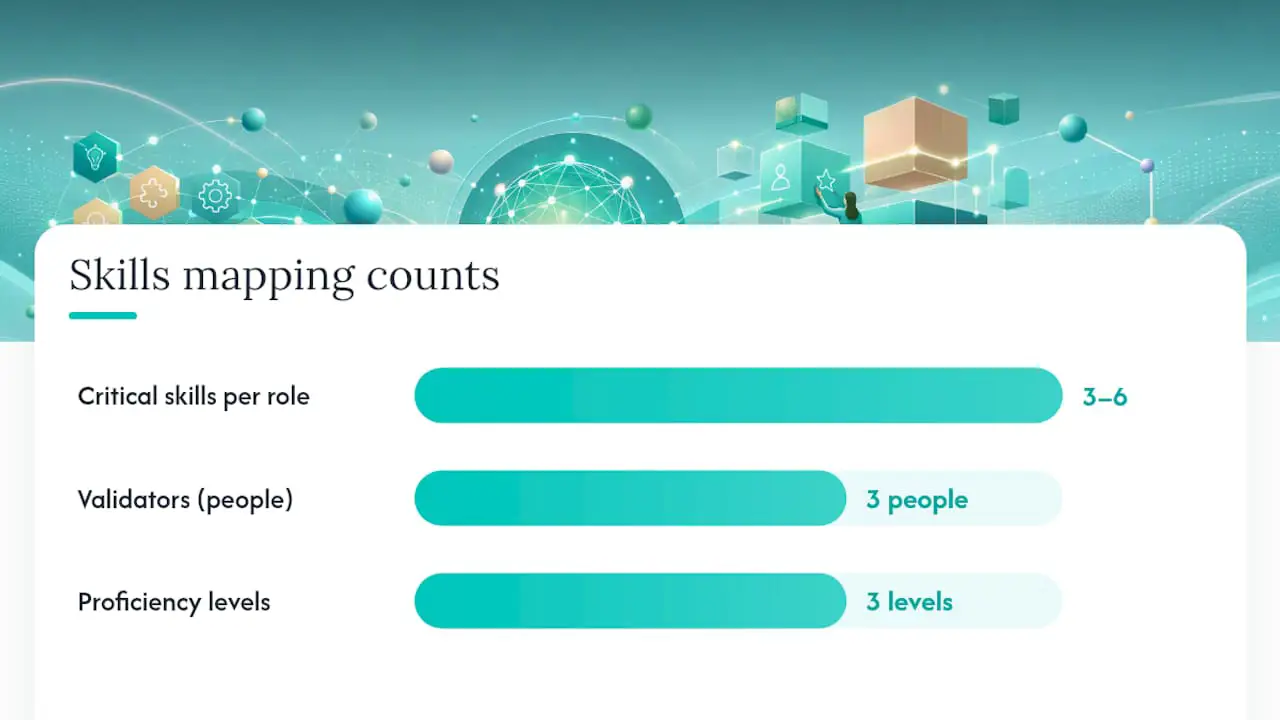
Define three to six critical skills per role and split them into must-have and nice-to-have before you write a single test question. Trying to test everything a job description mentions produces a bloated assessment candidates abandon halfway through.
Build a skills matrix with these fields for each role:
| Field | What to capture |
|---|---|
| Role | Job title and level |
| Critical outputs | What this person actually produces day to day |
| Hard skills | Testable technical or functional competencies |
| Soft skills | Communication, judgment, collaboration behaviors tied to outcomes |
| Assessment method | Work sample, simulation, structured interview, etc. |
| Proficiency level | Entry, intermediate, or expert threshold expected |
Validate the list with the hiring manager and two subject matter experts before finalizing. Ask them one question: “If a candidate could only prove three things, what would they be?” Anything beyond that list is a nice-to-have, not a screening criterion. Talent Approved’s guidance on selecting testable skills walks through this exercise role by role.
Pro Tip: Use T-shaped skill thinking: test broad, foundational competencies the same way across all levels, then adjust the depth of specialized skills based on seniority. A junior and senior candidate might both get a data analysis task, but the senior version expects strategic recommendations, not just correct math.
What Assessment Types and Scoring Rubrics Should Replace CV Screening?
Pair one practical task-based test with one structured interview or scenario exercise to validate results. Neither format alone gives you a complete picture. A coding task shows technical output but not communication; a structured interview shows judgment but can’t verify hands-on capability.

| Format | Best for | Trade-off |
|---|---|---|
| Work sample | Roles with clear deliverables (writing, design, analysis) | Time-intensive to build and score |
| Simulation | Customer-facing or judgment-heavy roles | Requires realistic scenario design |
| Coding task | Technical and engineering roles | Needs anti-cheat controls to prevent copied solutions |
| Take-home project | Senior or specialized roles | Risk of candidate drop-off if too long |
| Timed exercise | High-volume, entry-level screening | Less able to capture nuance or context |
A usable scoring rubric needs a rating scale (1 to 5), specific criteria tied to job outputs, and weighting per criterion. For a customer support role, a rubric might score problem diagnosis, tone and clarity, and resolution accuracy, each on a 1 to 5 scale, with resolution accuracy weighted double.
Build accessibility and anti-cheat protections into the design from the start, not as an afterthought:
- Offer accommodations for candidates with disabilities, consistent with reasonable accommodation practices.
- Build in flexible time windows rather than a single rigid deadline.
- Use anti-cheat monitoring, such as screen and webcam checks, disclosed transparently to candidates before they start.
- Keep instructions in plain language and test the assessment on a pilot group before full rollout.
What Technology Do You Need to Run CV-Free Hiring at Scale?
Require an assessment platform that supports templated assessment creation, anti-cheat monitoring, reporting, and ATS integration before you commit to a vendor. A tool that can’t connect to your existing applicant tracking system creates a manual bottleneck that undermines the entire point of automating screening.
Evaluate any platform against this checklist:
- Question and template libraries so you’re not building every assessment from scratch.
- Proctoring or anti-cheat tools, including screen and webcam monitoring and session replay for review.
- API or ATS connectors to route candidates automatically between application and assessment steps.
- Reporting dashboards with candidate rankings and exportable summaries for hiring managers.
- Multi-language support if you hire across regions.
In the funnel, the assessment step typically sits right after application and before the first interview: sourcing → apply → assessment → interview → offer. Routing rules should auto-advance top scorers and flag borderline candidates for manual review rather than an automatic rejection.
Before signing a contract, confirm data retention policies, candidate data security standards, and whether the vendor offers a pilot or trial period with per-candidate pricing rather than a long-term commitment.
How Do You Design and Measure a CV-Free Hiring Pilot?
Run a 6 to 12 week pilot with a defined cohort, and use a comparison group screened the traditional way if you can manage it. Without some form of comparison, you’re measuring the pilot in a vacuum and leadership will ask for one anyway.
- Prep (weeks 1 to 2): finalize skills matrix, build assessment, get legal or compliance sign-off.
- Launch (week 3): open the role, route candidates through the assessment step.
- Collect (weeks 4 to 8): gather scores, completion rates, and candidate feedback.
- Analyze (weeks 9 to 10): compare pilot metrics against baseline or control group.
- Decide (weeks 11 to 12): present findings and make the stop, iterate, or scale call.
| Metric | What it tells you |
|---|---|
| Time-to-hire | Whether the assessment step speeds or slows the funnel |
| Quality-of-hire | Manager satisfaction and performance ratings post-hire |
| Pass rate | Whether the assessment is calibrated correctly, not too easy or too hard |
| Diversity metrics | Whether the applicant and hired pool composition shifted |
| Candidate experience | Completion rate and post-assessment survey feedback |
Set stop/go criteria before you launch: if completion rates drop below an acceptable threshold, or if quality-of-hire doesn’t improve over the baseline within the measurement window, iterate on the assessment design before expanding. If metrics move in the right direction, move to scaling.
How Do You Scale CV-Free Hiring Across the Organization?
Convert every pilot artifact, your skills matrix, rubric, and job ad language, into a documented SOP before you roll the process out to a second role. A successful pilot that lives only in one recruiter’s head disappears the moment that person changes teams.
Build an SOP checklist covering:
- Standardized job ad language that describes the assessment step to candidates upfront.
- A repeatable process for building new skills matrices for additional roles.
- Templated candidate communications explaining what to expect and why.
- A documented escalation path for accommodation requests.
- Train interviewers and assessors on rubric application using real, anonymized past candidate responses.
- Run a calibration session where multiple reviewers score the same sample and reconcile differences.
- Cover bias mitigation explicitly: how pattern-matching to “culture fit” can creep back into supposedly objective scoring.
| Role | Responsibility |
|---|---|
| Pilot owner | Owns timeline, KPIs, and the go/no-go decision |
| Assessment SME | Builds and maintains skills matrices and rubrics |
| Data steward | Tracks metrics and manages candidate data retention |
| Compliance owner | Reviews adverse-impact data and accommodation requests |
What Legal and Fairness Steps Does CV-Free Hiring Require?
Document your selection criteria and validation evidence for every assessment before you use it to make a hiring decision. Undocumented criteria are the single biggest liability gap in any skills-based process, and it’s the first thing an auditor or plaintiff’s attorney will ask for.
Cover these bases as standard practice, not optional extras:
- Review assessments for EEO considerations, including whether scoring criteria disproportionately screen out a protected group.
- Build in ADA-compliant accommodations, offered proactively rather than only on request.
- Keep records of assessment versions, scoring rubrics, and pass/fail decisions for each candidate.
- Retain validation notes explaining why each assessment measures job-relevant skills.
| Check | Trigger for deeper review |
|---|---|
| Pass rate by demographic group | Meaningful gap between groups on pass rate |
| Selection ratio comparison | Any group’s selection rate notably below the highest group’s rate |
| Candidate complaint volume | Repeated accommodation or fairness complaints on one assessment |
If your adverse-impact analysis shows a meaningful gap between groups, or if you’re unsure how to interpret the numbers, bring in legal counsel or an industrial-organizational psychologist before making the assessment mandatory across the organization. This is general information, not legal advice, so confirm current requirements with qualified counsel for your jurisdiction.
What Does the Research Say About Skills-Based Hiring Outcomes?
The numbers HR teams cite most often in pilot proposals come from two sources, and both hold up under scrutiny.
As of 2026, 41% of employers are moving away from CV-first hiring, 10% have largely replaced CVs with skills-based assessments, and 42% have introduced skills-based assessments to supplement or replace traditional screening, according to a hiring trends report tracking the shift.
A quantitative study of HR professionals found skills-based hiring statistically correlated with higher employee performance satisfaction and improved retention compared to degree-based filtering, with organizations reporting a wider accessible talent pool after dropping unnecessary credential requirements.
Beyond published research, internal pilot data, your own time-to-hire, pass rates, and quality-of-hire comparisons, becomes the evidence that actually moves your leadership team. Track it from day one of your pilot so you have your own numbers to cite in the next budget cycle.
How Does Talent Approved Support Each Step of This Plan?
Talent Approved supports assessment creation, anti-cheat monitoring, AI-generated summaries, and reporting, the exact toolset this six-step plan requires. You don’t need five separate vendors to run a pilot; the core workflow, from writing a role-specific test to reviewing scored results, runs through one platform.
| Implementation step | Talent Approved capability |
|---|---|
| Skills mapping and assessment design | Magic Create builds a tailored assessment from a job description or skills list in minutes |
| Assessment integrity | Built-in anti-cheat with screen and webcam monitoring, plus session replay |
| Pilot measurement and review | AI-generated summaries and candidate rankings speed up scoring review |
| Scaling across roles | Reusable question libraries and multi-language support for growing teams |
A typical pilot: an HR team picks one hard-to-fill role, uses Magic Create to build the assessment from the existing job description, invites the pilot cohort to complete it with anti-cheat monitoring active, then reviews AI-generated summaries and rankings instead of reading every response line by line.
Pricing runs on a pay-as-you-go model, a fee per completed candidate assessment, with no subscription commitment, which makes a small pilot low-risk to budget for.
What HR Teams Get Wrong About the CV-Free Transition
The most common pilot failure isn’t a bad assessment. It’s a team that skips stakeholder alignment and builds the perfect rubric for a role nobody agreed to change first. I’ve seen well-designed assessments die in review because nobody secured a sponsor before investing weeks in the skills matrix. Sequence matters more than perfection here.
The second failure is calibration drift: three reviewers scoring the same response three different ways because the rubric criteria were written in the abstract instead of anchored to real candidate answers.
Pro Tip: Calibrate a new rubric fast by scoring five real or sample responses as a group before the pilot launches. Disagreements surface in minutes and tell you exactly which rubric language needs tightening.
The six-step plan works because it forces sequence: buy-in before design, design before technology, technology before scale. Skip a step and you’ll rebuild it later under more pressure.
Start a CV-Free Hiring Pilot With Talent Approved
Talent Approved gets a pilot assessment built and live in days, not the weeks it takes to draft custom tests from scratch or negotiate a long enterprise contract. There’s no subscription lock-in. You pay $5 per completed candidate assessment, so a small pilot cohort costs you a fixed, predictable amount before you decide whether to scale.
What you get for a pilot:
- Magic Create to turn a job description into a role-specific assessment in minutes.
- Built-in anti-cheat with screen and webcam monitoring and session replay for review.
- AI-generated summaries and candidate rankings so reviewing results doesn’t eat a week.
- Reusable templates and question libraries once you’re ready to add a second role.
Before you start, prepare a scoped role, two subject matter experts to validate the skills list, a candidate cohort size, and the three KPIs you’ll track. Visit the Talent Approved landing page to set up your first assessment and see how the pilot fits your timeline.
Sources
Several Talent Approved resources go deeper on individual steps of this plan if you need templates or examples before you build your own.
- Hiring trends report 2026: study finds AI pushing employers away from traditional screening
If you want to see internal pilot benchmarks or case study data beyond what’s published, reach out through the Talent Approved site to request specifics relevant to your industry.
FAQ
How long does a CV-free hiring pilot take?
Most pilots run 6 to 12 weeks, covering prep, launch, data collection, analysis, and a final scale-or-iterate decision.
What’s the first step to transition to CV-free hiring?
Secure stakeholder buy-in with a scoped pilot, a named sponsor, and three agreed KPIs before building any assessment.
Do CV-free hiring assessments create legal risk?
Documented, validated assessments with clear scoring criteria are generally more defensible under adverse-impact review than unstructured resume screening, though legal review is still recommended for your specific process.
What assessment types work best for replacing CVs?
Pair one task-based test, such as a work sample or coding exercise, with one structured interview or scenario to validate both capability and judgment.
Does Talent Approved support anti-cheat monitoring for assessments?
Yes. Talent Approved includes built-in anti-cheat features such as screen and webcam monitoring and session replay to protect assessment integrity.
How much does Talent Approved cost for a pilot?
Talent Approved uses a pay-as-you-go model with a $5 fee per completed candidate assessment and no subscription required.