
How to Transition to CV-Free Hiring Step by Step

Start with a 30 to 60 minute role-specific assessment paired with structured interviews, run it as a pilot on two or three roles, and measure retention and time-to-productivity before you touch every requisition in your company. That single move replaces the resume gate without requiring a company-wide policy overhaul on day one. Firms that lead on skills-based hiring already see the payoff: non-degreed hires at those companies retain at a rate 10 percentage points higher than degree-holding peers, and non-degreed hires in converted roles see an average 25% salary increase.
The Burning Glass Institute and Harvard Business School’s Project on Managing the Future of Work have tracked this shift closely, and their conclusion is blunt: dropping a degree requirement from a job posting changes nothing on its own. You need new screening tools, trained interviewers, and a way to measure results. That is what this guide walks through.
Here is the shortest version of the plan:
- Plan: pick your pilot roles and assign an owner within the first week.
- Define skills: map 3 to 5 core, measurable skills per role with input from a subject-matter expert.
- Build the assessment: design a 30 to 60 minute test tied directly to those skills, using a platform like Talent Approved to generate it quickly.
- Pilot: run it on 2 to 3 roles for 6 to 12 weeks before wider rollout.
- Measure: track completion rate, time-to-hire, and 90 day retention against your current process.
Pro Tip: Treat the pilot as a controlled experiment, not a soft launch. Write down your success thresholds before you see a single result, or you will end up rationalizing whatever numbers come back.
Key Takeaways
CV-free hiring succeeds when HR teams pilot a short, role-specific skills assessment on two or three roles, measure retention and time-to-hire against a resume-screened baseline, and scale only after hitting pre-set decision-gate thresholds.
| Point | Details |
|---|---|
| Start with a pilot, not a policy | Route two or three roles through a 30 to 60 minute assessment before any company-wide rollout. |
| Map 3 to 5 skills per role | Work with a subject-matter expert to define measurable, testable success criteria before designing tests. |
| Build in anti-cheat and calibration | Use session replay and webcam checks, then calibrate scoring with real anonymized pilot responses. |
| Track KPIs on a set cadence | Monitor completion rate and time-to-hire weekly; review retention and quality-of-hire quarterly. |
| Use Talent Approved to speed the build | Magic Create generates role-specific assessments in minutes, with per-completed-candidate billing for lean pilot budgets. |
Table of Contents
- Step-by-Step Plan to Transition to CV-Free Hiring
- How Do You Design a Valid Skills Assessment?
- How Long Should a Cv-Free Hiring Pilot Run?
- Preparing Your Team and Candidates for the Change
- Which Metrics Prove the New Process Is Working?
- What Legal and Bias Risks Should You Watch For?
- Why CV-Free Hiring Works, and Where the Pushback Comes From
- Getting Started With Talent Approved for Your Pilot
- Sources
- FAQ
Step-by-Step Plan to Transition to CV-Free Hiring
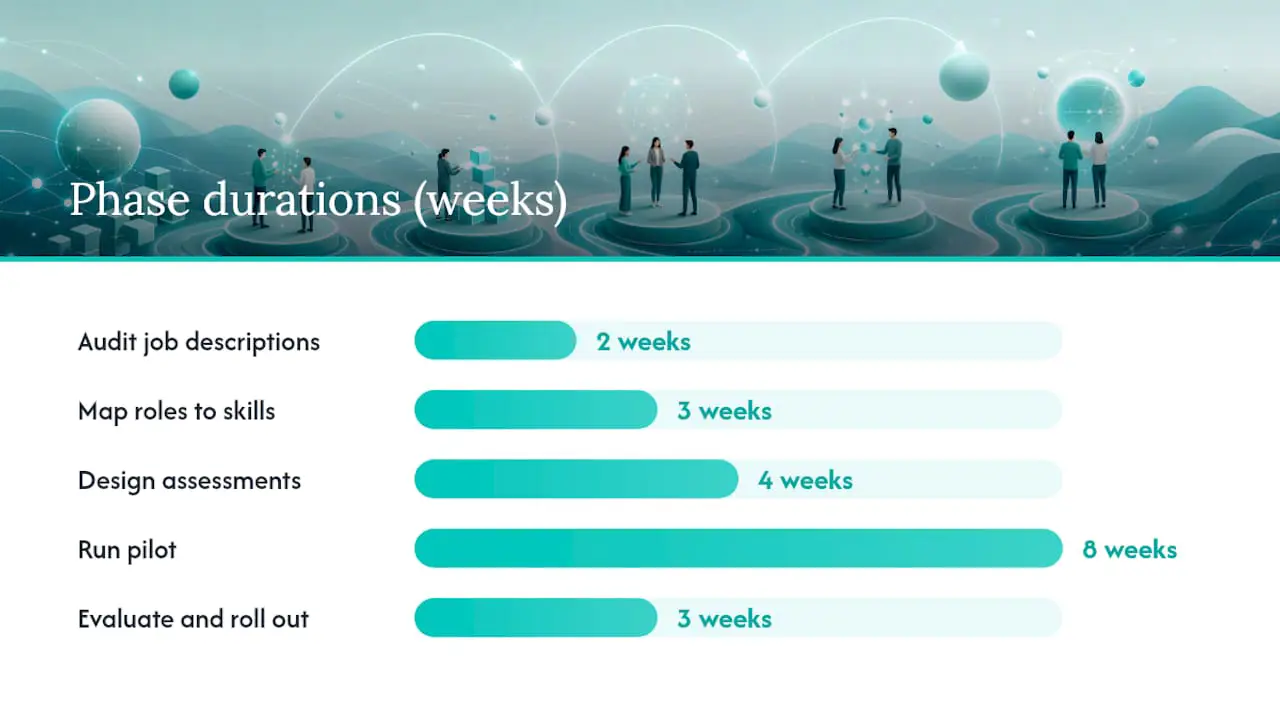
A phased rollout beats a flash cutover every time. Treegarden’s implementation research outlines a five-phase roadmap, audit job descriptions, define skills, redesign screening, build assessments and structured interviews, then measure and iterate, and that sequence maps cleanly onto a realistic HR calendar.
- Audit current job descriptions (weeks 1 to 2). Pull your top 10 requisitions by volume and flag which qualifications are degree proxies rather than actual skill requirements.
- Map roles to skills (weeks 3 to 5). Bring in a subject-matter expert for each role and define 3 to 5 measurable success criteria. Vague terms like “strong communicator” get rewritten as specific, testable behaviors.
- Design assessments (weeks 6 to 9). Build role-specific tests that mirror actual job tasks. Skillfuel’s guidance recommends piloting the test internally with current top performers first to set a baseline before any candidate sees it.
- Run the pilot (weeks 10 to 17). Route two or three roles through the new process while keeping resume screening as a control for comparison.
- Evaluate and roll out (weeks 18 to 20). Compare pilot metrics against baseline, then expand to additional roles in waves rather than all at once.
| Role | Primary Responsibility | Key Deliverable |
|---|---|---|
| HR lead | Owns timeline, budget, and vendor selection | Approved pilot plan and KPI targets |
| Hiring manager | Defines role skills and reviews candidate results | Signed-off skills matrix per role |
| Subject-matter expert | Validates task realism in assessment design | Reviewed assessment draft |
| Legal or compliance | Checks for adverse impact risk and documentation | Sign-off on job analysis records |
| Assessment vendor | Builds, hosts, and scores the test | Configured assessment and ATS integration |
Budget for a small pilot runs lean. Expect platform fees on a per-completed-candidate basis (Talent Approved charges $5 per completed assessment, with no subscription), plus staff time for skills mapping and calibration sessions. A pilot covering 50 to 100 candidates across two roles typically costs less in direct fees than a single week of agency resume screening.
Pro Tip: Pilot one high-volume entry-level role and one mid-skill specialist role at the same time. The entry role tests your process at scale; the specialist role tests whether the assessment actually predicts on-the-job success. You need both signals before you scale further.
How Do You Design a Valid Skills Assessment?
Match the assessment format to what the job actually demands. A customer support role calls for a situational judgment test. A data analyst role calls for a timed technical task using real (anonymized) datasets. A project manager role might need a short simulation involving a mock stakeholder conflict.
- Work samples: best for roles with a clear, observable output, like writing, design, or coding.
- Job simulations: best for roles involving judgment calls under time pressure, such as sales or operations.
- Situational judgment tests: best for measuring interpersonal and decision-making skills where there is no single “correct” output.
- Structured behavioral tasks: best for leadership and people-management roles where past behavior patterns predict future performance.
Skillfuel’s best-practice research recommends identifying exact technical, cognitive, and interpersonal skills before writing a single test question, then piloting the draft with top performers to calibrate difficulty and timing.
Once you know the skills, translate them into a scoring rubric with behavioral anchors rather than vague labels:
| Score | Anchor Description |
|---|---|
| 5 | Solution exceeds requirements; demonstrates initiative beyond the prompt |
| 4 | Solution meets all requirements with minor gaps |
| 3 | Solution meets core requirements but lacks polish or efficiency |
| 2 | Solution partially addresses the task; notable gaps in accuracy |
| 1 | Solution fails to address the core task |
Set your pass threshold before scoring begins, typically a 3 or higher on the core competencies, and run a calibration session where two or three reviewers score the same sample response independently to check for consistency.
Anti-cheat and accessibility controls matter just as much as the rubric. Session replay, browser lockdown, and periodic webcam checks catch most integrity issues without turning the test into an interrogation. Pair that with accommodations: extended time for candidates who request it, and alternate formats for candidates with visual or motor impairments. A well-designed layered approach, assessments combined with structured interviews and portfolio reviews, reduces bias and improves how predictive your process is of actual job performance.

Pro Tip: Keep the first-stage gate to 30 to 60 minutes. Save deeper simulations, the ones running 90 minutes or more, for finalists only. Long early-stage tests kill completion rates fast.
How Long Should a Cv-Free Hiring Pilot Run?
Six to twelve weeks gives you enough signal without dragging the transition out. Break the pilot into five stages: recruit candidates into the new flow, administer the test, calibrate interviewer scoring, evaluate results against your baseline, and hit a formal decision gate.
- Weeks 1 to 2, recruit: route new applicants for your two pilot roles directly into the skills-based flow instead of resume review.
- Weeks 3 to 6, test: administer assessments and structured interviews, tracking completion and drop-off rates weekly.
- Weeks 7 to 8, calibrate: hold a scoring calibration session with hiring managers using real (anonymized) pilot responses.
- Weeks 9 to 10, evaluate: compare time-to-hire, pass rates, and hiring manager satisfaction against your resume-screening baseline.
- Weeks 11 to 12, decision gate: decide to scale, iterate, or pause based on pre-set thresholds.
For cohort size, aim for a minimum of 30 to 50 completed assessments per role before drawing conclusions. Below that, pass-rate differences and time-to-hire deltas are too noisy to act on with confidence.
- Choose one high-volume role and one specialist role for the pilot, as noted earlier, so you test both scale and predictive validity.
- Set a completion-rate floor (many teams use 70% as a working benchmark) below which you revisit test length or clarity.
- Trigger a “scale” decision when time-to-hire improves or holds steady, hiring managers report satisfaction with candidate quality, and pass rates look consistent across role variants.
- Trigger an “iterate” decision when completion rates lag or hiring managers flag mismatches between assessment scores and interview impressions.
Operationally, confirm your ATS can route pilot candidates correctly and pull assessment scores back into the candidate record before you launch, not after the first cohort is already mid-test.
Preparing Your Team and Candidates for the Change
Hiring managers need real training, not a memo. Build a short program that covers structured interview scoring, a calibration session using sample pilot responses, and hands-on time with the assessment dashboard before their first real candidate comes through.
- Run a 60 to 90 minute training session on how to read assessment scores alongside structured interview notes.
- Hold a calibration exercise where managers score the same anonymized response independently, then compare notes.
- Give managers a one-page cheat sheet on what each competency score anchor actually means.
- Prepare a short candidate-facing message explaining why the role uses a skills assessment instead of resume screening.
Candidates will ask why there is no resume review, and hiring managers should have a ready answer: the assessment measures the exact skills the role requires, which gives every applicant, regardless of background, background or pedigree, a fair shot at proving fit. Practitioner research on skills-based hiring backs this up. Some initial hesitation from candidates is normal, but those willing to complete an assessment tend to be genuinely qualified and committed, while candidates who balk are often self-selecting out of a role that was never the right fit anyway.
Internal stakeholders raise their own concerns. Legal teams worry about defensibility; hiring managers worry about losing “gut feel.” Address both directly: documented job analysis and calibrated scoring rubrics are more defensible in an audit than resume screening ever was, and structured scoring does not eliminate manager judgment, it just gives that judgment a consistent, comparable input.
Pro Tip: Before the pilot goes live, run interviewer calibration using anonymized pilot responses, not hypothetical examples. Real responses build trust in the assessment outputs faster than any slide deck can.
Which Metrics Prove the New Process Is Working?
Track a consistent set of KPIs from week one, and review them on a set cadence so small problems get caught before they compound.
| KPI | Monitoring Cadence | Who Reviews It |
|---|---|---|
| Completion rate, pass rate | Weekly | HR pilot lead |
| Time-to-hire | Weekly | HR pilot lead, hiring manager |
| Hiring manager satisfaction | Monthly | HR pilot lead |
| Time-to-productivity, 90-day retention | Quarterly | HR leadership |
| Quality-of-hire, diversity of hire, cost-per-hire | Quarterly | HR leadership, legal/compliance |
- Disaggregate pass rates by role and by demographic subgroup every quarter to check for adverse impact early.
- Compare pilot cohort performance ratings against a matched resume-screened baseline cohort at the 90 and 180 day marks.
- Use early completion and pass-rate data to tune assessment difficulty, if fewer than half your strongest applicants clear the bar, the test is likely miscalibrated, not the candidate pool.
- Revisit pass thresholds after the first 100 completions rather than waiting for a full year of data.
What Legal and Bias Risks Should You Watch For?
Documentation is your best defense. Keep a written job analysis for every role in the new process, along with evidence tying assessment content to job-relevant tasks, this is what auditors and courts look for if a hiring decision is ever challenged.
- Maintain job analysis records and criterion-related validity evidence for every assessment you deploy.
- Retain assessment records and scoring notes for the same period your legal counsel recommends for other hiring records.
- Contract carefully with assessment vendors, confirming data handling and validation practices in writing.
- Measure subgroup pass rates every reporting cycle and have a remediation plan ready if disparities appear.
- Limit access to candidate assessment data to reviewers who need it, and set clear retention and deletion policies.
Firms that lead on skills-based hiring see meaningfully better retention outcomes, 10 percentage points higher among non-degreed hires, but that same research is clear that policy changes without process reform rarely move the needle. Bake legal review into your pilot documentation from the start rather than retrofitting it later, and consult counsel directly for any high-risk or heavily regulated role.
Why CV-Free Hiring Works, and Where the Pushback Comes From
The business case for skills-based hiring is stronger than most HR teams realize going in. It is not just about fairness, it is about performance. Firms leading on this approach see materially higher retention among non-degreed hires and meaningful salary growth in converted roles, exactly the outcomes a CFO cares about when asked to fund a new assessment platform.
The pushback is predictable, and mostly comes down to fear of the unknown. Hiring managers worry they will lose the ability to “just know” a good candidate when they see one. Legal teams worry a new process is harder to defend than the old one. Both concerns are reasonable, and both are addressable, structured scoring does not remove manager judgment, it disciplines it, and a documented, validated assessment process is generally easier to defend than a resume screen that never had objective criteria to begin with.
What gets underestimated is how much resume screening already introduces bias without anyone noticing. A skills test does not care where someone went to school. It cares whether they can do the work. That is a harder sell in the boardroom than it should be, mostly because “we’ve always hired this way” is a comfortable default, not because the data supports sticking with it.
The playbook in this guide did not come from a single source. It reflects patterns across implementation research, practitioner accounts, and the practical mechanics of running a pilot without breaking your existing hiring pipeline. Talent Approved’s own step-by-step transition resource goes deeper into role-mapping templates if you want to build out the skills matrix further.
Getting Started With Talent Approved for Your Pilot
Talent Approved is built for exactly the pilot described above: a fast, low-risk way to test skills-based hiring on two or three roles before committing to a full rollout. The platform’s Magic Create feature turns a job description or skill list into a tailored assessment in minutes, cutting weeks off the assessment-design phase covered earlier.
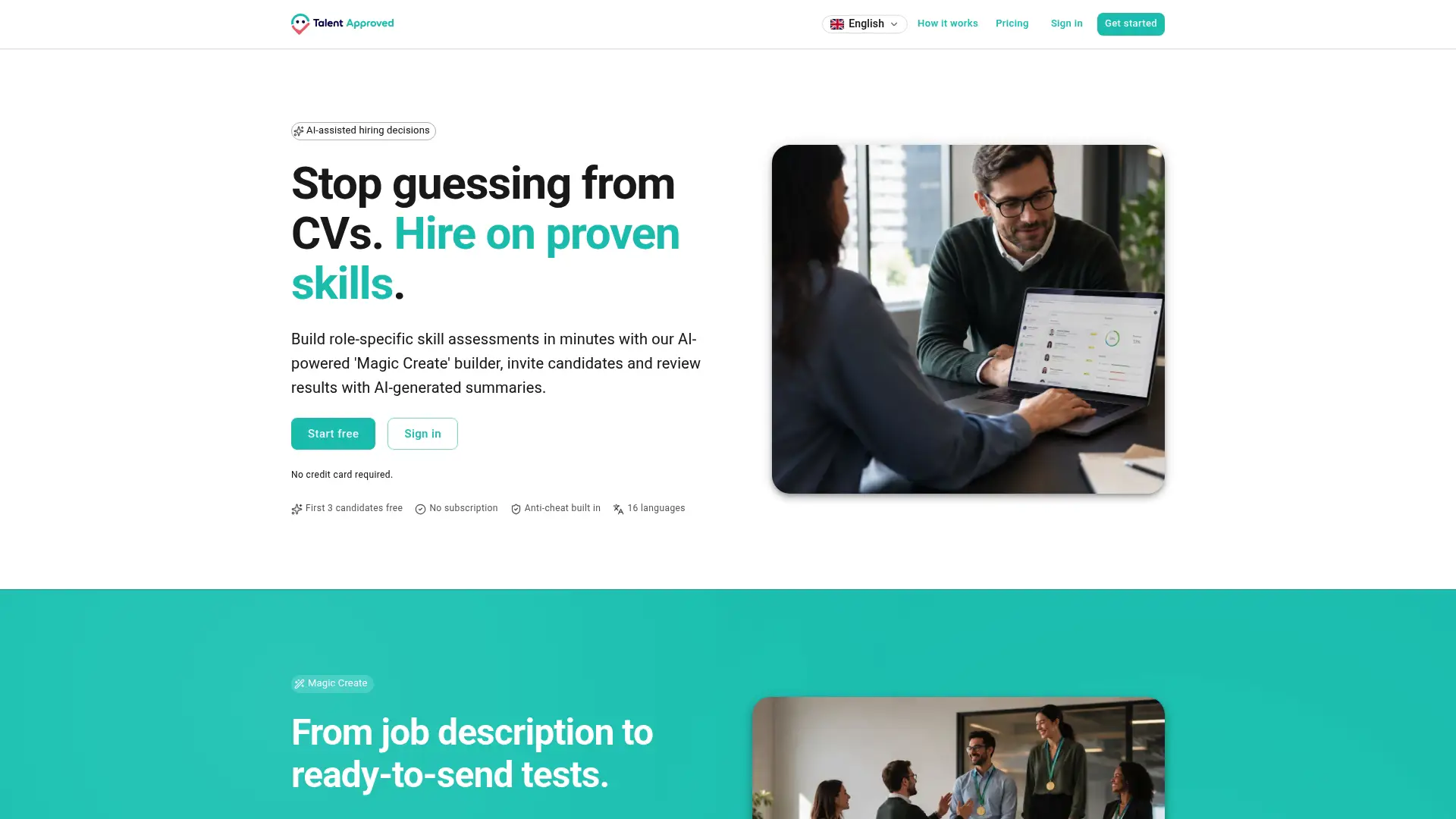
Anti-cheat controls, screen and webcam monitoring plus session replay, are built in, so you get the test security your legal team will ask about without hiring a separate proctoring vendor. AI-generated candidate summaries speed up review, and because Talent Approved bills $5 per completed candidate with no subscription, a two-role pilot stays cheap enough to greenlight without a lengthy procurement cycle.
To start, pick your two pilot roles from the skills-mapping step, loop in your hiring managers and one legal or compliance reviewer, and build your first assessment directly from an existing job description. From there, the platform’s candidate ranking and dashboard tools carry you straight into the measurement phase outlined above.
Sources
Start with the implementation research that underpins this plan, then pull the internal templates below to build your own pilot documentation.
- Skills-Based Hiring: The Long Road from Pronouncements to Practice (Burning Glass Institute / HBS Project on Managing the FOW)
- Best Practices for Custom Skills Assessments - Skillfuel
- Skills-Based Hiring: How to Implement It Step by Step | Treegarden Blog
- Skills-Based Hiring: Benefits, Challenges, and How to Do It Right - Summit Search Group
- Why Skills-Based Hiring Is Winning in 2026 (And Resumes Matter Less Than Ever) | InterviewBee
FAQ
How Long Does It Take to Transition to CV-Free Hiring?
A focused pilot runs 6 to 12 weeks, and a full phased rollout across multiple roles typically takes around 20 weeks from initial audit to broader scale.
What Skills Should I Map for Each Role First?
Start with 3 to 5 measurable technical, cognitive, and interpersonal skills identified with a subject-matter expert, then translate each one into a scoring rubric before building the assessment.
Do Candidates Resist Skills Assessments?
Some initial hesitation is common, but practitioner research finds candidates willing to complete an assessment are usually genuinely qualified and motivated, while hesitant candidates often were not a strong fit regardless.
How Do I Choose Which Roles to Pilot First?
Pick one high-volume entry-level role and one mid-skill specialist role so you validate both scale and predictive accuracy at once, then expand to other roles once metrics clear your decision-gate thresholds.
Which Platform Should We Use to Build the Assessments?
Talent Approved’s Magic Create feature builds a role-specific assessment directly from a job description in minutes, with built-in anti-cheat controls and per-completed-candidate billing suited to a small pilot budget.