
Startup Job Descriptions That Actually Convert Hires

A startup job description must sell impact, spell out Day-1 expectations, and convert directly into a skills assessment. That’s the whole job of the document. It’s not a legal disclaimer or a wish list. It’s a filter and a pitch running at the same time.
Before you publish anything, run this checklist against your draft:
- Title uses a standard, searchable job function (not “Growth Ninja”).
- First sentence states a concrete outcome the person will own, not a mission statement.
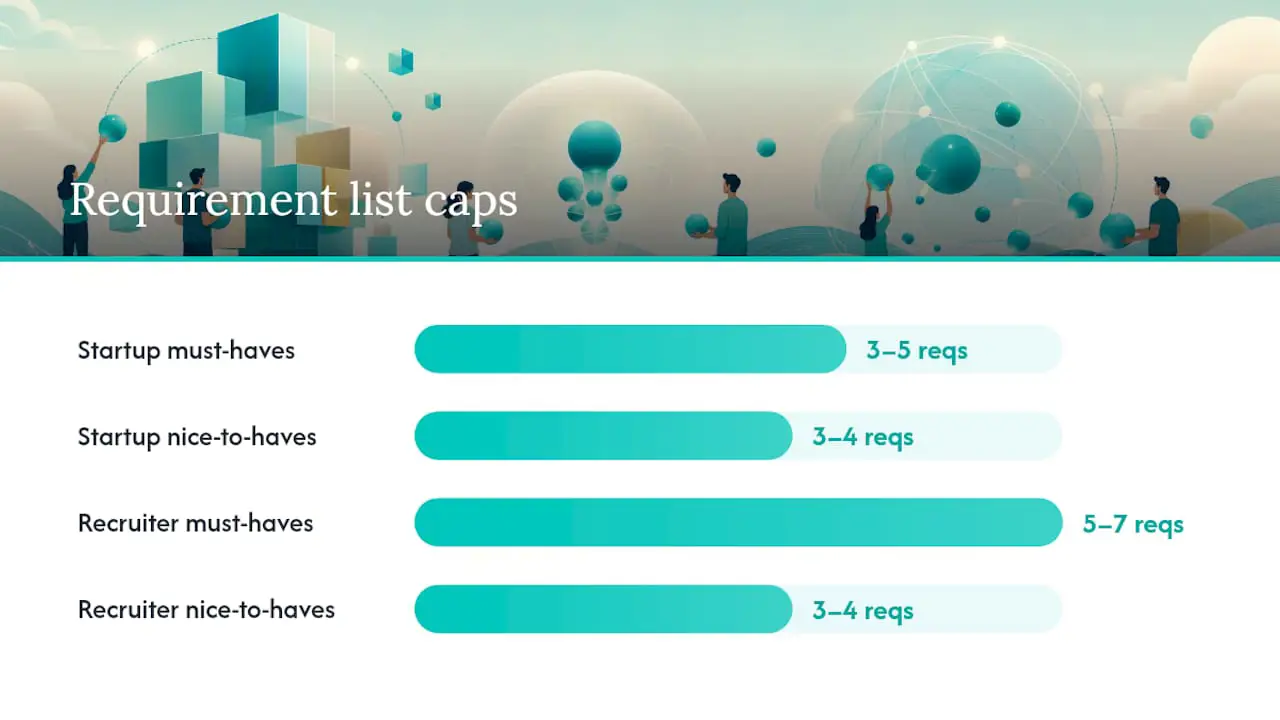
- Requirements list 3 to 5 Day-1 must-haves, not 15.
- Salary range is present and realistic, not a placeholder or a $40K spread.
- Application steps tell candidates exactly what happens next and by when.
Miss any one of these and your best candidates either skip the post or, worse, apply and then bail three interviews in when reality doesn’t match the pitch.
Key Takeaways
The most effective startup job description sells a concrete 90 to 180 day outcome, limits requirements to three to five testable must-haves, and converts directly into a skills assessment.
| Point | Details |
|---|---|
| Fix the title first | Use a standard, searchable job function so candidates and Google for Jobs can find the post at all. |
| Lead with one outcome | State what the hire owns in 90 to 180 days instead of opening with a mission statement. |
| Cap requirements at 3 to 5 | Move tool lists and preferences to a separate nice-to-haves section to reduce bias and noise. |
| Publish a real salary range | A narrow, honest range builds trust and increases both application volume and quality. |
| Convert the JD into a test | Talent Approved’s Magic Create builds a role-specific skills assessment directly from your finished job description. |
Table of Contents
- Startup job description writing tips that start with the title
- How do you write a compelling opening paragraph?
- What should the candidate profile and daily reality look like?
- How many requirements should a startup job posting have?
- How do you make responsibilities scannable?
- How much should a startup share about pay and equity?
- What should the application instructions say?
- What language mistakes quietly repel good candidates?
- Two full startup job description examples you can adapt
- How do you turn a job description into a skills assessment?
- How should startup culture show up in the posting?
- How do you highlight flexibility and growth potential?
- Can storytelling really help you recruit?
- How do you handle remote and hybrid options in the posting?
- How often should you update a startup job description?
- How Talent Approved turns your JD into a hiring shortcut
- Sources
- FAQ
Startup job description writing tips that start with the title
Get the title wrong and nothing else in the post matters, because nobody sees it. Job boards and Google for Jobs rely on structured data to match search queries, and creative titles like “Growth Wizard” or “Chief Vibes Officer” simply don’t map to what candidates type into a search bar. Practitioner guidance on discoverability consistently points to standard job titles paired with core skill keywords as the pattern that performs best in board search and indexing.
Someone searching for “backend engineer” will never find your “Full-Stack Wizard” listing, no matter how well the rest of the post reads. The fix is almost mechanically simple:
- Use a recognized seniority marker (Junior, Senior, Lead) only when it’s accurate, not aspirational.
- Lead with the core function (Engineer, Marketer, Operations Manager), not the department slogan.
- Save culture and personality for the opening paragraph, not the title field.
- Skip internal shorthand entirely. If your team calls the role “Growth Hacker” internally, the public title should still read “Growth Marketer” or “Performance Marketing Manager.”
Pro Tip: Keep titles under 60 characters. Most job boards truncate anything longer on mobile, and a cut-off title reads as sloppy before a candidate has read a single word of your pitch.
How do you write a compelling opening paragraph?
The opening paragraph either earns a scroll or loses a candidate in the first ten seconds. Answer three questions, in order: what does the company actually do, what will this person own, and why does that ownership matter right now. Skip any one of the three and the paragraph reads like filler.
Vague growth claims (“we’re disrupting the industry”) and generic clichés (“fast-paced environment,” “wear many hats”) do the opposite of what founders intend. They signal that the writer didn’t think hard enough to be specific, and specificity is exactly what makes a startup role attractive in the first place. Keep the whole paragraph under roughly 60 words. Startup-focused hiring advice backs this framing directly, recommending that founders lead with why the role matters rather than opening with a list of duties.
Here’s what that looks like in practice, for a backend engineering role at a seed-stage logistics startup:
We build the routing software that keeps 200 regional delivery fleets on schedule. You’ll own our core API layer as we go from 200 fleets to 2,000, which means the architecture decisions you make this quarter will still be running the business in three years.
Notice what’s missing: no “rocket ship,” no “join our journey,” no adjective doing the work a fact should be doing.
What should the candidate profile and daily reality look like?
Translate your Ideal Candidate Profile into four to six persona bullets that describe mindset and context, not just a resume checklist. A candidate profile answers a different question than a requirements list. Requirements ask “can they do the job.” A profile asks “will they thrive in this specific environment,” which for an early-stage startup usually means comfort with ambiguity and a track record of owning outcomes without a playbook.
A strong persona section for an early operations hire might read like this:
- Has operated in a role where the job description changed every quarter, and treated that as normal rather than chaotic.
- Prefers building the first version of a process over inheriting a mature one.
- Has made a consequential decision with incomplete information and lived with the outcome.
- Communicates proactively without waiting to be asked for a status update.
- Has directly owned a metric, not just contributed to a team that owned one.
Pair that with a short “day in the life” snapshot. For that same operations role: A typical Tuesday might start with reconciling a vendor invoice discrepancy, move into a 30-minute call with a fulfillment partner about a shipping delay, and end with drafting the first version of a returns policy nobody has written yet. That paragraph does more filtering work than any bullet list of “responsibilities” because it shows the texture of ambiguity rather than describing it abstractly.
Tie every persona bullet back to the 90 to 180 day outcomes stated earlier in the post. If the outcome is “stand up a returns process from scratch,” the profile should explicitly value someone who’s built a process from zero before, not just someone with “operations experience.”
How many requirements should a startup job posting have?
Cap your must-haves at three to five and your nice-to-haves at three or four. That’s it. That’s the rule, and startup hiring guidance converges on it because a longer list does the opposite of what founders think it does: it doesn’t raise the bar, it just shrinks the applicant pool without improving quality. Recruiter-focused frameworks recommend 5 to 7 must-haves and 3 to 4 nice-to-haves as the ceiling before returns start turning negative.
Here’s a statistic that should change how you write requirement lists: research from Harvard Business Review found that women tend to apply for a role only when they feel they meet nearly all of the listed qualifications, while men apply after meeting a much looser bar. Every unnecessary line item on your requirements list isn’t neutral. It’s actively filtering out qualified people who take your list at face value.
The fix is specificity, not just brevity. Compare these two:
- Vague: “Backend development experience required.”
- Specific and testable: “3+ years building REST APIs with Python, including at least one production system handling real user traffic.”
The second version is shorter to write and dramatically easier to screen for. It also tells the candidate exactly what to highlight in their application instead of leaving them guessing.
Degree requirements deserve a hard look too. Unless a license or accreditation is legally required for the role, a degree line usually belongs nowhere near your must-haves. If you genuinely use a specific tool stack, list it under a separate “Tools We Use” section rather than folding it into requirements. A candidate who’s never touched Linear but has run three product launches with Asana isn’t unqualified. They’re one Slack message away from being productive.
How do you make responsibilities scannable?
Most candidates skim a job post before they ever decide to read it closely, which is why the shape of your responsibilities section matters almost as much as its content.
That doesn’t mean cramming everything into paragraphs. It means using bullets for the things that genuinely benefit from a hard visual break, like the three or four highest-leverage responsibilities, and using short prose for context that connects them. A wall of 15 bullet points reads as a task list. A tight paragraph followed by three sharp bullets reads as a role with actual scope.
Rewrite generic duties as outcome statements. Compare:
- Generic: “Manage customer support tickets.”
- Outcome-oriented: “Bring first-response time under two hours within your first 60 days, and build the FAQ library that gets us there.”
- Generic: “Write marketing copy.”
- Outcome-oriented: “Own the email sequence that currently converts at 2% and get it above 4% by end of Q2.”
- Generic: “Help with backend development.”
- Outcome-oriented: “Migrate our payments service off the legacy queue system without a single day of downtime.”
Outcome framing works because it lets the candidate self-assess against something concrete instead of guessing whether “help with backend development” means fixing typos or architecting a service.
Pro Tip: Keep bullet lines under roughly 15 words. On mobile, anything longer wraps to three lines and the visual scannability you were going for disappears entirely.
How much should a startup share about pay and equity?
Publish a real salary range, not a placeholder, and not a $60,000 spread that tells candidates nothing. Guidance on compensation transparency consistently finds that publishing a realistic salary range increases both application volume and applicant trust, largely because candidates can self-select instead of applying blind and finding out three interviews later that the number doesn’t work.

A narrow, honest range does more for your funnel than a wide one that’s technically accurate but practically useless. If the role pays $95,000 to $105,000, say that. If it pays $80,000 to $140,000 depending on experience level, you probably haven’t decided what level you’re hiring for yet, and that’s worth fixing before you post.
Here’s what to spell out, specifically:
- Base salary range, stated as a number, not “competitive” or “market rate.”
- Equity framework, even briefly: percentage range or option pool size, and whether it’s standard 4-year vesting with a 1-year cliff.
- Bonus structure, if one exists, stated as a target percentage rather than left vague.
- Key benefits that are genuinely differentiated for this role, not a generic list copied from a template.
We offer full health coverage and unlimited PTO with a 10-day minimum we actually enforce."* Notice the last clause. Specificity about how a benefit actually works in practice reads as more credible than the benefit itself.
What should the application instructions say?
Tell candidates exactly what to submit and exactly what happens after they hit send. Ambiguity here doesn’t just annoy applicants, it actively degrades the quality of what you receive, because strong candidates with options will deprioritize a role that gives them no sense of the process.
Ask for three things, and only three, unless the role genuinely demands more: a resume, a relevant portfolio or GitHub link for technical roles, and a short, targeted response to a specific question about the role rather than a generic cover letter. That third item does more filtering work than the first two combined, because it takes real effort to fake and instantly reveals whether someone actually read the posting.
Publishing the expected timeline up front and being explicit about required materials measurably reduces candidate drop-off and prevents the kind of early-stage ghosting that wastes a founder’s week.
A realistic timeline for an early-stage hire looks something like this: application review within 3 business days, a 20-minute screening call within the following week, a role-specific skills assessment sent immediately after, and a final onsite or live working session within 10 to 14 days of the initial application. Publish something close to that in the post itself.
A sample “how to apply” block: “Send your resume and a two-paragraph answer to: what’s the most ambiguous problem you’ve solved with incomplete information? We review applications within 3 business days and aim to complete the full process within two weeks.” That single sentence sets an expectation that most job posts never bother to set, and it’s the difference between a candidate who checks their email obsessively and one who quietly moves on to your competitor’s posting.
What language mistakes quietly repel good candidates?
The single most common mistake in startup job descriptions is the kitchen-sink requirements list, the one that reads like a wish list for a mythical hire who’s simultaneously a senior engineer, a product strategist, and a part-time community manager. Recruiters increasingly treat a job description as a sales document rather than an inventory of everything that would be nice to have, and long lists disproportionately discourage strong candidates, particularly women, from applying at all.
Masculine-coded language is a subtler version of the same problem. Words like “dominant,” “aggressive growth,” or “ninja” don’t describe a skill. They describe a personality type, and they quietly narrow your applicant pool without adding any signal about actual job performance.
| Phrase to avoid | Clearer replacement |
|---|---|
| “Rockstar” or “ninja” developer | “Experienced backend engineer” |
| “Must thrive under pressure” | “Comfortable re-prioritizing when plans shift weekly” |
| “Wear many hats” | “Own three distinct functions in your first 90 days: X, Y, Z” |
| “Aggressive growth targets” | “Grow monthly signups from 500 to 2,000 by Q3” |
| “Competitive salary” | “$85,000 to $95,000 base, plus equity” |
| “Bachelor’s degree required” (unless legally necessary) | “Demonstrated experience with [specific skill]” |
Keep must-haves and nice-to-haves in genuinely separate sections. Blending them back together in the body text of the post, even after you’ve labeled them correctly in a bulleted list, reintroduces the same confusion you were trying to fix. And resist the temptation to publish a performative salary range just to check a compliance box. A range like $50,000 to $150,000 signals that you either haven’t decided what level you’re hiring for or you’re trying to avoid a real commitment, and candidates read it that way immediately.
Two full startup job description examples you can adapt
The universal template holds for any role: hook → outcome → team context → must-haves → salary → apply. Here’s how it plays out fully for two very different early-stage roles.
Backend Engineer, early-stage fintech startup (approximately 280 words)
We’re building the payments infrastructure that lets small businesses accept card payments without a merchant account. You’ll own our core transaction service as we scale from 500 to 5,000 daily transactions, which means the reliability decisions you make this year determine whether we can support that growth without downtime.
In your first 90 days, you’ll migrate our legacy payment queue to a fault-tolerant architecture and cut our P1 incident rate by half.
You’ll work directly with our two founders and one other engineer. There’s no separate QA team yet, so you’ll own testing for what you build.
What you’ll need on Day 1:
- 3+ years building production REST APIs, ideally in Python or Go
- Direct experience with payment processing systems or PCI-compliant infrastructure
- Comfort owning a service end-to-end without a dedicated ops team
Nice to have: experience with Kubernetes, prior startup experience, familiarity with Stripe’s API.
To apply: Send your resume and a short note on the most reliability-critical system you’ve owned. We respond within 3 business days.
Operations Generalist, seed-stage consumer startup (approximately 260 words)
We sell direct-to-consumer skincare and just crossed 10,000 orders a month. You’ll build the operations backbone that lets us hit 30,000 without the wheels coming off, starting with a returns process that currently doesn’t exist.
Within 90 days, you’ll cut average fulfillment delays from 4 days to under 24 hours and stand up our first written returns policy.
You’ll report directly to our COO and work alongside our two-person customer support team.
What you’ll need on Day 1:
- 2+ years in an operations or logistics role at a small company
- Direct experience negotiating with vendors or fulfillment partners
- A track record of building a process from scratch, not just maintaining one
Nice to have: e-commerce experience, familiarity with Shopify, supply chain background.
Pay: $70,000 to $80,000 base, plus equity in the 0.05% to 0.1% range.
To apply: Send your resume and a two-paragraph answer to: describe a process you built at a previous job that didn’t exist before you arrived.
| Section | Backend engineer example | Operations example |
|---|---|---|
| Hook | Payments infrastructure scaling story | Fulfillment scaling story |
| 90-day outcome | Migrate queue, cut incidents 50% | Cut delays to 24 hours, build returns policy |
| Must-haves | 3, technical and testable | 3, experience-based and testable |
| Nice-to-haves | 3, tool-specific | 3, industry-specific |
| Compensation | Base range plus equity band | Base range plus equity band |
How do you turn a job description into a skills assessment?
A finished job description isn’t the end of the writing process. It’s raw material for a screening tool, and treating it that way is what separates founders who make fast, confident hires from founders stuck manually reading forty near-identical resumes.
Here’s the workflow:
- Extract three core outcomes from your responsibilities section. For the backend engineer example above, that’s reliability engineering, API design, and independent ownership without a QA team.
- Define three skills per outcome. For “reliability engineering,” that might mean debugging under production pressure, understanding failure modes in distributed systems, and writing tests that actually catch regressions.
- Create two to three short test prompts per skill. A prompt might ask a candidate to diagnose a described production incident and propose a fix, or to review a snippet of queue-handling code and flag the failure points.
- Bundle the prompts into a single short assessment, scored against a simple rubric: does the response identify the core problem, does it propose a workable fix, and does it show awareness of tradeoffs.
That structure converts a subjective resume review into an objective comparison of actual output, which is exactly the gap that role-specific skill assessments are built to close. The benefit compounds as you hire more: faster shortlists, less resume-based bias, and interview time spent probing strong answers instead of screening out weak ones.
Pro Tip: Don’t build every assessment by hand. Tools that generate structured tests directly from job description text can turn a 40-minute manual process into a five-minute one, which matters enormously when you’re hiring for three roles at once.
How should startup culture show up in the posting?
Culture belongs in specifics, not adjectives. Writing “we have a fast-paced, collaborative culture” tells a candidate nothing, because every company claims the same three words regardless of whether they’re true. What actually communicates culture is a description of how decisions get made, how disagreements get resolved, and what a bad week looks like when it happens.
Consider including a short, honest “expectations” section that states the realities of early-stage work bluntly: priorities shift week to week, there’s no dedicated support function for most roles yet, and ambiguity is the default state rather than the exception. This kind of direct framing filters for candidates who find that environment energizing rather than draining, and it repels the ones who’d be miserable there within a month. Founders who add this section report that it changes the tenor of who applies almost immediately, because it’s the opposite of the vague optimism most postings default to.
How do you highlight flexibility and growth potential?
Startups genuinely offer something large companies structurally can’t: a much shorter distance between doing good work and getting more responsibility for it. That’s a real advantage, but only if you state it concretely instead of implying it with a generic “room to grow” line.
Instead of “opportunity for advancement,” write what advancement actually looks like at your company’s current stage. If your first ops hire has a realistic shot at building and leading a three-person team within a year given your growth trajectory, say that directly. If your engineering hire will likely be your technical lead by the time you raise a Series A, say that too. Specific, plausible growth paths are far more persuasive than abstract promises, and they’re also easier for a candidate to evaluate honestly against their own career goals.
Flexibility deserves the same specificity. “Flexible schedule” means something different at every company. State your actual norms: core hours, async expectations, how much autonomy someone has over their calendar day to day.
Can storytelling really help you recruit?
A job description that reads like a legal document attracts people who want a predictable, well-defined role. A job description that tells a short, specific story attracts people who want to build something. For startups competing against companies that can outspend them on salary, storytelling is often the only lever left that actually works.
The story doesn’t need to be elaborate. It needs one concrete detail that a generic posting wouldn’t include: the specific problem the company is solving, the moment that revealed the need for this exact hire, or the scale the founder expects to hit and by when. A posting that opens with “we noticed customers were manually reconciling invoices in spreadsheets, and we built software that does it in seconds” says more in one sentence than three paragraphs of mission-statement language. Entrepreneurial-minded candidates, the ones who thrive in ambiguity and want ownership, respond to specificity because it signals a real problem worth solving rather than a job to fill.
How do you handle remote and hybrid options in the posting?
State your actual policy in one clear sentence, not a vague gesture toward “flexibility.” Startups increasingly default to remote-first or hybrid arrangements, and candidates now treat this as a primary filter almost as important as salary, so burying it in paragraph four of the posting wastes the clarity it could provide up front.
If the role is fully remote, say whether there are time zone constraints tied to team overlap hours. If it’s hybrid, state the actual expected in-office days rather than “occasional office visits,” which means something different to every candidate who reads it. If the role requires relocation or is strictly on-site for operational reasons, say that plainly too rather than letting a candidate discover it three interviews in. Ambiguity here doesn’t create flexibility. It creates candidates who accept an offer under one assumption and quit within two months once reality sets in.
How often should you update a startup job description?
Treat every job description as a living document, not a one-time artifact. A posting written for a role six months ago rarely reflects what the company actually needs today, especially at the pace most early-stage startups evolve, and reposting stale language wastes both your time and candidates’ time.
Update a JD immediately after any of these triggers: the role’s core outcomes shift because of a pivot, you complete a hire for a similar role and learn what actually mattered in interviews, or your applicant quality drops noticeably over a two-week posting window. That last signal is often the clearest. If a posting that used to generate five strong applicants a week suddenly generates zero, the market has moved or your language has gone stale, and it’s worth a rewrite before you assume the talent pool has dried up.
Keep a simple internal log of what changed and why each time you touch a posting. Over three or four hires, that log becomes its own internal playbook of which phrasing and structure actually convert.
Practical lessons learned when hiring for early-stage startups
The pattern I see fail most often isn’t a bad job description. It’s a technically fine job description that oversells the role’s stability and undersells its actual demands, which produces candidates who accept the offer and then quit within the probation window once they discover what the job really involves. The postings that hold up over multiple hiring cycles are the blunt ones, the ones willing to name a hard rejection criterion or two up front rather than trying to appeal to everyone.
What reliably works is treating the job description as the first draft of the interview scorecard, not a separate document written by a different part of the brain. If a requirement isn’t specific enough to test for, it’s usually not specific enough to screen for either, and it should probably be cut.
A few operational habits worth adopting immediately:
- Revisit and edit the job description after every completed hire, using what you learned in interviews to sharpen the next version.
- Track application quality, not just volume, and treat a drop in quality as a signal to rewrite before you assume the candidate pool is weak.
- Tie every job description directly to the skills assessment you’ll use to screen candidates, so the two documents never drift apart.
How Talent Approved turns your JD into a hiring shortcut
Once your job description is tight, the fastest way to act on it is to feed it directly into a skill assessment rather than rewriting the same requirements a second time by hand. Talent Approved’s Magic Create feature does exactly that: paste in your finished job description or a short skill list, and it builds a role-specific assessment in minutes instead of the hours it typically takes to write test questions from scratch.
The platform handles the parts that eat up founder time during screening. Built-in anti-cheat monitoring, including screen and webcam checks, keeps results honest. AI-generated summaries and candidate rankings mean you’re reviewing a short, structured readout instead of forty raw transcripts. Because the assessment is generated straight from your job description’s actual must-haves, it tests the specific skills you listed rather than a generic competency bank, which closes the gap between what you asked for and what you actually measure.
Talent Approved runs on a pay-as-you-go model, a $5 fee per candidate who completes an assessment, with no subscription commitment required. If you’ve just tightened a job description using the framework above, the natural next step is to turn it into a test: create a skill test from your job description and see the candidate ranking it produces on your first batch of applicants.
Sources
A handful of sources shaped the guidance in this article, and each one is worth a closer read if you’re building a case for changing how your team writes job postings.
- Why Women Don’t Apply for Jobs Unless They’re 100% Qualified | Harvard Business Review
- How to Write Job Descriptions That Attract Top Candidates | StartupKit
- How to Write Job Descriptions That Attract Qualified Candidates | Recruiter Copilot
- How to Write Startup Job Descriptions — Allied Venture Partners
FAQ
What is the 70/30 rule in hiring?
What is the 3 month rule in a job?
In job description writing, the “3 month” framing usually refers to stating a concrete outcome the new hire should achieve within their first 90 days, giving both the candidate and the employer a clear early benchmark for fit and performance.
What are the common mistakes in job descriptions?
The most common mistakes are kitchen-sink requirement lists that discourage qualified candidates from applying, vague corporate clichés like “fast-paced environment,” missing or performative salary ranges, and titles too creative for job boards to index.
What is a good starting point for developing a job description?
Start with the outcome the hire needs to deliver in their first 90 to 180 days, then work backward to the three to five must-have skills required to hit it, rather than starting from a generic list of duties.
How do I turn a finished job description into a skills test?
Extract the role’s core outcomes, define two or three testable skills per outcome, and build short prompts around them. Talent Approved’s Magic Create feature automates this process directly from your job description text.