How Hiring Tools Drive SME Growth in 2026

How AI hiring tools are reshaping SME recruitment and growth
AI hiring tools are not a luxury for large HR departments. For small and medium-sized enterprises, they are one of the most direct levers available to compete for talent without a dedicated recruiting team. The core role of hiring tools in SME growth is straightforward: they cut the administrative burden of each hire so that founders and HR professionals can focus on decisions that actually require human judgment.
The practical impact is measurable. AI tools save small businesses 5 to 10 hours per hire by automating tasks like job description writing, resume screening, and interview scheduling. That time compounds quickly across a year of hiring. Beyond the pre-hire process, a notable portion of new hires leave early, with each early departure incurring substantial costs to the business. Onboarding automation, often overlooked, addresses that cost directly.
Key capabilities AI hiring tools bring to SMEs:
- Job description drafting using AI-generated first drafts that reduce writing time from hours to minutes
- Resume parsing and screening that surfaces qualified candidates from large applicant pools without manual review
- Interview scheduling via AI chatbots that eliminate the back-and-forth email threads per candidate
- Candidate matching algorithms that widen access to relevant applicants beyond local networks
- Post-hire onboarding automation generating 30–60–90 day plans from job descriptions and auto-assigning training modules
Human judgment remains central to every final hiring decision. AI handles volume and logistics; people handle culture fit, character assessment, and the candidate relationship. That division of labor is what makes the approach work for SMEs.
Table of Contents
- Key ways AI hiring tools assist SMEs throughout recruitment
- What are the real benefits of AI hiring tools for SMEs?
- What risks and challenges do AI hiring tools create for SMEs?
- What does the research actually say about AI’s impact on SME hiring?
- How can SMEs adopt AI hiring tools effectively to support growth?
- Talent Approved gives SMEs a faster path to skill-based hiring
- FAQ
- Key Takeaways
Key ways AI hiring tools assist SMEs throughout recruitment
AI hiring tools address each stage of the recruitment process differently, and the value at each stage depends on your hiring volume and the time constraints your team faces.
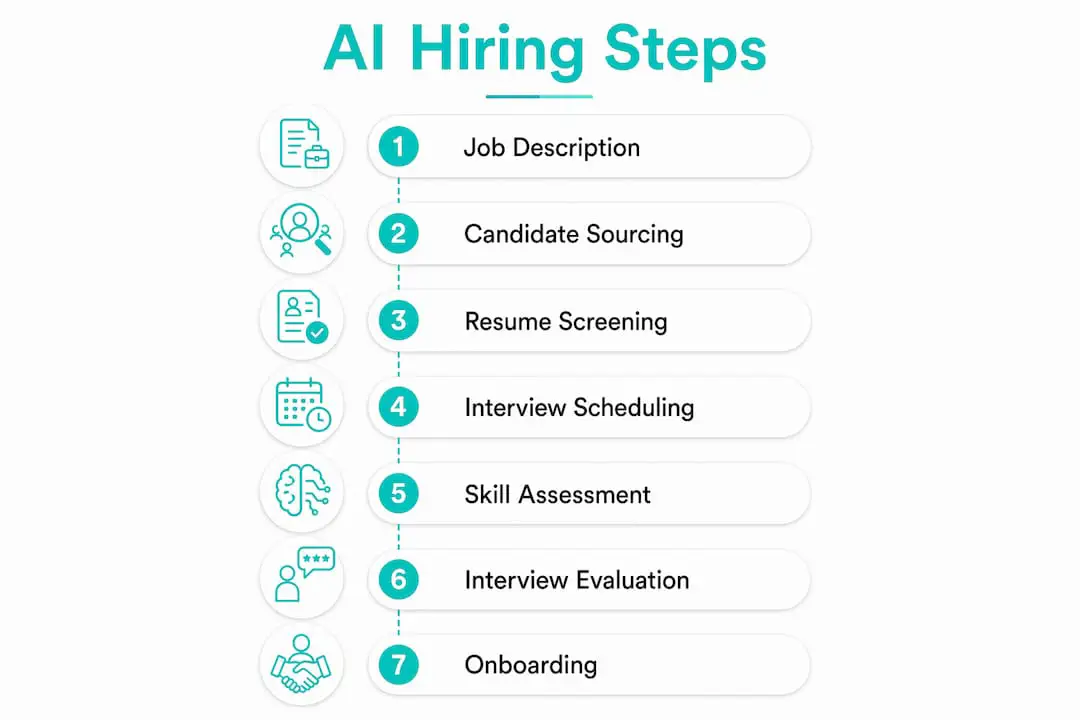
1. Job description creation
AI drafts role-specific job descriptions from a few inputs: the job title, required skills, and reporting structure. What used to take a founder 90 minutes of writing and editing now takes under 10. The output is also more consistent, which matters when you are posting multiple roles or updating descriptions frequently.
2. Candidate sourcing and matching
AI-powered sourcing tools scan job boards and professional networks to surface candidates who match your role criteria. For SMEs without a sourcing budget or a recruiter, this widens the talent pool considerably, including candidates who are not actively applying but fit the profile.

3. Resume parsing and automated screening
Parsing tools extract structured data from resumes and rank candidates against defined criteria. This is most valuable when you receive more applications than you can manually review. The key is setting the right criteria upfront; the AI applies whatever filters you give it, consistently and at scale.
4. Interview scheduling via AI chatbots
Scheduling is one of the highest-friction tasks in recruiting. AI chatbots handle candidate communication, propose available times, confirm appointments, and manage rescheduling automatically. This eliminates numerous email exchanges per candidate that consume considerable coordinator time weekly.
5. Skill-based assessment
Structured skill assessments give SMEs objective data on candidate capabilities before the final interview stage. Platforms like Talent Approved let you build tailored assessments from a job description in minutes, testing for the specific skills the role requires rather than relying on resume claims alone.
6. AI-assisted interview evaluation
AI tools can score asynchronous interview responses and flag candidates who meet defined criteria. Research shows AI assessment tools predicted subsequent employment success better than human recruiters, capturing soft skills and potential that humans sometimes overlook. That said, human review of AI scores before any decision is made is not optional.
7. Post-hire onboarding automation
This is the stage most SMEs skip entirely. AI generates structured onboarding plans for the first few months from job descriptions, auto-assigns training modules based on role requirements, and schedules check-in reminders. Given that early turnover is where the real cost of a bad hiring process shows up, this stage often delivers the highest return on investment.
What are the real benefits of AI hiring tools for SMEs?
The efficiency gains from AI recruitment tools are well-documented, but the full picture includes cost, quality, and retention outcomes that matter more to SME growth than speed alone.
| Dimension | Traditional/manual process | With AI hiring tools |
|---|---|---|
| Time per hire | Several hours | Reduced by automation |
| Early turnover cost | Substantial per exit | Potentially reduced via onboarding automation |
| Candidate pool | Limited by manual sourcing | Widened by AI matching |
| Screening consistency | Variable by reviewer | Standardized criteria applied uniformly |
| Candidate experience | Dependent on coordinator bandwidth | Faster, more responsive communication |
| Bias risk | Human cognitive bias | Algorithmic bias (requires active management) |
Key finding: A multi-sector survey of 423 HR professionals found AI was a strong predictor of recruitment efficiency, and also showed a positive association with candidate experience through more structured and responsive communication.
Cost savings are real but context-dependent. Replacing even one agency placement fee with an AI-assisted direct hire typically covers months of tool costs. For SMEs making 5–15 hires per year, the math favors AI-assisted direct hiring over agency fees in most cases.
Candidate experience improves when the process is faster and more structured. Candidates who receive timely communication and clear next steps are less likely to drop out or accept competing offers mid-process.
Hire quality benefits from consistent initial screening. When every candidate is evaluated against the same criteria, the shortlist reflects actual fit rather than which resumes happened to land on the right desk at the right time.
Pro Tip: The highest-ROI AI applications for most SMEs are job description writing and post-hire onboarding automation, not enterprise sourcing tools. Start there before investing in more complex platforms.
What risks and challenges do AI hiring tools create for SMEs?
AI hiring tools create real efficiency gains, but they also introduce risks that SMEs need to manage deliberately rather than assume the technology handles automatically.
- Algorithmic bias: Stanford HAI research found that 26% of Black applicants and 15% of Asian applicants applied to positions where the AI system discriminated against their racial group. Algorithmic monocultures, where many employers rely on the same few AI vendors, compound this problem by shutting the same candidates out across multiple applications.
- Candidate drop-off from asynchronous interviews: A field experiment found that asynchronous interview formats caused more than a 50% decrease in application continuation, with the largest drop among women. Efficiency gains for the employer came at a direct cost to candidate pipeline volume.
- Bias mitigation is not automatic: Research shows that while AI significantly improves recruitment efficiency, bias mitigation showed only modest effects, and trust and transparency were not significantly improved by AI deployment alone.
- Fraudulent applications: Automated sourcing tools make it easier for bad actors to submit fabricated credentials at scale. By 2028, 25% of applications are projected to be fake, driven partly by the same automation tools that make sourcing easier.
- Opacity in AI decisions: Most AI screening tools do not explain why a candidate was ranked or rejected. That lack of transparency creates legal exposure and makes it difficult to audit for fairness.
- Over-reliance reducing human connection: Candidates who interact only with automated systems throughout a process often feel the company does not value them. That perception affects offer acceptance rates and employer reputation.
Pro Tip: Run a quarterly audit of your AI screening criteria and review rejection rates by demographic group. If you cannot explain why a candidate was filtered out, neither can your tool, and that is a compliance risk.
What does the research actually say about AI’s impact on SME hiring?
The empirical picture on AI in recruitment is more nuanced than vendor marketing suggests. The efficiency gains are real and well-supported. The fairness and transparency claims are not.
A multi-sector study of 423 HR professionals found that AI was a strong predictor of recruitment efficiency, but bias mitigation showed only modest effects, and trust and transparency were not significantly improved by AI deployment alone. Those findings hold even when controlling for firm size, meaning SMEs and large enterprises face the same limitations.
The Stanford HAI study of 3.4 million job applications across 150 employers found that algorithmic monocultures in hiring create systemic rejection patterns. When many employers rely on the same AI vendor, candidates rejected by that vendor’s algorithm tend to be rejected everywhere they apply. Ten percent of applicants who submitted four applications were rejected from all of them.
| Research metric | Finding |
|---|---|
| Time-to-hire improvement | Strong positive effect of AI on recruitment efficiency |
| Candidate experience | Positive but weaker association via structured communication |
| Bias mitigation | Modest effect only; requires active management |
| Trust and transparency | Not significantly improved by AI deployment alone |
| Asynchronous interview drop-off | Significant decrease in application continuation observed |
| Early turnover cost | Early departures impose substantial costs on businesses |
Where AI does outperform humans is in predictive accuracy. The field experiment on asynchronous interviews found that AI assessment scores predicted subsequent employment success better than human recruiters, capturing soft skills that human evaluators missed. That finding supports using AI as an input to human decisions, not as a replacement for them.
Talent Approved’s approach reflects this balance. Its AI skill assessment platform generates structured, role-specific tests that give hiring managers objective data on candidate capabilities, while keeping the final decision firmly with the human reviewer. Anti-cheat mechanisms and AI-generated summaries reduce the review burden without removing human judgment from the process.
How can SMEs adopt AI hiring tools effectively to support growth?
Adoption strategy matters as much as tool selection. SMEs that get the most from AI hiring tools start with high-ROI, low-complexity applications and build from there.
- Start with job description writing and scheduling. These two applications are available at low or no cost, require minimal setup, and free up meaningful time immediately. ChatGPT or similar tools handle JD drafts; AI scheduling tools eliminate coordinator overhead.
- Add screening tools when hiring volume justifies it. At 5–15 hires per year, AI-powered resume parsing starts delivering real value. Below that threshold, manual review of a smaller applicant pool is often faster than configuring a screening tool.
- Prioritize onboarding automation early. Given that early turnover costs $15,000–$50,000 per exit, automating the 30–60–90 day onboarding plan is one of the highest-ROI moves an SME can make, regardless of hiring volume.
- Maintain human review at every decision point. AI outputs should inform decisions, not make them. Set explicit checkpoints where a human reviews the shortlist, the interview scores, and the final offer before anything is sent to a candidate.
- Implement structured interview checklists. AI screening works best when paired with standardized interview questions that every candidate answers. This reduces the cognitive bias that human interviewers introduce and makes the process defensible.
- Audit your tools regularly for fairness. Review rejection rates by demographic group quarterly. If a filter is eliminating candidates from a particular group at a disproportionate rate, investigate before assuming the algorithm is correct.
- Use hybrid approaches for fraud prevention. SMEs using hybrid hiring approaches that combine AI for volume tasks with human verification for finalists manage fraud and bias most effectively. Verify credentials manually for every finalist, regardless of how they were sourced.
- Choose tools that integrate with your existing workflow. A tool that requires a separate login, manual data export, or a new process for every hire will not get used consistently. Talent Approved, for example, integrates skill assessments directly into the hiring workflow, so reviewing assessment results takes minutes rather than hours.
Understanding responsible AI deployment practices is also worth your time as you evaluate tools, particularly around data handling, explainability, and audit trails.
Pro Tip: Match your AI tool investment to your hiring volume, not your company size. A 30-person company hiring 3 people per year needs different tools than one hiring 15. Volume drives the ROI calculation.
Talent Approved gives SMEs a faster path to skill-based hiring
Most SMEs waste time on resumes that tell them very little about whether a candidate can actually do the job. Talent Approved solves that directly. Its Magic Create feature builds a tailored skill assessment from your job description in minutes, testing candidates on the specific capabilities the role requires before you spend time on interviews.
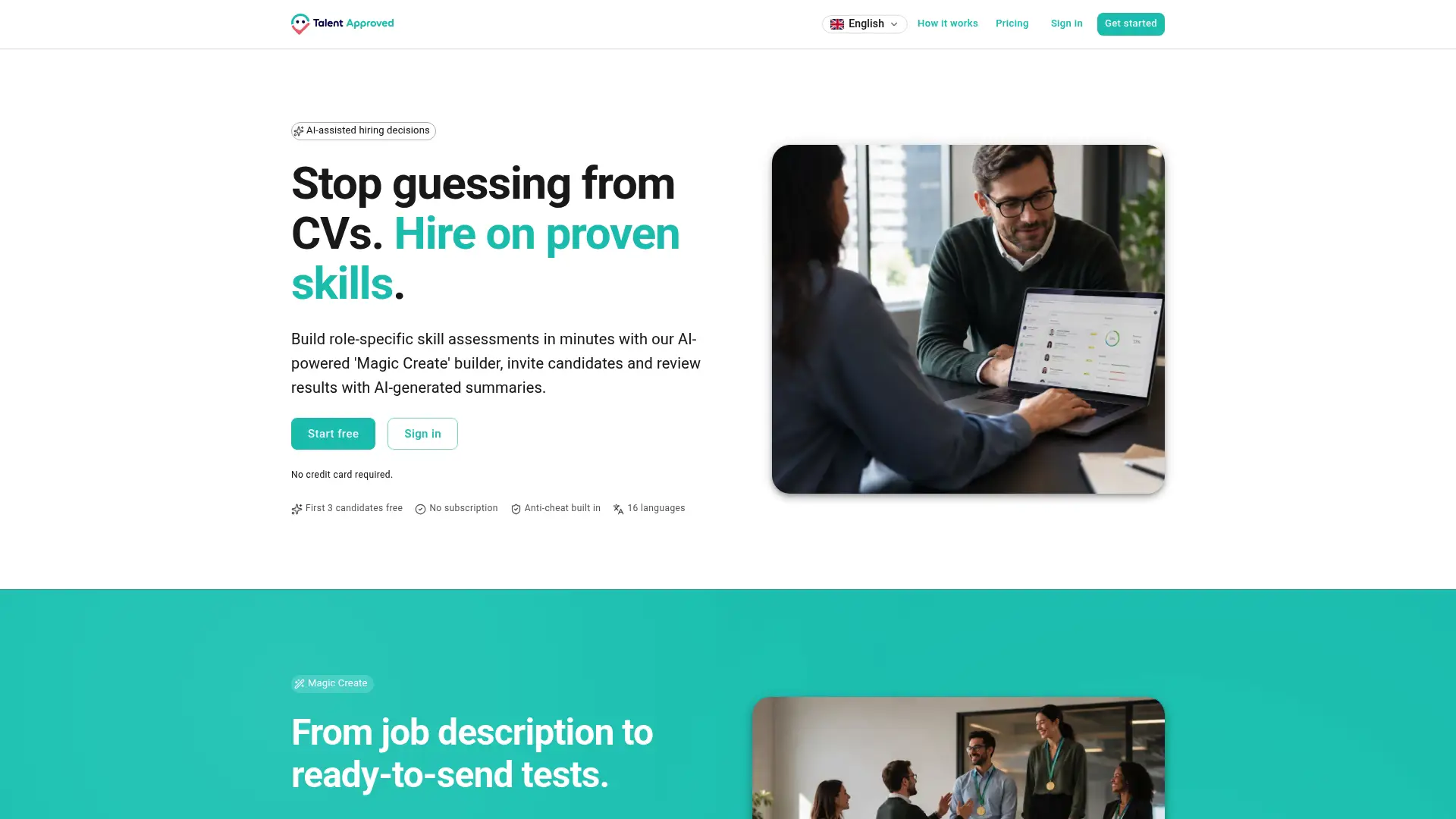
The platform’s built-in anti-cheat mechanisms and AI-generated candidate summaries mean your team spends less time reviewing raw results and more time talking to candidates who have already demonstrated they can do the work. For HR professionals managing multiple open roles without a large team, that shift in how you spend your time is where the growth impact shows up. Talent Approved is built for exactly this situation: structured, fair, and fast skill-based screening without the complexity of enterprise HR software.
Start building your first assessment and see how quickly you can move from job description to a ranked shortlist of qualified candidates.
FAQ
What is the purpose of hiring tools in SME recruitment?
Hiring tools automate repetitive tasks like resume screening, interview scheduling, and job description writing, freeing SME owners and HR teams to focus on decisions that require human judgment. The goal is faster, more consistent hiring without a large recruiting department.
What is an SME in the context of hiring?
An SME (small or medium-sized enterprise) is typically a business with smaller teams and budgets. In hiring, SMEs face the same talent competition as larger companies but with fewer resources, which is why efficient hiring solutions matter more per hire.
What is the 70/30 rule in hiring?
Hiring decisions typically balance evidence of demonstrated skills and performance with cultural or interpersonal fit. AI tools support the skills side through structured assessments; human judgment covers the fit side.
What are the 4 R’s of recruitment?
The 4 R’s are Reach, Relevance, Responsiveness, and Retention. AI hiring tools directly improve all four: widening candidate reach, improving applicant relevance through matching, speeding up responsiveness via automation, and supporting retention through onboarding tools that reduce early turnover.
How do AI hiring tools affect candidate experience?
Research shows AI tools can improve candidate experience through faster, more structured communication, but asynchronous interview formats caused a 50%+ drop in application continuation in one field experiment. The safest approach combines AI efficiency with human touchpoints at key stages.
Key Takeaways
AI hiring tools deliver the strongest SME growth impact when applied to job description writing, interview scheduling, and post-hire onboarding automation, with human oversight maintained at every decision point.
| Point | Details |
|---|---|
| Time savings per hire | AI automation saves small businesses 5 to 10 hours per hire, according to research. |
| Onboarding ROI | 20% of new hires leave within 45 days; each exit costs $15,000–$50,000, making onboarding automation a high-priority investment. |
| Bias requires active management | Research confirms AI improves efficiency but shows only modest bias mitigation; human oversight and regular audits are required. |
| Hybrid approach works best | SMEs combining AI for volume tasks with human review for final decisions manage fraud, bias, and candidate experience most effectively. |
| Talent Approved for skill-based hiring | Talent Approved’s AI assessment platform lets SMEs build role-specific skill tests in minutes and rank candidates by proven capability, not resume claims. |